
Homeschooling in Alabama has undergone a dramatic legislative evolution, transforming the Heart of Dixie into one of the nation’s most favorable states for parent-directed education. Families enjoy broad statutory protections with virtually zero state administrative interference.
Alabama law provides three distinct statutory avenues for home education under Title 16 of the Code of Alabama[1].
Alabama Homeschool Legal Pathways
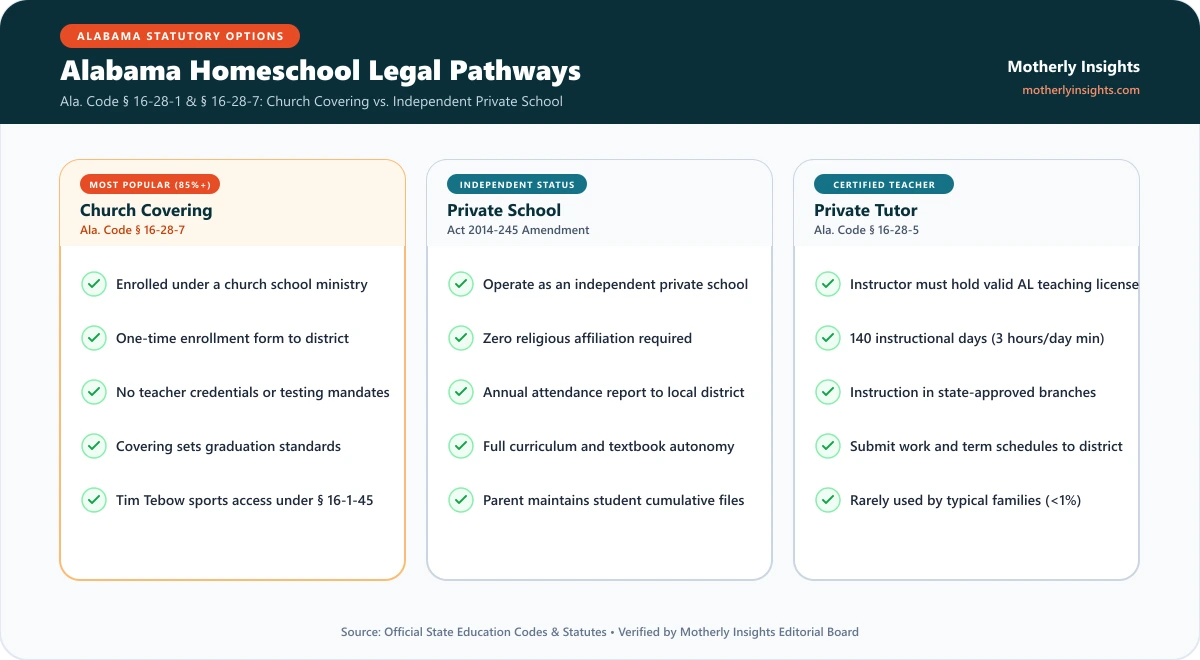
Option 1: The Church School Covering (Ala. Code § 16-28-7)
The church school option is the most established and widely used pathway in Alabama, selected by more than 85% of home-educating families:
- Legal Authority: Defined under Ala. Code § 16-28-1(2) and § 16-28-7, a church school is an educational ministry of a local church or religious denomination.
- Filing Procedure: Parents submit a one-time Church School Enrollment Form (signed by the church school administrator) to the local superintendent of education when first commencing instruction.
- Maximum Freedom: Church schools are completely exempt from state regulations, teacher credential checks, mandatory course hours, standardized testing, and portfolio reviews.
- Covering Requirements: Each church school sets its own administrative guidelines, recordkeeping policies, and modest annual covering fees (typically $50–$150/year).
Option 2: The Independent Private School Pathway (Act 2014-245)
Prior to 2014, families without a religious affiliation faced legal obstacles. In 2014, the Alabama Legislature passed Act 2014-245 (Senate Bill 38), which amended Ala. Code § 16-28-1 to officially recognize home-based instruction as a private school[2]:
- Secular Independence: Families can establish their own private home school without joining a religious church covering.
- Registration: Parents file an annual attendance report with the local public school district.
- Full Autonomy: Parents select their own curricula, determine daily schedules, and issue independent high school transcripts and diplomas.
Option 3: The Private Tutor Pathway (Ala. Code § 16-28-5)
Under Ala. Code § 16-28-5, a child may be educated by a private tutor:
- The tutor must hold a valid, active Alabama state teacher certificate.
- Instruction must occur for at least 140 instructional days (minimum of 3 hours per day).
- Instruction must cover the state-mandated branches of education taught in public schools.
- Due to the rigid certification requirement, fewer than 1% of Alabama families utilize this option.
Equal Athletic Access: Alabama’s Tim Tebow Act (Ala. Code § 16-1-45)
Under Ala. Code § 16-1-45 (The Tim Tebow Law), homeschooled and church school students enjoy a protected statutory right to try out for interscholastic sports teams at their zoned public high school[3]:
- The student must meet the same academic eligibility benchmarks, residency criteria, and physical exam standards as enrolled public students.
- Students must notify the public school principal prior to the first official day of practice.
- The public high school cannot charge discriminatory athletic fees to homeschoolers.
💡 Related Educational Pathways: To compare related legal frameworks and recommended study programs, explore our detailed reviews on California homeschool legal guidelines, Ohio homeschool notification regulations, Pennsylvania Act 169 requirements.
💡 Related Educational Pathways: To compare related legal frameworks and recommended study programs, explore our detailed reviews on Georgia homeschool compliance framework, Michigan homeschool statutory rules, Indiana homeschool attendance laws.