
Homeschooling in Maryland offers parents a clear, highly structured regulatory environment. Home instruction in the Old Line State is governed by the Code of Maryland Regulations (COMAR) 13A.10.10.01, which establishes procedural protections and parental responsibilities under state supervision[1].
Compulsory school attendance in Maryland applies to children between the ages of five (5) and eighteen (18) (with a kindergarten waiver available under Md. Code Ann., Educ. § 7-301).
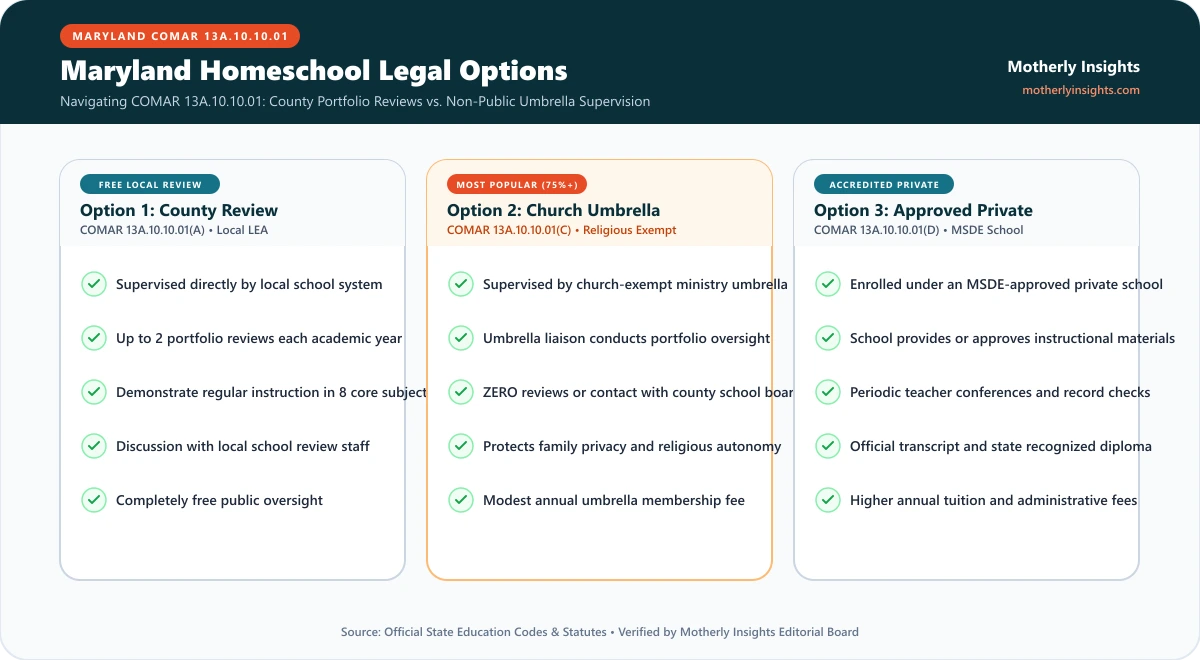
The central decision for every Maryland home educator is choosing between County Portfolio Reviews (Option 1) and a Church-Exempt Umbrella School (Option 2).
This guide provides an authentic, statutorily verified breakdown of Maryland’s 15-day notice, the 8 mandatory subjects, portfolio conference procedures, umbrella coverings, and sports access rules.
The Three Legal Options Under COMAR 13A.10.10.01
1. The 15-Day Written Notice of Consent
Regardless of which option you select, Maryland law requires parents to submit an initial Home Instruction Notification Form (Notice of Consent) to the local school system superintendent[2].
- Filing Deadline: Submit at least fifteen (15) calendar days before you begin home instruction.
- Content: The form indicates the child’s name, birthdate, address, and which of the three statutory supervision options you have selected.
- Annual Continuation: After the initial filing, parents submit an annual verification of continuation each autumn.
2. Option 1: County Portfolio Reviews Explained
If you choose Option 1 (supervision directly by your local school system, such as Montgomery County, Fairfax-border counties, or Baltimore County):
- The local school system may schedule up to two (2) portfolio review conferences per school year.
- What Is Reviewed: The parent presents a portfolio containing instructional materials, reading logs, and dated samples of the student’s writings, worksheets, workbooks, and creative projects.
- The Eight Mandatory Subjects: The portfolio must demonstrate that regular, thorough instruction of sufficient duration occurred in:
- English
- Mathematics
- Science
- Social Studies
- Art
- Music
- Health
- Physical Education
- Statutory Standard: The reviewer determines whether the child is receiving “regular, thorough instruction.” If deficiencies are noted, parents have thirty (30) days to submit a corrective remediation plan.
3. Option 2: The Church-Exempt Umbrella Alternative
To avoid semi-annual public school system conferences, thousands of Maryland parents choose Option 2: Church-Exempt Umbrella Schools under COMAR 13A.10.10.01(C)[3].
Under Option 2:
- You enroll your child in an umbrella organization operated by a bona fide church or religious institution that has registered with the MSDE.
- The umbrella assigns a liaison who reviews your educational plan and student progress.
- You are completely exempt from local school system portfolio reviews. The school district has no legal authority to review your student’s work or schedule meetings.
- The umbrella issues official progress reports and high school transcripts.
4. Standardized Testing Is 100% Optional
Under Maryland law:
- Homeschooled students are NOT required to take standardized tests or participate in the Maryland Comprehensive Assessment Program (MCAP).
- Standardized testing is strictly optional. If a parent wishes their student to take a national standardized test (such as the CAT or Stanford 10) for their own records, they may do so privately.
💡 Related Educational Pathways: To compare related legal frameworks and recommended study programs, explore our detailed reviews on California homeschool legal guidelines, Ohio homeschool notification regulations, Pennsylvania Act 169 requirements.
💡 Related Educational Pathways: To compare related legal frameworks and recommended study programs, explore our detailed reviews on Georgia homeschool compliance framework, Michigan homeschool statutory rules, Indiana homeschool attendance laws.