
Idaho is recognized throughout the United States as the benchmark of uncompromised home education liberty. Governed by Idaho Code § 33-202, Idaho law affirms that the primary right and responsibility of educating children resides fundamentally with the family, not the state[1].
Compulsory school attendance applies to children from age seven (7) to sixteen (16). Idaho law provides a clean, single-sentence statutory exemption for home instruction: children are exempt from attending public school if they are “otherwise comparably instructed” by a parent or guardian.
Idaho Pure Parental Liberty
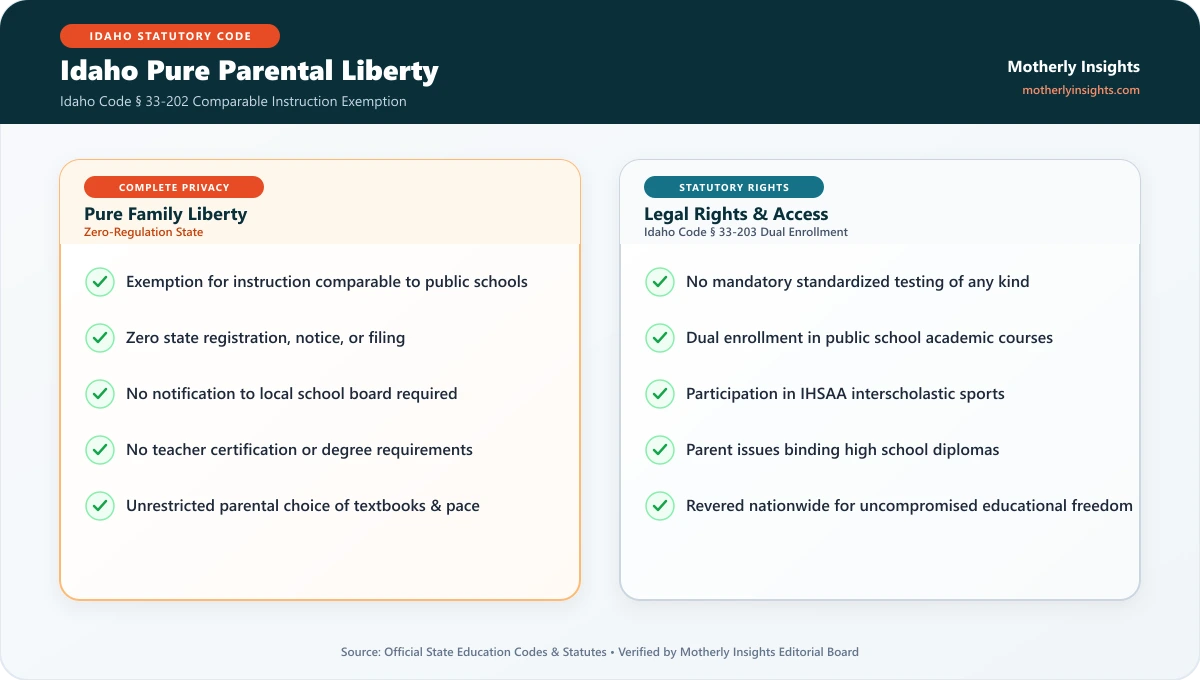
1. Zero Registration and Zero District Notification
Idaho requires zero administrative contact with government or school officials:
- No Notice of Intent: Parents are not required to notify the Idaho State Department of Education (SDE) or their local public school district.
- No State Registration: There are no state forms, permissions, or annual renewal filings.
- No Degree or Certification Requirements: Parents do not need a teaching license or college degree to instruct their children.
2. Curriculum Autonomy and Testing Exemption
Idaho does not dictate what, when, or how you teach your children:
- Curriculum Selection: Parents choose all educational materials, programs, and religious or secular content.
- No State Testing Mandates: Idaho does not require homeschooled students to take state ISAT exams or national standardized tests.
- No Calendar Day Mandates: There are no statutory requirements to teach a specific number of hours per day or days per year.
3. Dual Enrollment Rights in Public Schools (Idaho Code § 33-203)
Under Idaho Code § 33-203, homeschooled pupils enjoy broad statutory dual enrollment rights[2]:
- Nonpublic and homeschooled students may enroll in public school courses on a part-time basis.
- Students have the legal right to participate in non-academic public school programs, clubs, and Idaho High School Activities Association (IHSAA) sports.
- The school district receives proportional state foundation funding for participating dual-enrolled pupils, creating a mutually beneficial partnership[3].
💡 Related Educational Pathways: To compare related legal frameworks and recommended study programs, explore our detailed reviews on California homeschool legal guidelines, Ohio homeschool notification regulations, Pennsylvania Act 169 requirements.
💡 Related Educational Pathways: To compare related legal frameworks and recommended study programs, explore our detailed reviews on Georgia homeschool compliance framework, Michigan homeschool statutory rules, Indiana homeschool attendance laws.