Minnesota offers home educators an organized, highly respected statutory framework. Home education in Minnesota operates under Minnesota Statutes § 120A.22 (Compulsory Instruction) and § 120A.24 (Reporting)[1].
Compulsory instruction applies to children from age seven (7) to seventeen (17). Minnesota strikes a healthy balance between accountability and family autonomy: while the state requires an initial registration and annual standardized testing, parents retain complete control over curriculum, grading, and test administration, and test scores remain 100% private to the family[2].
This guide provides a comprehensive legal roadmap for Minnesota home educators, including initial reporting deadlines, subsequent renewal letters, mandatory 15-subject guidelines, parent qualification standards, and how to access state-funded nonpublic pupil aid reimbursements.
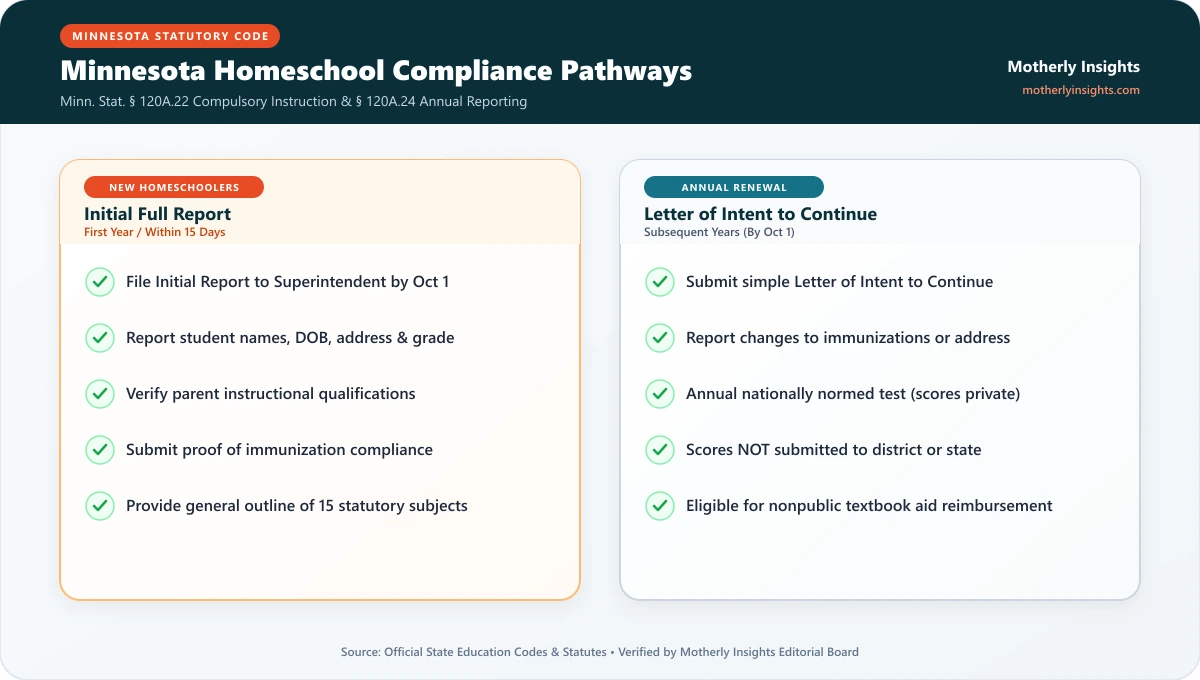
Minnesota Homeschool Compliance Pathways
The Initial Report vs. Letter of Intent to Continue
Minnesota law distinguishes between your first year of homeschooling and subsequent years:
1. First-Year Requirement: The Initial Full Report
By October 1 of your child’s first year of home education (or within 15 days of withdrawing a student from public school), you must submit an Initial Report to Superintendent to your resident school district. The report includes:
- The name, date of birth, and home address of each child receiving instruction.
- The name of each instructor and evidence of the parent’s instructional qualifications.
- Immunization records or a notarized statement of conscientious objection.
- The name of the nationally normed standardized test the parent plans to administer.
2. Subsequent Years: Letter of Intent to Continue
In all subsequent years, parents do not need to resubmit the lengthy Initial Report. Instead, under Minn. Stat. § 120A.24, parents file a simple Letter of Intent to Continue Homeschooling by October 1. This annual notification confirms ongoing instruction and notes any changes in address or immunizations.
Parent Instructor Qualifications
Under Minn. Stat. § 120A.22, Subd. 10, a parent is legally qualified to instruct their own children if they meet any one of the following criteria:
- Hold a valid Minnesota teaching license in the field taught.
- Be directly supervised by an individual holding a valid Minnesota teaching license.
- Successfully complete a teacher education program.
- Hold a baccalaureate degree.
- Be the parent or legal guardian of the child being instructed.
The fifth provision guarantees that every parent has the fundamental right to educate their child, regardless of whether they hold a college degree or formal teaching certification.
The 15 Mandatory Statutory Subjects
Under Minn. Stat. § 120A.22, Subd. 9, instruction must cover the following fifteen required areas:
- Reading and Writing
- Literature
- Fine Arts (Music, Visual Art, Drama)
- Mathematics
- Science (Physical and Biological)
- History (Minnesota, U.S., and World History)
- Geography
- Economics
- Government and Citizenship
- Physical Education
- Health
Families have total freedom to select their curricula, such as pairing structured programs like Saxon Math vs. Math-U-See with living literature from Five in a Row or Sonlight.
Annual Standardized Testing: 100% Private to Parents
Under Minn. Stat. § 120A.22, Subd. 11, home-educated children must take an annual nationally normed achievement test each year:
- Approved Tests: Peabody Individual Achievement Test (PIAT-R), Iowa Assessments, Stanford Achievement Test (SAT-10), California Achievement Test (CAT), or TerraNova.
- Privacy Protections: The law explicitly mandates that parents administer or supervise the test, and test scores remain strictly private to the parents.
- No District Submission: You are not required to submit test results to the school district, MDE, or state officials.
- Assessment of Progress: If scores fall below the 30th percentile or one grade level below the national norm, the parent must arrange for professional diagnostic assessment.
State-Funded Nonpublic Pupil Aid Reimbursements
One of Minnesota’s most advantageous features is state reimbursement for homeschool educational expenses under Minn. Stat. §§ 123B.40-48[3]:
- Textbook and Software Aid: Reimburses up to ~$100–$120 per eligible student per year for secular textbooks, workbooks, and educational software.
- Standardized Testing Aid: Reimburses the actual cost of purchasing and scoring approved achievement tests.
- Health and Guidance Services: Provides access to district speech therapy, hearing/vision screenings, and psychological evaluation services.
- Deadline to Request Forms: Request the MDE Pupil Aid request form from your local district office by October 1 each year.
💡 Related Educational Pathways: To compare related legal frameworks and recommended study programs, explore our detailed reviews on California homeschool legal guidelines, Ohio homeschool notification regulations, Pennsylvania Act 169 requirements.