
Selecting the right homeschool math curriculum is one of the most critical instructional decisions a parent makes. Few programs are more widely utilized and distinctly philosophical than Teaching Textbooks 4.0 and Math-U-See[1].
While both programs have transformed math instruction for millions of home-educated students, they embody opposite pedagogical strategies. Teaching Textbooks delivers an automated, gamified digital spiral curriculum that fosters independent learning. Math-U-See provides a tactile, parent-intensive, manipulative-driven mastery curriculum designed for profound conceptual fluency[2].
This guide compares Teaching Textbooks 4.0 and Math-U-See across instructional philosophy, daily lesson structure, parental involvement, remediation efficacy, and long-term college readiness.
Curriculum Showdown: Teaching Textbooks 4.0 vs. Math-U-See
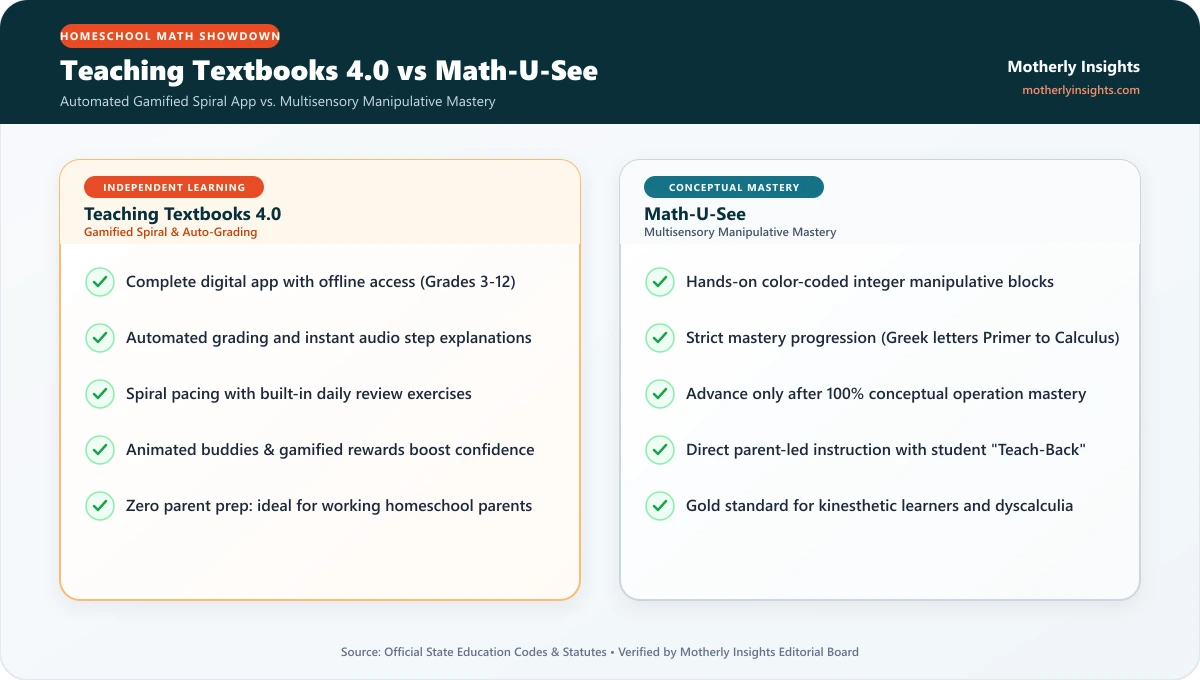
Pedagogical Philosophies: Spiral vs. Mastery
1. Teaching Textbooks 4.0: Incremental Spiral Approach
Teaching Textbooks uses a classic spiral format. Each daily lesson introduces a single new concept, followed by mixed practice that continuously revisits previously learned operations throughout the school year.
- Audiovisual Lectures: Every lesson begins with an animated, voiced multimedia lecture that breaks complex mathematical ideas into digestible chunks.
- Immediate Audio Feedback: When a student enters an incorrect answer, the program provides an immediate second chance. If they miss it again, they can watch a step-by-step audio explanation demonstrating exactly how to solve that specific problem.
- Confidence-Building Gamification: Customizable desktop themes, animated “buddies,” and collectible stickers dramatically reduce math anxiety in reluctant learners.
2. Math-U-See: Multisensory Manipulative Mastery
Developed by Steve Demme, Math-U-See is structured around strict conceptual mastery. Rather than following grade levels, students progress through stages named after the Greek alphabet:
- Primer & Alpha: Single-digit addition and subtraction.
- Beta & Gamma: Multiple-digit addition/subtraction and single/multiple-digit multiplication.
- Delta & Epsilon: Division and fractions.
- Zeta & Pre-Algebra: Decimals, percentages, and algebraic readiness. A student does not move forward until they demonstrate 100% mastery of the core concept. Instruction relies on the physical Integer Block Kit—color-coded, notched blocks that allow students to physically construct math problems before solving them abstractly.
Parent Time Commitment & Teaching Style
| Metric | Teaching Textbooks 4.0 | Math-U-See |
|---|---|---|
| Parent Involvement | Minimal (10–15 min/week for review) | High (30–45 min/day direct instruction) |
| Format | App-based (iOS, Android, Windows, Mac) | Physical books, DVD/streaming, manipulatives |
| Pacing Style | Spiral (continuous rotational review) | Mastery (stay on one topic until mastered) |
| Best For | Independent learners, busy parents | Kinesthetic learners, dyscalculia, visual thinkers |
| Grading | 100% automated gradebook | Manual parent grading & rubric evaluation |
The “Teach-Back” Method vs. Automated Gradebook
A standout feature of Math-U-See is the Teach-Back method. After watching the brief video demonstration and practicing with the manipulatives, the child must teach the mathematical concept back to the parent using the blocks. This ensures that the student is not simply memorizing algorithms, but deeply understands why the mathematical principle works[3].
Teaching Textbooks, by contrast, removes the parent from the instructional hot seat. The software tracks completion percentages, quiz scores, and attempts per problem in a secure Parent Portal. If your student encounters persistent difficulty, the parent can review specific lesson solution logs. For working parents and large families, this independence is often transformative.
💡 Related Educational Pathways: To compare related legal frameworks and recommended study programs, explore our detailed reviews on Beast Academy vs. Singapore Math comparison, All About Reading vs. Logic of English comparison, Sonlight vs. BookShark curriculum.