Homeschooling in the Palmetto State offers families exceptional legal flexibility when choosing the right statutory pathway. While South Carolina law provides three different operating options, understanding their regulatory differences is essential to ensuring full legal compliance while preserving educational privacy.
The statutory framework governing South Carolina home instruction is codified in Title 59, Chapter 65 of the South Carolina Code of Laws[1].
South Carolina Homeschool Operating Options
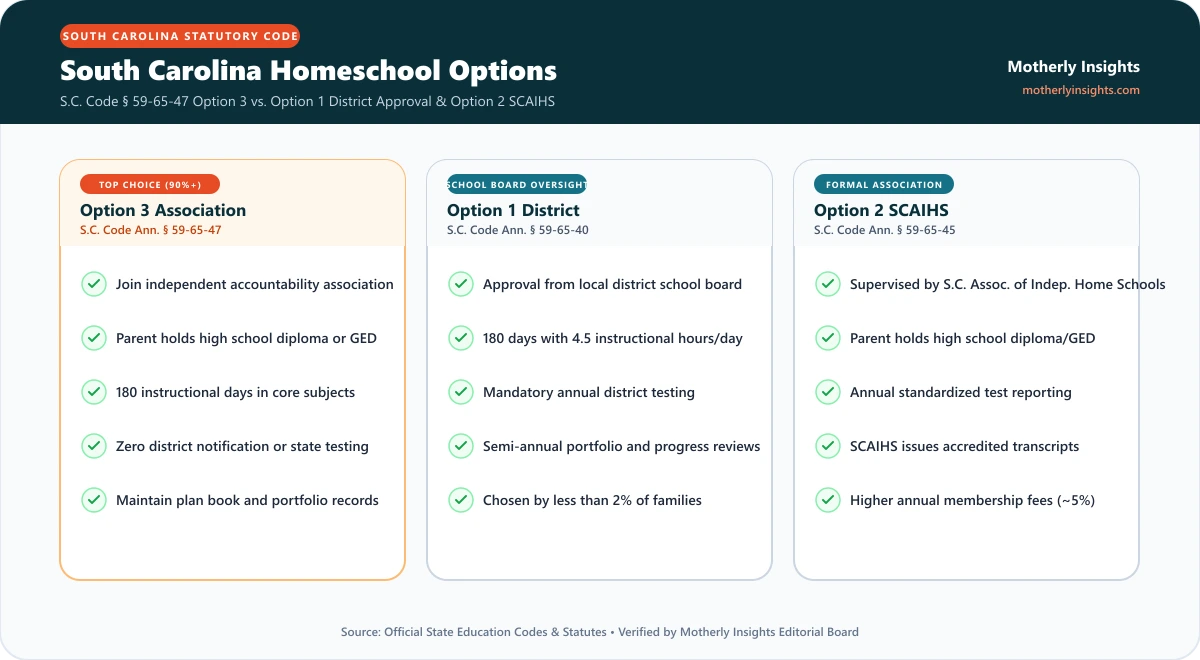
Option 3: The Independent Accountability Association (S.C. Code § 59-65-47)
Enacted by the General Assembly in 1996, Option 3 is by far the most popular pathway in South Carolina, chosen by more than 90% of home-educating families:
- Statutory Authority: Governed by S.C. Code Ann. § 59-65-47, parents satisfy compulsory school attendance by joining an independent homeschool association with a membership of at least 50 members.
- Parent Qualifications: The teaching parent or guardian must possess at least a high school diploma or a General Educational Development (GED) certificate.
- Instructional Calendar: Instruction must be conducted for at least 180 calendar days per school year.
- Mandatory Subjects: Instruction must include reading, writing, mathematics, science, and social studies. In grades 7 through 12, courses in composition and literature must be added.
- Why It Is Preferred: Option 3 involves no district notifications, no superintendent approvals, and no mandatory state standardized testing!
Option 3 Mandatory Recordkeeping:
Under S.C. Code § 59-65-47, parents must maintain four core records:
- A plan book, lesson log, or other written record of instructional activities.
- A portfolio of samples of student academic work.
- A daily attendance log demonstrating 180 days of schooling.
- A semi-annual academic assessment or report card evaluating the student’s progress in each subject.
Option 1: School District Board of Trustees Approval (S.C. Code § 59-65-40)
Under S.C. Code Ann. § 59-65-40, parents may homeschool with the formal approval of their local district school board[2]:
- Requires submitting detailed curriculum plans, textbook lists, and daily schedules for district review.
- Instruction must occur for at least 4.5 hours per day for 180 days.
- Students must participate in annual district standardized testing (SC READY or equivalent).
- Due to the intrusive oversight, fewer than 2% of South Carolina families use Option 1.
Option 2: South Carolina Association of Independent Home Schools (SCAIHS)
Codified under S.C. Code Ann. § 59-65-45, Option 2 allows families to homeschool under the oversight of SCAIHS:
- Operates similarly to Option 3, but is administered exclusively by one specific historical statewide organization.
- Requires annual standardized test reporting and formal review of lesson plans.
- SCAIHS provides specialized academic counseling and accredited transcripts, but involves significantly higher annual membership fees.
Public School Sports & Fine Arts Access (S.C. Code § 59-63-100)
Under the Equal Access to Interscholastic Activities Act (S.C. Code § 59-63-100), home-educated students (under all three options) have a statutory right to participate in interscholastic sports and fine arts activities at their resident public school[3]:
- Homeschoolers must reside within the school’s attendance zone.
- Students must fulfill the same academic, disciplinary, and tryout standards as enrolled public school pupils.
- High schools cannot exclude homeschoolers from teams solely on the basis of their non-enrolled status.
💡 Related Educational Pathways: To compare related legal frameworks and recommended study programs, explore our detailed reviews on California homeschool legal guidelines, Ohio homeschool notification regulations, Pennsylvania Act 169 requirements.