
Arizona revolutionized national educational freedom by establishing the country’s first universal school choice program. Under Arizona Revised Statutes (A.R.S.) § 15-2401 through § 15-2404, any Arizona K-12 student is eligible to receive an Empowerment Scholarship Account (ESA), redirecting approximately 90% of state basic education funding (averaging between $7,200 and $7,500+ per non-special-education student annually, and substantially higher for students with identified IEP needs) toward customized home education and approved private instruction[1].
However, navigating the Arizona ESA requires home educators to understand a critical legal distinction: An ESA student is statutorily distinct from an affidavit homeschooler under A.R.S. § 15-802.
This comprehensive guide clarifies statutory obligations, ClassWallet expense approvals, curriculum purchase regulations, quarterly accounting rules, and how to preserve maximum educational autonomy while utilizing state scholarship funds.
The Core Choice: Universal ESA Contract vs. Statutory Homeschool Affidavit
Home educators in Arizona operate under one of two fundamentally distinct legal mechanisms. Before applying for state funding, families must weigh financial support against statutory autonomy.
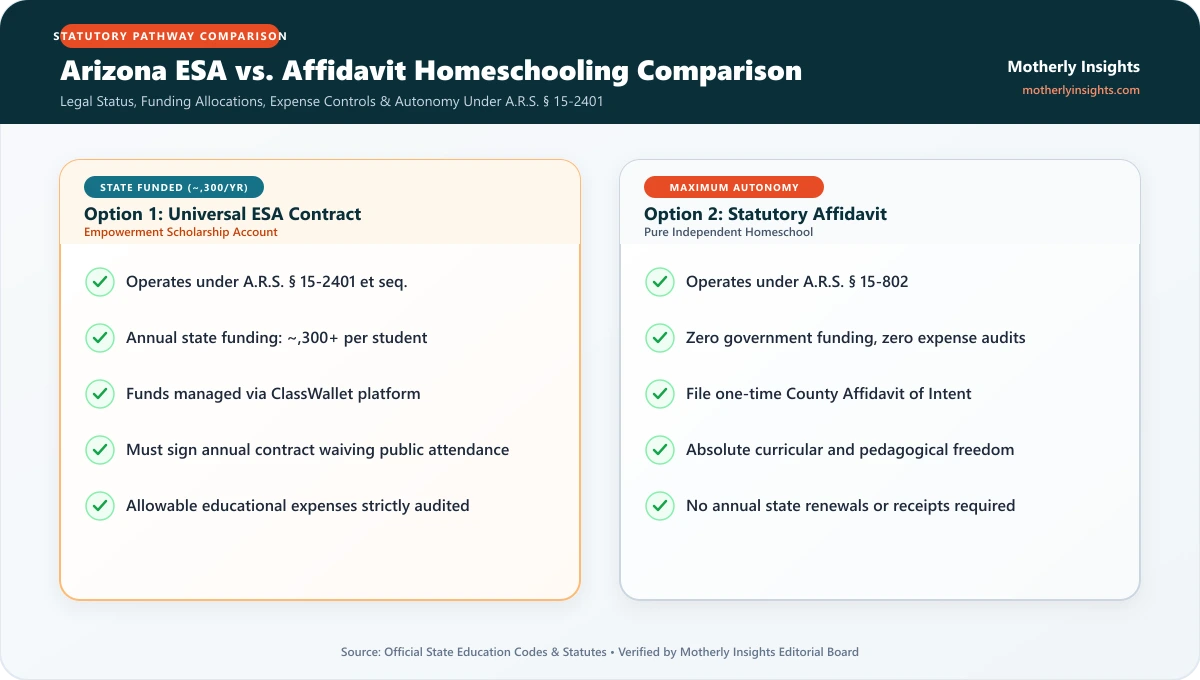
1. Statutory Foundations: A.R.S. § 15-2402 Eligibility and Contracts
To receive state education funds under an Empowerment Scholarship Account, parents enter into a binding contract with the Arizona Department of Education (ADE) under A.R.S. § 15-2402(B):
- Compulsory Attendance Waiver: The parent agrees to provide an education in at least reading, grammar, mathematics, social studies, and science.
- Public School Non-Enrollment: The student cannot be enrolled full-time in a public school district or public charter school while receiving ESA funds.
- Withdrawal of Homeschool Affidavit: If the parent previously filed a County Homeschool Affidavit of Intent under A.R.S. § 15-802 with the County School Superintendent (such as Maricopa or Pima County), the parent must file a letter of withdrawal with the county within 30 days of executing an ESA contract[2].
- Funding Release Schedule: Scholarship funds are disbursed into the family’s digital ClassWallet account in four equal quarterly allocations across the academic calendar year.
2. Navigating ClassWallet: Direct Pay vs. Debit Cards vs. Reimbursements
All Arizona ESA financial transactions are processed through the ClassWallet digital platform. ADE enforces rigorous auditing standards to ensure state funds are expended exclusively on qualified educational expenses under A.R.S. § 15-2401(5).
The Three Transaction Methods:
| Transaction Method | Best Use Case | Audit Risk Level |
|---|---|---|
| Direct Pay Marketplace | Purchasing approved boxed curricula (e.g., Saxon, All About Reading, Beast Academy) directly from integrated vendors (Amazon Business, Scholastic, Kaplan) | Zero (Pre-approved) |
| Vendor Direct Invoicing | Paying certified private tutors, music instructors, therapists, or regional microschools directly through ClassWallet | Low (Invoices vetted prior to payout) |
| Out-of-Pocket Reimbursement | Purchasing educational supplies from brick-and-mortar stores or non-integrated vendors | Medium to High (Requires itemized receipts & curriculum ties) |
3. Allowable vs. Prohibited Educational Expenses: The 2026 Audit Rules
Under ADE audit rules, every purchase submitted for reimbursement or direct pay must have a demonstrable educational nexus to required subject areas.
Permissible Expenses Under A.R.S. § 15-2401(5):
- Curricula & Textbooks: Comprehensive instructional materials, digital courses, workbooks, and teacher manuals.
- Tuition & Tutoring Fees: Accredited online academies, private tutoring by instructors with relevant subject credentials, and community college dual enrollment tuition.
- Standardized Testing Fees: AP exams, PSAT, SAT, ACT, and nationally standardized achievement assessments (such as the Iowa Assessments or Stanford 10).
- Special Education Therapies: Occupational, physical, speech-language, and behavioral therapies provided by licensed clinical professionals.
- Educational Hardware: One computer or tablet device per student every two to three academic years, provided it meets minimum educational specification thresholds.
Strictly Prohibited Expenses:
- Entertainment, amusement park tickets, and recreational gym memberships.
- Transportation expenses, mileage, and vehicle maintenance.
- Consumable groceries and family food items (even if utilized during culinary science demonstrations).
- Religious materials that lack secular academic instructional content when audited under strict state procurement guidelines.
4. Academic Autonomy: Does Accepting ESA Funds Dictate What You Teach?
The most common fear among prospective Arizona home educators is government intrusion into daily family learning.
A.R.S. § 15-2404(A) specifically protects educational autonomy:
“Nothing in this chapter shall be deemed to authorize this state or any agency of this state to restrict the style, curriculum, or educational philosophy of any qualified school or nonpublic education provider that serves a qualified student.”
Key Protections for Families:
- No Mandatory State Standardized Testing: Unlike traditional public schools, ESA students are not legally required to participate in the statewide Arizona’s Academic Standards Assessment (AASA). Parents retain full authority over assessment methodologies.
- No Mandated State Syllabi: The state cannot compel you to adhere to public school scope-and-sequence schedules. Parents may adopt classical, Charlotte Mason, unit study, or traditional textbook methods.
5. Annual Renewal & Quarterly Reconciliation Procedures
To maintain uninterrupted ESA funding throughout your child’s academic journey, parents must execute predictable administrative routines:
- Annual Contract Renewal: Every spring, ADE opens the online contract renewal window. Parents must log in to the ESA portal, confirm residency in Arizona, and execute the renewed educational contract.
- Quarterly Expense Reconciliation: Every transaction executed within ClassWallet must be reconciled before the subsequent quarter’s funds are released. Unitemized receipts or non-compliant purchases will trigger an audit notice requiring repayment or item justification within 30 calendar days.
- High School Completion & Graduation: Parents who educate their high school students under an ESA maintain full authority to design their high school transcript, determine graduation credit thresholds, and issue a valid diploma recognized by universities and trade institutions[3].
Summary Checklist for Arizona Families
- Decide between universal state funding (ESA) vs. absolute regulatory privacy (Affidavit under A.R.S. § 15-802).
- If choosing an ESA, submit your application through the official ADE portal with proof of Arizona residency and your child’s birth certificate.
- File a formal withdrawal letter with your County School Superintendent if a homeschool affidavit is currently active.
- Establish your ClassWallet portal account and familiarize yourself with the Direct Pay Marketplace.
- Maintain digital copies of all detailed receipts, lesson plans, and course descriptions for at least four academic years.
Frequently Asked Questions About Arizona ESA
Can a student switch from a standard homeschool affidavit to an ESA mid-year? ↓
What happens to unspent funds in ClassWallet at the end of the school year? ↓
Are ESA students allowed to play sports for their local public high school? ↓
Disclaimer: This post is for informational and educational purposes only, accurate to the best of our knowledge at publication. It does not constitute legal or financial advice. We do not guarantee accuracy or completeness and accept no liability for any decisions or losses resulting from reliance on this content.