
Home education in the Cornhusker State is governed by a well-established administrative framework codified in Nebraska Revised Statutes § 79-1601 and detailed in Nebraska Department of Education (NDE) Rule 13[1]. Known legally as ‘Exempt Schools’, homeschools operate free from state accreditation mandates while fulfilling compulsory education duties.
Compulsory school attendance in Nebraska applies to all children between the ages of six (6) and eighteen (18) under Neb. Rev. Stat. § 79-201.
Nebraska Homeschool Legal Pathways: Statutory Overview
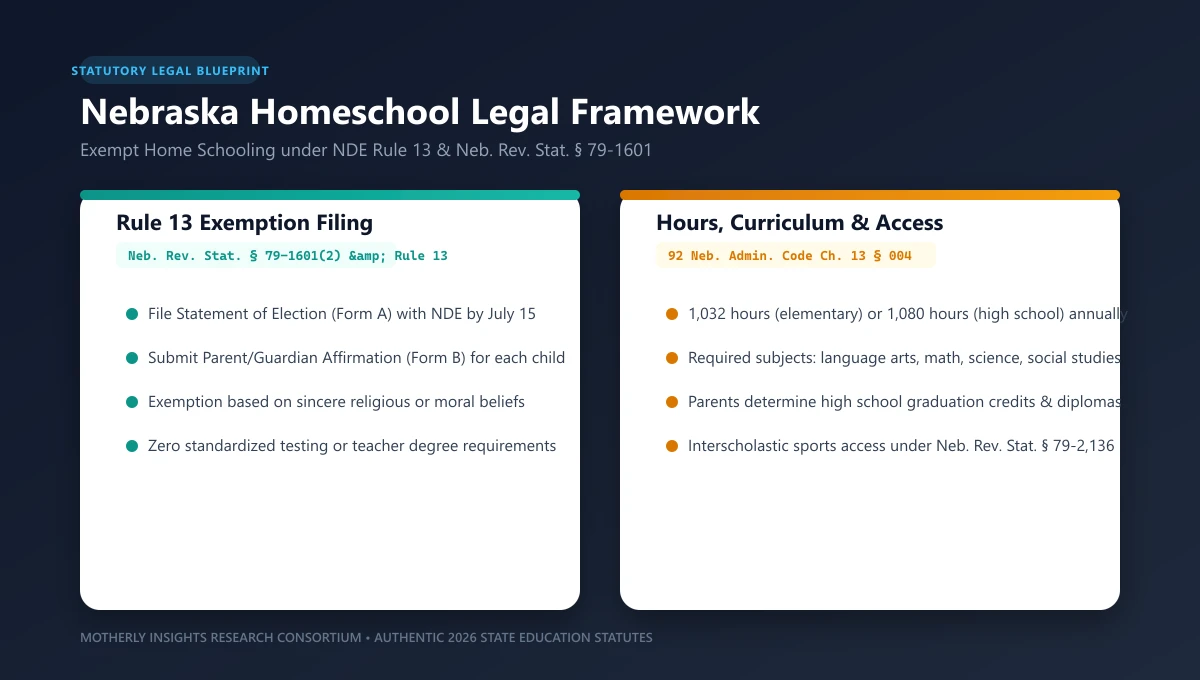
1. Filing for Rule 13 Exemption with NDE
Under NDE Rule 13 (92 Neb. Admin. Code Ch. 13), parents establish their exempt home school by filing two official forms with the Nebraska Department of Education[2]:
- Statement of Election (Form A): Designates the home school as exempt based on religious convictions or moral beliefs regarding educational governance.
- Parent/Guardian Affirmation (Form B): Identifies each participating student, provides birth dates, and confirms the parent’s commitment to delivering required instructional hours.
- Annual Deadline: The Rule 13 exemption packet must be submitted to NDE by July 15 prior to each school year (or at least 30 days prior to beginning instruction if starting mid-year).
- NDE Acknowledgment: Upon review, the NDE issues an official Certificate of Exemption, which protects the family against truancy inquiries.
2. Annual Instructional Hours and Core Subject Mandates
Nebraska law requires exempt home schools to provide substantial, organized instruction satisfying annual hourly benchmarks under Rule 13 § 004:
- Elementary Grades (Kindergarten - Grade 8): Minimum of 1,032 aggregate hours of instruction each year.
- Secondary Grades (Grades 9 - 12): Minimum of 1,080 aggregate hours of instruction each year.
- Mandatory Curricular Branches: The instructional program must provide sequential courses in language arts (reading, writing, grammar, spelling), mathematics, science, social studies (history, civics, geography), and health.
3. Teacher Credentials and Standardized Testing Freedom
Nebraska exempt home schools enjoy broad educational independence[3]:
- No Teacher Certifications: Parents are completely exempt from Nebraska state teacher certification and college degree requirements.
- No Mandatory Standardized Testing: Nebraska statute does not mandate state achievement testing, annual standardized exams, or portfolio audits for Rule 13 exempt schools.
- Curriculum Independence: Parents select and purchase any commercial, classical, or faith-based curricula aligned with their family values.
4. Public School Sports and Interscholastic Access
Under Neb. Rev. Stat. § 79-2,136, homeschooled students enrolled in Rule 13 exempt schools possess protected legal rights to participate in local public school athletic and extracurricular programs[4]:
- Athletic Eligibility: Homeschoolers can try out for sports teams governed by the Nebraska School Activities Association (NSAA) at their local resident high school.
- Extracurricular Programs: Eligible to participate in school bands, choir, theater productions, and academic competitions.
- Dual Enrollment: High school students can access dual-credit college courses through the University of Nebraska System and local community colleges.
5. Nebraska High School Graduation and College Readiness
Parents operating under Rule 13 have the exclusive legal prerogative to determine high school graduation criteria:
- Official Transcripts & Diplomas: Parents issue comprehensive transcripts calculating grade point averages and confer legal high school diplomas.
- University Acceptance: Institutions across the state, including the University of Nebraska-Lincoln, Creighton University, and Nebraska Wesleyan University, recognize and accept homeschool diplomas and transcripts without barrier.
6. Homeschooling Neurodivergent Students under NDE Rule 13
Nebraska Rule 13 exempt schools provide parents with total pedagogical autonomy to address individual learning differences, including autism spectrum disorders, ADHD, dyslexia, and processing speed variations:
- Customized Pacing & Materials: Parents are completely free to utilize specialized reading interventions (such as Orton-Gillingham or Wilson Reading System), un-timed testing, and adaptive digital learning suites without district oversight.
- Exemption from State Testing Stress: Because Rule 13 schools are exempt from mandatory state testing, neurodivergent children can learn at their developmental pace without high-stakes standardized exam anxiety.
- Public District Child Find Services: Under federal IDEA mandates, parents of homeschooled students in Nebraska may request diagnostic evaluations through their local public school district to identify specific speech or learning disabilities.
7. Nebraska Secondary Transcripts, Credits, and College Admissions
Parents operating Rule 13 exempt schools hold full sovereign authority over high school diplomas and transcripts. The following 4-year curriculum matrix aligns with admissions standards at the University of Nebraska System and colleges nationwide:
| Academic Area | Required High School Credits | Course Examples and Rigor Benchmarks |
|---|---|---|
| Language Arts | 40 Credit Hours (4 Years) | English Literature, Advanced Composition, Speech & Debate, World Classics |
| Mathematics | 30 - 40 Credit Hours | Algebra I, Geometry, Algebra II, Pre-Calculus, Probability & Statistics |
| Science | 30 Credit Hours | Biology with Lab, Chemistry with Lab, Physics, Agricultural Agronomy |
| Social Studies | 30 Credit Hours | American History, Nebraska State History, Civics & Government, Economics |
| Health & Physical Education | 10 - 20 Credit Hours | Lifetime Sports, Nutrition, First Aid & CPR, Mental Wellness |
| Electives & Career Tech | 40 - 50 Credit Hours | Foreign Language (2 years), Computer Science, Livestock Management, Music |
8. Dual Enrollment and College Readiness in Nebraska
Nebraska high school homeschoolers have remarkable access to collegiate coursework before graduation:
- ACE Scholarship Program: The Access to College Early (ACE) Scholarship Program helps eligible low-income Nebraska high school students pay tuition for dual-enrollment college courses.
- Community College Partnerships: Institutions such as Southeast Community College, Metropolitan Community College, and Central Community College welcome Rule 13 high school students into university-transferable courses.
9. Step-by-Step Guide: Exiting a Nebraska Public School
If you decide to pull your child out of a Nebraska public school mid-year:
- Submit Rule 13 Packet to NDE: Submit Form A and Form B to the NDE Exempt Schools Program at least 30 days prior to withdrawal (or concurrently with withdrawal if immediate).
- Deliver Withdrawal Letter to District: Provide your local school principal with written notice of withdrawal, attaching a copy of your submitted NDE Form A.
- Secure Official School File: Request the student’s complete cumulative educational file, immunization records, and any diagnostic evaluations.
💡 Related Educational Pathways: To compare related legal frameworks and recommended study programs, explore our detailed reviews on California homeschool legal guidelines, Ohio homeschool notification regulations, Pennsylvania Act 169 requirements.
💡 Related Educational Pathways: To compare related legal frameworks and recommended study programs, explore our detailed reviews on Georgia homeschool compliance framework, Michigan homeschool statutory rules, Indiana homeschool attendance laws.