
Florida enacted historic educational expansion under House Bill 1, transforming the state into a national leader for universal education choice. Under Florida Statutes (F.S.) § 1002.395 and § 1002.394, Florida established the Personalized Education Program (PEP), an education savings account (ESA) scholarship program administered through state-approved Scholarship Funding Organizations (SFOs) such as Step Up for Students and the AAA Scholarship Foundation[1].
The PEP scholarship allocates an average of $8,000 to $8,400+ per student annually (funded through the Florida Tax Credit Scholarship and Family Empowerment Scholarship frameworks) directly into a parent-directed digital account for home-based instructional materials, private tutoring, hybrid microschooling, and licensed therapies.
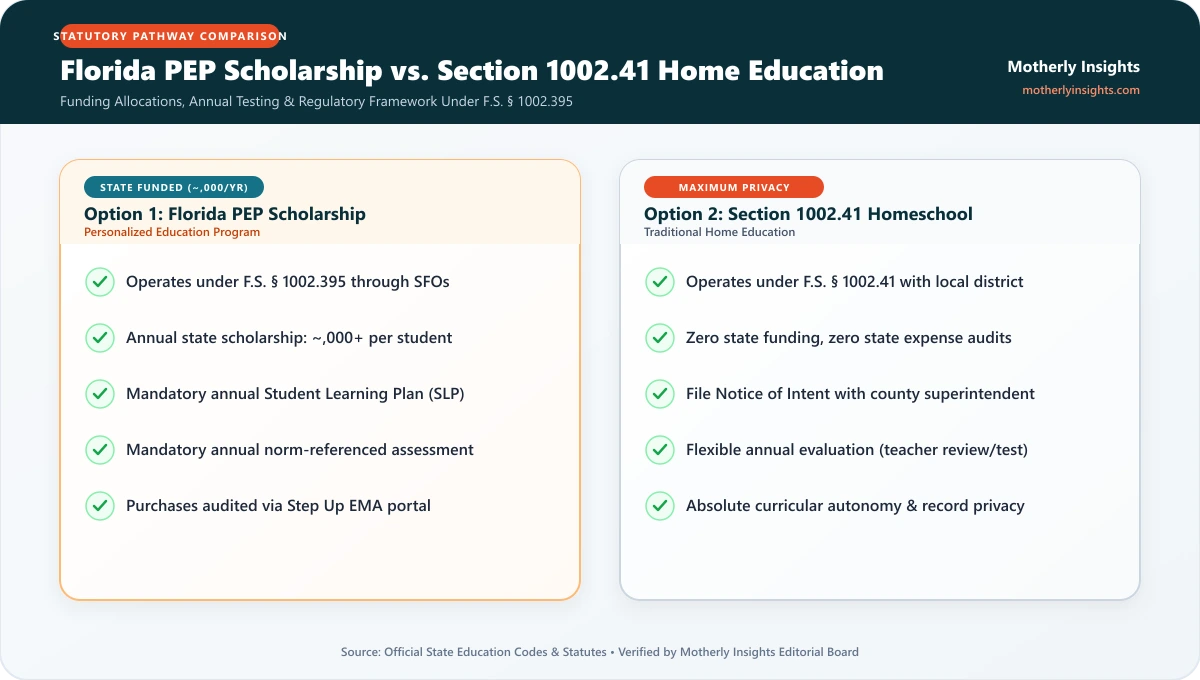
However, parents must navigate a critical legal foundation: A student enrolled in the Florida PEP scholarship is legally categorized as a private school choice recipient, NOT a traditional home education student under F.S. § 1002.41.
This comprehensive operational guide details eligibility criteria, the mandatory Student Learning Plan (SLP), state-approved annual testing requirements, eligible purchases in the Education Marketplace Assistant (EMA), and legal procedures for transitioning between traditional homeschooling and PEP.
Legal Classification: Florida PEP vs. Traditional Section 1002.41 Home Education
Understanding the statutory distinction between PEP and traditional Florida homeschooling is essential to avoid non-compliance and dual-enrollment truancy flags.
1. The Core Legal Distinction: You Cannot Be Both
Florida statute strictly prohibits a student from being simultaneously enrolled in a district Home Education Program under F.S. § 1002.41 and receiving a PEP scholarship under F.S. § 1002.395:
- Private Choice Legal Status: PEP students are officially registered with the state as private scholarship students whose parents direct their education.
- Mandatory County NOI Termination: If you currently have an active Notice of Intent filed with your county public school district (such as Miami-Dade, Broward, Hillsborough, or Orange County), you must submit a formal letter of termination to your district home education office within 30 days of accepting a PEP scholarship award[2].
- No District Portfolio Evaluations: Because PEP students do not operate under Section 1002.41, parents do not submit an annual certified teacher portfolio review to the local school district. Instead, compliance is reported exclusively to the SFO.
2. The Annual Student Learning Plan (SLP) Requirement
To maintain PEP scholarship eligibility, Florida statute mandates that parents author and submit an annual Student Learning Plan (SLP) through the Step Up for Students Education Marketplace Assistant (EMA) portal:
Core Requirements of the SLP:
- Curricular Scope: Outline the learning goals, planned subjects, and instructional resources across core subject areas (mathematics, language arts, science, and social studies).
- Personalized Adaptation: Identify specific academic milestones tailored to your child’s age, ability, or identified learning challenges.
- Deadlines: The initial SLP must be submitted prior to the release of scholarship funds, with annual updates completed during the re-enrollment window each spring.
- Parental Sovereignty: SFOs verify completion of the SLP, but statutory language explicitly protects parents from ideological or pedagogical censorship. You are free to utilize classical, faith-based, Montessori, Charlotte Mason, or customized modern curricula.
3. Mandatory Annual Norm-Referenced Testing
While traditional Florida homeschoolers under F.S. § 1002.41 have five different annual evaluation options (including informal portfolio reviews by certified teachers), PEP students are statutorily required to complete an annual nationally norm-referenced standardized assessment[3].
Approved Florida Norm-Referenced Tests Include:
- Iowa Assessments (Form E/F)
- Stanford Achievement Test (Stanford 10 / SAT-10)
- TerraNova (3rd Edition) / CAT/5
- NWEA MAP Growth Assessment
- Classic Learning Test (CLT, CLT10, CLT8)
- College Board PSAT, SAT, or ACT
Assessment Rules:
- Testing Window: Testing must be administered annually between the student’s enrollment date and the close of the academic year.
- Score Submission: Official test score reports must be uploaded directly to your SFO portal (Step Up for Students or AAA) to qualify for subsequent year scholarship renewal.
- Funding Reimbursement: Testing fees, test booklets, and proctoring costs are 100% reimbursable through PEP scholarship funds.
4. Navigating the EMA Portal: Allowable vs. Disallowed Purchases
All Florida PEP scholarship transactions are managed through Step Up for Students’ Education Marketplace Assistant (EMA) portal. Purchases are handled either via direct marketplace ordering or post-purchase reimbursement.
Reimbursable & Pre-Approved Expenses Under F.S. § 1002.395:
- Instructional Materials & Curricula: Full-year curricula (Saxon, Singapore Math, All About Reading, Apologia), workbooks, digital software subscriptions, and literature books.
- Private Tutoring & Instruction: In-person or virtual tutoring by individuals possessing a valid Florida educator certificate, an adjunct teaching certificate, or demonstrated subject expertise.
- Part-Time Tuition & Microschooling: Tuition fees for hybrid homeschool academies, co-ops, fine arts schools, or university dual-enrollment courses.
- Therapeutic Services: Applied Behavior Analysis (ABA), speech therapy, occupational therapy, and physical therapy provided by licensed clinical specialists.
- Hardware & Technology: Desktop or laptop computers, tablets, and printers purchased within approved SFO device frequency guidelines (generally one computer every three fiscal years).
Prohibited Expenses Under State Audit Rules:
- Household furniture, general office supplies, and non-instructional room decor.
- Recreational tickets, family vacation expenses, or general theme park admissions without formal educational curriculum alignment.
- Food, snacks, and meal preparations.
- Competitive athletic team registrations and league dues that do not meet instructional class definitions.
5. FHSAA Interscholastic Sports & Extracurricular Rights
Florida provides robust statutory protections ensuring non-traditional students can participate in public school athletic programs. Under F.S. § 1006.15 (The Craig Dickinson Act):
- PEP scholarship students maintain the legal right to try out for interscholastic sports teams at their zoned public neighborhood school or a local public charter school.
- Students must meet the same academic GPA standards (minimum 2.0 unweighted GPA) and behavioral eligibility standards required of full-time public school students.
- Parents submit athletic eligibility forms directly to the school athletic director prior to the start of the athletic season.
Step-by-Step Transition Checklist for Florida Families
- Determine Enrollment Strategy: Compare the complete privacy of F.S. § 1002.41 against the financial backing of F.S. § 1002.395 PEP.
- Create SFO Account: Open an account on Step Up for Students or AAA Scholarship Foundation.
- Submit Verification Documents: Upload proof of Florida residency (utility bill, driver’s license) and child’s birth certificate.
- Terminate County Notice of Intent: If registered as a 1002.41 homeschooler, submit a formal termination letter to your school district office.
- Draft Student Learning Plan: Complete the digital SLP within the EMA portal outlining learning objectives for the upcoming year.
- Schedule Norm-Referenced Testing: Book your child’s annual standardized assessment with an approved testing service before the spring deadline.
Frequently Asked Questions About Florida PEP
Can a PEP student enroll part-time in Florida Virtual School (FLVS Flex)? ↓
What happens if my child scores below grade level on the required annual test? ↓
Can unused PEP scholarship funds be saved for college? ↓
Disclaimer: This post is for informational and educational purposes only, accurate to the best of our knowledge at publication. It does not constitute legal or financial advice. We do not guarantee accuracy or completeness and accept no liability for any decisions or losses resulting from reliance on this content.