
Home education in the Natural State is protected by progressive, family-friendly statutory provisions. Under the Arkansas Home School Law (Arkansas Code Annotated § 6-15-501 through § 6-15-509), parents possess clear constitutional and statutory rights to direct their children’s education from home[1].
Compulsory school attendance in Arkansas governs children between the ages of five (5) and seventeen (17) under A.C.A. § 6-18-201. Compliance is streamlined through a convenient centralized electronic filing system managed by the Arkansas Division of Elementary and Secondary Education (DESE).
Arkansas Homeschool Legal Pathways: Regulatory Overview
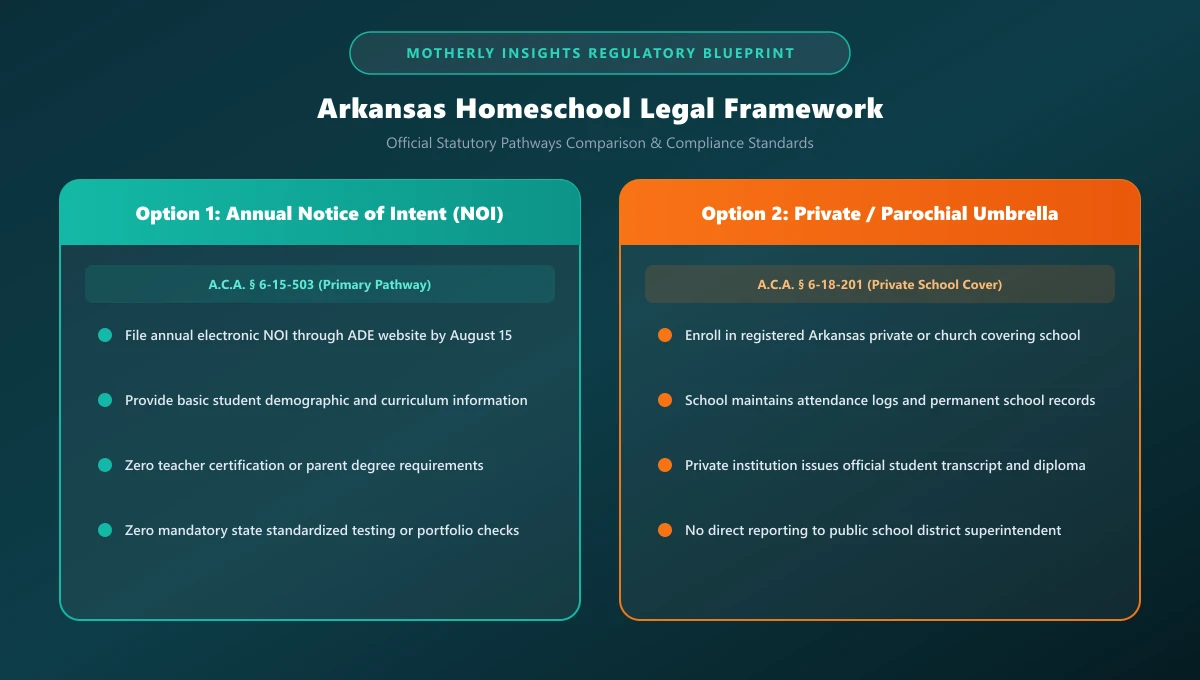
1. Filing the Annual Notice of Intent (NOI)
To legally homeschool in Arkansas, parents must submit an annual Notice of Intent to Home School and a signed Parent/Guardian Agreement[2].
Submission Guidelines:
- Online Filing Portal: Parents can submit their NOI online through the Arkansas DESE Homeschool Portal, which immediately generates an official electronic confirmation letter.
- Filing Deadline: The standard deadline is August 15 of each academic year.
- Mid-Year Withdrawals: Families withdrawing from public school during the academic term must submit the NOI at least 14 calendar days prior to withdrawal, unless the local school superintendent grants an expedited immediate waiver.
- Parent Qualifications: Arkansas imposes zero educational requirements on parent instructors. You do not need a high school diploma, college degree, or teaching license to instruct your own children.
2. Curriculum, Subjects, and Assessment Freedom
Arkansas law intentionally leaves curriculum design entirely to the discretion of the teaching parents:
- No Mandatory Subject List: Unlike states with rigid statutory course catalogs, Arkansas gives parents total autonomy over academic subjects, scope, and sequence.
- Zero Standardized Testing Mandate: Mandatory state assessments for homeschooled students were repealed. Arkansas does not require home-educated students to take state exams or submit portfolio evaluations[3].
- Optional Subsidized Testing: For families that desire standardized benchmarks, DESE permits homeschooled students to participate in state-administered testing (such as ACT Aspire) at their local district free of charge upon advance parental request.
3. Equal Access Under the Arkansas Tim Tebow Law
Under A.C.A. § 6-15-509 (The Tim Tebow Law), homeschooled students have protected statutory rights to try out for interscholastic athletics and extracurricular activities at their resident public school[4].
Eligibility Criteria:
- The student must reside within the school district boundaries.
- The parent must submit written notice of intent to participate at least one week prior to the start of athletic tryouts or official team practices.
- The student must meet all standard academic eligibility and residency benchmarks established by the Arkansas Activities Association (AAA).
4. High School Transcripts, Graduation, and Arkansas Academic Challenge
Arkansas homeschool graduates enjoy full legal recognition for post-secondary education, trade apprenticeships, and employment:
- Parent-Issued Diplomas: Under Arkansas law, a homeschool diploma signed by the parent carries the same legal validity as a diploma issued by an accredited public high school.
- Arkansas Academic Challenge Scholarship: Homeschool graduates can qualify for substantial funding under the Arkansas Academic Challenge Scholarship by achieving the state benchmark score on the ACT (currently a composite score of 19).
5. Arkansas Homeschool Recordkeeping and Portfolio Blueprint
While Arkansas statutes do not mandate that parents submit student portfolios to school district officials, maintaining a professional academic recordkeeping system is critical for high school credit transfers, driver’s license applications, and college admissions:
The Essential Homeschool Binder Architecture
- Official State Confirmation: Keep a physical printed copy of your annual electronic Notice of Intent confirmation letter from the Division of Elementary and Secondary Education.
- Attendance Log: Maintain a standard calendar tracking 178 to 180 days of active instruction. While the state does not audit hours, this documentation provides proof of compulsory attendance compliance.
- Curriculum Scope and Sequence: Document course titles, textbooks, publisher names, and syllabi for all core academic subjects.
- Graded Work Samples: Retain dated representative samples of student writing, mathematics evaluations, and science lab reports across each semester.
- Standardized Test Records: Store all score reports from optional standardized tests (such as the ACT, SAT, or Iowa Assessments).
6. Homeschool Driver Education and Learner’s Permit Certification
Under Arkansas law, teenagers seeking an Arkansas learner’s permit or driver’s license must demonstrate lawful school enrollment. For homeschooled students, parents must present:
- A notarized Affidavit of Home School Enrollment.
- A copy of the current school year’s Notice of Intent confirmation letter issued by DESE.
- A passing score on the state written driver examination.
7. Dual Enrollment and Concurrent College Credit
Arkansas high school homeschoolers have broad access to dual enrollment through the state’s community college and public university system:
- Concurrent Enrollment: High school juniors and seniors may enroll in college courses at institutions such as the University of Arkansas, Arkansas State University, and local community colleges.
- Tuition Discounts: Many Arkansas institutions offer reduced concurrent tuition rates for eligible high school students.
- Credit Articulation: College credits earned during high school apply toward high school diploma requirements while transferring into undergraduate degree programs across regional accrediting associations.
8. Special Education Rights and Individualized Instruction
Under federal IDEA law, homeschooled students with diagnosed learning differences (such as dyslexia, ADHD, or autism spectrum disorder) are classified as private school students. Arkansas school districts must engage in timely “Child Find” consultations to identify children requiring special services. Parents can request comprehensive educational evaluations through their resident school district at no cost to obtain diagnostic baselines, speech therapy referrals, or occupational therapy recommendations.
9. Homeschool Transitioning: Re-Entering Arkansas Public Schools
If a family decides to transition from home education back into the public school system, A.C.A. § 6-15-504 outlines specific grade-placement guidelines. Local public school principals determine grade placement based on student age, parent portfolios, and administration of standard diagnostic assessments. High school students transferring course credits must provide course descriptions, syllabi, and textbook records to satisfy Arkansas graduation credit benchmarks.
💡 Related Educational Pathways: To compare related legal frameworks and recommended study programs, explore our detailed reviews on California homeschool legal guidelines, Ohio homeschool notification regulations, Pennsylvania Act 169 requirements.
💡 Related Educational Pathways: To compare related legal frameworks and recommended study programs, explore our detailed reviews on Georgia homeschool compliance framework, Michigan homeschool statutory rules, Indiana homeschool attendance laws.