
When parents embark on home education, two time-tested, literature-rich methodologies dominate the landscape: the Charlotte Mason method and Classical education. While both reject the standardized, fragmented textbook approach of conventional classrooms in favor of whole books and noble ideas, their underlying philosophies, daily rhythms, and instructional techniques diverge significantly[1].
Understanding the distinctions between Charlotte Mason’s concept of “Education is an atmosphere, a discipline, a life” and the Classical three-stage developmental model known as the Trivium (Grammar, Logic, and Rhetoric) is essential for choosing a sustainable, joy-filled educational path for your household.
This comprehensive guide analyzes core principles, lesson structures, memorization versus narration, curriculum options (such as AmblesideOnline vs. The Well-Trained Mind), and how to decide which framework best aligns with your family’s educational vision.
The Methodological Crossroads: Core Contrasts at a Glance
Before examining daily scheduling and book selections, review the structural foundations of each approach.
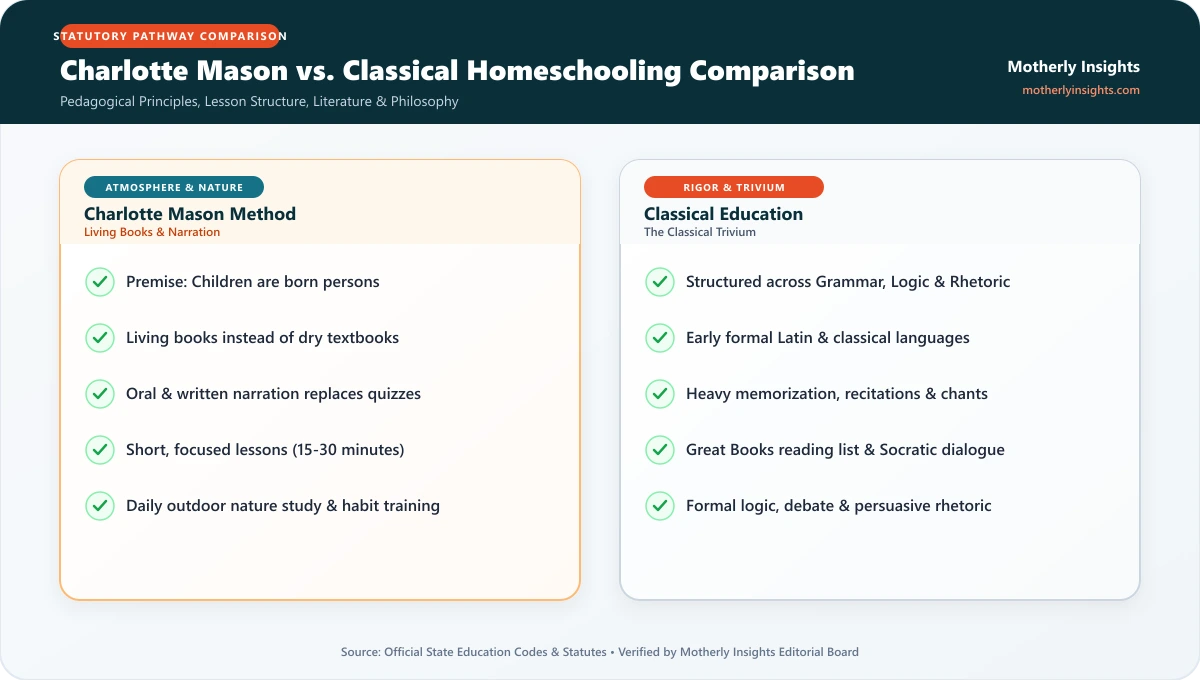
1. Philosophical Foundations: How Each Method Views the Child
The core divergence between Charlotte Mason and Classical education begins with their philosophical definition of child development:
The Charlotte Mason Philosophy:
- Core Premise: “Children are born persons.” Charlotte Mason (a late 19th-century British educator) insisted that children are not empty vessels to be filled or animals to be conditioned. They possess active, hungry minds designed to assimilate ideas from birth.
- The Three Instruments of Education:
- Atmosphere: The natural environment, home culture, and parental attitude.
- Discipline: The deliberate cultivation of good mental and moral habits (attention, neatness, truthfulness).
- Life: Living thoughts and noble ideas presented through inspiring literature, history, and theology rather than dry factual digests.
The Classical Model & The Trivium:
- Core Premise: The classical model, popularized in modern homeschooling by author Dorothy Sayers and Susan Wise Bauer, aligns instruction with the developmental cognitive stages of the classical Trivium[2]:
- Grammar Stage (Grades K–4): The “Poll-Parrot” stage, where young children naturally absorb facts, rhymes, dates, rules, and vocabulary with ease through memorization, recitations, and chants.
- Logic Stage (Grades 5–8): The “Pert” stage, where adolescents develop analytical skepticism, questioning cause-and-effect, evaluating arguments, and learning formal syllogistic logic.
- Rhetoric Stage (Grades 9–12): The “Poetic” stage, where mature students integrate knowledge, cultivate persuasive writing, and deliver articulate oral arguments.
2. Daily Rhythms & Lesson Architecture
How do these theoretical differences manifest during a regular homeschooling morning?
| Feature | Charlotte Mason Method | Classical Education |
|---|---|---|
| Lesson Length | Short & Focused: 15–20 minutes in early elementary; expanding to 30–45 minutes in middle school. | Deep & Thorough: 45–60+ minutes per subject; emphasizes stamina and mastery. |
| Pacing & Rest | Lessons end promptly before mental fatigue sets in. Afternoons are preserved for outdoor nature study, handicrafts, and independent reading. | Academic work often extends into the afternoon, balancing heavy writing, translation drills, and analytical discussions. |
| Language Studies | Focus on modern living spoken languages (French, Spanish, German) alongside Latin introduced later in Form III (grade 7). | Rigorous formal Latin introduced early (grades 2–3), followed by Classical Greek or formal logic in middle school. |
| Assessment Style | Oral and Written Narration: Quizzes and multiple-choice tests are avoided; children re-tell or synthesize what they learned in their own words. | Formal Recitations & Tests: Chants, memorized speeches, vocabulary quizzes, and structured essay rubrics. |
3. Literature & Curriculum: “Living Books” vs. “The Great Books”
Both movements venerate great books over pedestrian commercial workbooks, but their scope and sequence differ:
Charlotte Mason’s Living Books:
- Charlotte Mason defined a “living book” as one written by a passionate author with a literary style that captures the child’s imagination, conveying ideas rather than dry facts.
- Nature Lore & History: Students read narrative histories (e.g., H.E. Marshall, Genevieve Foster) and natural history narratives (e.g., Arthur Ransome, Thornton Burgess).
- Picture Study & Composer Study: Children spend six weeks studying a single master artist and composer, observing works deeply without premature technical analysis.
The Classical Canon & Chronological History:
- Classical education structures learning chronologically through a 4-year historical cycle repeated three times across the Trivium:
- Ancients (Creation to Fall of Rome)
- Middle Ages to Renaissance
- Early Modern Times
- Modern Times
- Great Books Reading: High school students engage directly with primary source documents, Homer, Virgil, Augustine, Dante, Shakespeare, and modern political philosophy[3].
4. Leading Curricula Comparison
If you choose to purchase an established curriculum framework, here are the benchmark providers for each philosophy:
Premier Charlotte Mason Curricula:
- AmblesideOnline (AO): A free, comprehensive K-12 Charlotte Mason curriculum meticulously recreating Mason’s original PUS (Parents’ Union School) syllabus using public domain classics and high-caliber living books.
- Simply Charlotte Mason (SCM): A user-friendly, family-style curriculum offering modular history, literature, and nature guides with video training for parents.
- A Gentle Feast: A structured, Charlotte Mason curriculum organized into a four-year chronological language arts and history cycle designed for teaching multiple ages together.
Premier Classical Curricula:
- The Well-Trained Mind Press: Susan Wise Bauer’s foundational classical guide accompanied by Story of the World, Writing With Ease, and First Language Lessons.
- Memoria Press: A traditional, Latin-centered classical curriculum prioritizing structured workbooks, Christian humanism, and mastery of classical languages.
- Veritas Press: Highly academic classical curriculum offering self-paced online courses, classical history flashcards, and omnibus Great Books studies.
- Classical Conversations (CC): A nationwide weekly co-op community providing structured memory work (Foundations), writing and Latin (Essentials), and Socratic seminars (Challenge).
5. Can You Blend Charlotte Mason and Classical Education?
Many modern home educators discover that an either/or dilemma is unnecessary. A hybrid approach often yields an optimal balance:
- Elementary Years (K–4): Adopt Charlotte Mason’s short lesson lengths, nature journaling, outdoor exploration, and living books to build a passionate love for learning without early academic burnout.
- Middle & High School Years (5–12): Transition toward classical logic, rigorous formal writing, Great Books discussions, and chronological history cycles to prepare students for college-level research and competitive admissions.
Decision Matrix: Which Method Fits Your Family?
Choose Charlotte Mason if:
- You value outdoor exploration, daily nature study, and unhurried afternoons.
- Your children learn best through vivid storytelling, oral discussion, and creative narration rather than worksheets.
- You want to teach multiple siblings together using shared living books.
- You believe habit formation and character development precede academic pressure.
Choose Classical Education if:
- You appreciate systematic, structured, chronological academic milestones.
- You want your child to master formal Latin, logic, debate, and classical rhetoric.
- You thrive on detailed teacher guides, clear rubrics, and formal assessment metrics.
- You envision your high schoolers participating in rigorous Great Books seminars and Socratic dialogue.
Frequently Asked Questions
How does math work in a Charlotte Mason homeschool? ↓
Is Latin mandatory in a Charlotte Mason education? ↓
Are Charlotte Mason high school graduates prepared for competitive colleges? ↓
Disclaimer: This post is for informational and educational purposes only, accurate to the best of our knowledge at publication. It does not constitute legal or financial advice. We do not guarantee accuracy or completeness and accept no liability for any decisions or losses resulting from reliance on this content.