

Educating your children at home in Kentucky provides families with broad educational autonomy protected by long-standing statutory provisions. Under Kentucky law, home schools are not classified under a separate, restrictive homeschool category; instead, they operate with the exact same legal rights and responsibilities as private and parochial schools.
The statutory foundation of Kentucky home education is KRS § 159.030(1)(b), which exempts children from public school attendance if they are enrolled in and attending a private, parochial, or church day school[1].
This guide provides a comprehensive walkthrough of Kentucky homeschool laws, the annual letter of intent requirement, attendance logging, required academic subjects, and high school graduation protocols.
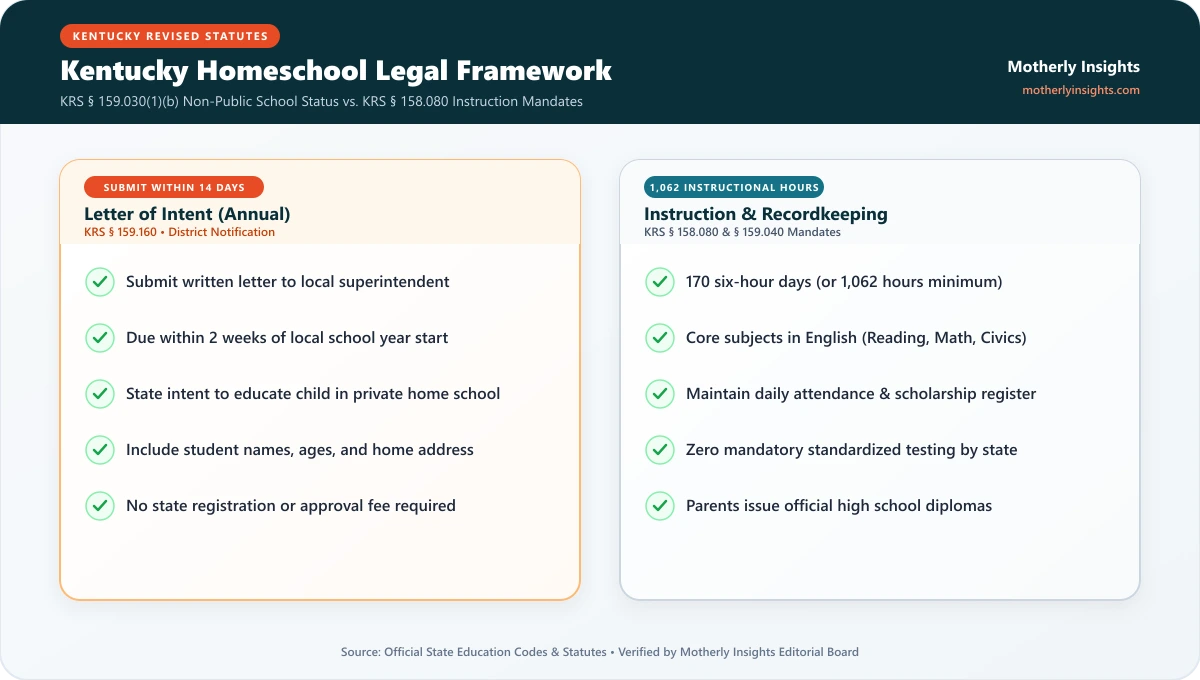
Kentucky Homeschool Legal Framework
1. The Annual Letter of Intent (KRS § 159.160)
Under KRS § 159.160, all private schools—including private home schools—must report their student enrollment to the local public school district superintendent[2]:
- Deadline: The letter of intent must be submitted within two weeks (14 calendar days) of the start of the local public school district’s academic year.
- Recipient: Address the letter to the Superintendent of the local school district in which your family resides.
- Required Information: State law simply requires the names, ages, and places of residence of each pupil in attendance.
- No Approval Necessary: The superintendent’s role is strictly ministerial. The district does not have legal authority to approve, disapprove, or inspect your curriculum.
Legal Tip: Send your Letter of Intent via Certified Mail with Return Receipt Requested, or hand-deliver it and obtain a date-stamped receipt for your permanent legal records.
2. Instructional Time: The 1,062-Hour Benchmark (KRS § 158.080)
Under KRS § 158.080, private schools must offer instruction for a term equal to that of the local public school district[3]:
- Standard Requirement: A minimum of 170 six-hour instructional days, which totals 1,062 instructional hours per academic year.
- Flexible Pacing: Parents maintain full discretion over how daily hours are distributed throughout the year, including morning lessons, afternoon reading, educational excursions, and hands-on projects.
- Instructional Calendar: Families may operate on a traditional 9-month schedule or an ongoing year-round calendar, provided the annual hourly requirement is satisfied.
3. Mandatory Core Academic Branches
KRS § 158.080 mandates that home education programs provide instruction in the English language covering the following core subjects:
- Reading
- Writing
- Spelling
- English Grammar
- History (State, National, and World)
- Mathematics
- Civics (Government and Citizenship)
Parents are free to supplement these statutory branches with science, art, music, foreign languages, physical education, and practical life skills. The Kentucky Department of Education exercises no curriculum approval over textbook selections or instructional methodologies[4].
4. Attendance and Scholarship Records (KRS § 159.040)
Under KRS § 159.040, parents must maintain two essential ongoing records:
- Daily Attendance Register: A simple log or calendar noting the days your student participated in educational instruction.
- Record of Scholarship: A portfolio of student work samples, test scores, or quarterly grade summaries demonstrating academic progress.
These records remain in your home binder and are not submitted to the state. However, maintaining an organized record binder is your statutory shield if a truancy officer or district official makes an inquiry.
💡 Related Educational Pathways: To compare related legal frameworks and recommended study programs, explore our detailed reviews on California homeschool legal guidelines, Ohio homeschool notification regulations, Pennsylvania Act 169 requirements.
💡 Related Educational Pathways: To compare related legal frameworks and recommended study programs, explore our detailed reviews on Georgia homeschool compliance framework, Michigan homeschool statutory rules, Indiana homeschool attendance laws.