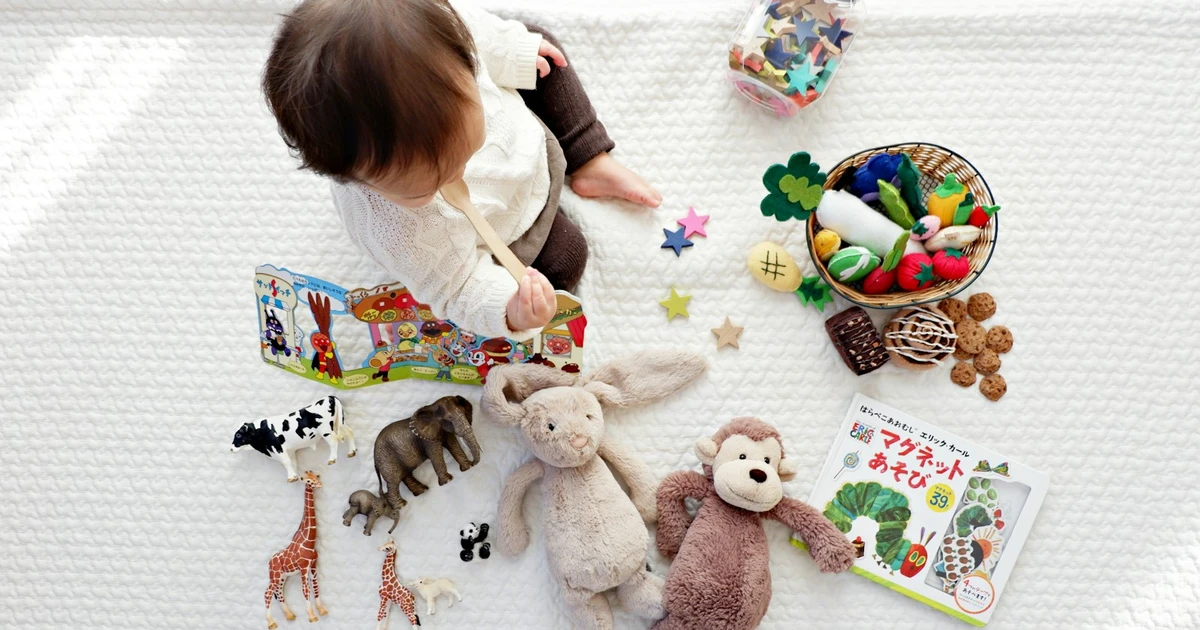
Enter a conventional nursery or daycare, and you will see plastic bins overflowing with blinking electronic toys, synthetic miniature play-kitchens with fake velcro plastic food, and adults performing virtually every physical task on behalf of the children: buttoning coats, wiping spills, pouring juice, and unzipping backpacks.
Now enter an authentic Montessori Children’s House (Casa dei Bambini)[1]. A three-year-old in a linen apron stands at a low wooden table, carrying a heavy ceramic pitcher filled with warm water. With quiet, solemn concentration, they pour water into a porcelain soap dish without spilling a single drop. Nearby, a four-year-old uses a real, small carbon-steel crinkle-cutter to slice cucumbers into delicate circles for morning snack. There is no background television, no plastic clutter, and no harried adult hovering to say “Let Mommy do that for you.”
This is the miracle of Montessori Practical Life. Far from being domestic chores or busywork, practical life exercises are the profound neurological foundation upon which all future literacy, mathematical reasoning, and executive functioning are constructed[2].
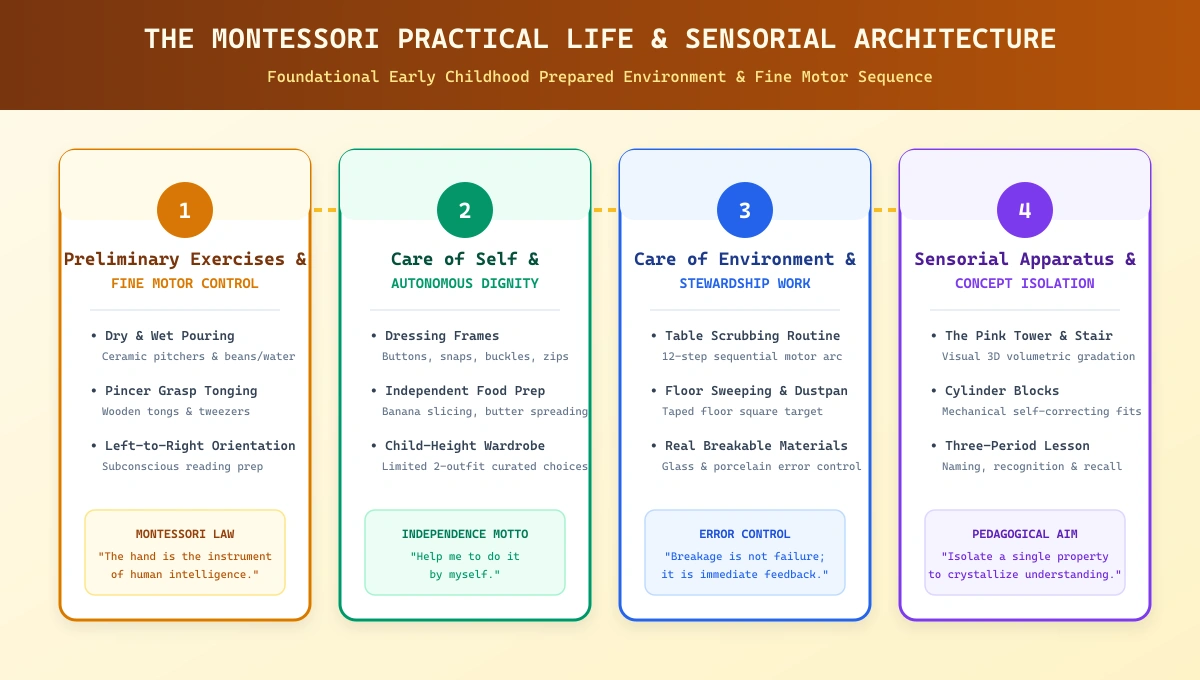
1. The Four Quadrants of Practical Life: Developing the Will
Dr. Maria Montessori famously asserted: “The child can only develop by means of the hand, which is the instrument of the human mind.”[1]
When a toddler repeats the act of transferring dry lentils with a three-pronged wooden spoon thirty times consecutively, they are not merely playing with food. They are building the neurological sheath of myelination around the motor circuits governing the pincer grasp (the thumb and first two fingers), building the exact muscular endurance and spatial hand-eye coordination required to hold a fountain pen without fatigue.
| Practical Life Quadrant | Representative Home Activities | Core Pedagogical & Developmental Benefit |
|---|---|---|
| 1. Preliminary Exercises | Carrying a work mat, rolling/unrolling rugs, spooning beans, dry and wet pouring, tonging wooden balls. | Motor coordination, crossing the midline, left-to-right tracking preparation for reading. |
| 2. Care of Self | Dressing frames (snaps, buttons, zippers, shoe-lacing), nose blowing, independent hand washing, coat flip trick. | Autonomous self-efficacy, body awareness, dignity, fine finger dexterity. |
| 3. Care of Environment | Table scrubbing, mirror polishing, brass polishing, plant watering, floor sweeping into a taped square. | Environmental empathy, sequential memory (following a 10-step protocol), gross motor balance. |
| 4. Grace and Courtesy | Greeting guests with eye contact, offering a glass of water, pushing in chairs silently, waiting without interrupting. | Social executive function, impulse inhibition, community harmony, pro-social awareness. |
2. The Prepared Environment at Home: Architecture of Independence
A Montessori home is not an expensive classroom filled with thousands of dollars of proprietary wooden apparatus. A Montessori home is simply an adult habitat that has been thoughtfully curated and scaled down so that a young child can function without constant adult intervention[3].
If a child must cry to an adult every time they want a glass of water, need an apple, or wish to put on their jacket, they remain in a chronic state of artificial dependency. When the physical environment is prepared, the child’s natural drive toward autonomy flourishes.
Key Architectural Scaffolds for a Montessori Home:
- Low, Heavy Wooden Shelving: Replace toy chests (which encourage dumping and overstimulation) with low, open, two-tier wooden shelves. Display no more than 6 to 8 curated work trays at any given time, each spaced generously apart.
- The “Kitchen Independence Station”: A small, child-height table or learning tower equipped with a small glass beverage dispenser with an easy spigot, two real 4-ounce glass cups, a sponge on a dish for wiping spills, and a small wooden cutting board with a dull butter knife.
- Child-Height Entryway Nook: Wall hooks mounted 30 inches from the floor, a low wooden stool, and a basket holding two pairs of seasonal shoes. The child can independently hang their jacket and put on their footwear.
- The Power of Real, Fragile Materials: Banish plastic cups and silicone plates. Handing a child a real, breakable glass cup conveys profound respect. If plastic drops, it bounces noisily without consequence, teaching nothing. If glass drops, it shatters—providing immediate, undeniable, natural Control of Error[1]. The child learns to carry objects with two deliberate hands.
3. The Sensorial Sequence: Materialized Abstractions
Following Practical Life, the Montessori child enters the Sensorial Curriculum. Dr. Montessori observed that young children are bombarded by a chaos of sensory inputs: colors, weights, temperatures, sounds, and dimensions.
The Sensorial materials act as a mental gymnasium that isolates one single sensory quality at a time, allowing the young brain to classify, order, and name reality[2].
| Sensorial Material | Physical Property Isolated | Mathematical & Scientific Foundation |
|---|---|---|
| The Pink Tower | Volume / 3D Size (10 pink wooden cubes graduating from $1\text{ cm}^3$ to $10\text{ cm}^3$). | Physical preparation for the decimal system and base-10 mathematics ($1^3$ to $10^3$). |
| The Brown Stair | Width / 2D Thickness (10 brown prisms of identical length with varying cross-sections). | Visual discrimination of thickness; tactile calibration of weight and balance. |
| The Cylinder Blocks | Complex 3-Way Dimensional Gradients (Height vs. Diameter in hardwood blocks). | The definitive pincer-grasp exercise; self-correcting mechanical control of error. |
| The Color Tablets (Boxes 1–3) | Pure Chromatic Hue & Value (Pairing primaries, secondaries, and 63 graded tints). | Visual discrimination of light wavelengths; artistic nuance and vocabulary. |
| Touch Boards & Rough/Smooth | Tactile Texture (Polished pine vs. fine and coarse sandpapers). | Sensitivity training for fingertips prior to tracing Sandpaper Letters. |
| The Sound Cylinders | Auditory Pitch & Volume (12 wooden cylinders filled with varying materials). | Auditory discrimination and acoustic classification foundational to phonemic awareness. |
4. The Three-Period Lesson: The Gold Standard of Instruction
How does a Montessori educator introduce new terminology (such as “thick and thin,” “rough and smooth,” or letter sounds) without quizzing, grading, or inducing performance anxiety? They utilize Edouard Séguin’s Three-Period Lesson[4]:
Period 1: Naming (Introduction)
The parent isolates two contrasting objects (e.g., the thickest Brown Stair prism and the thinnest prism). The parent gently strokes the thick prism and clearly states:
“This is thick.” (Pause). “Thick.” The parent then touches the thin prism: “This is thin.” (Pause). “Thin.”
Period 2: Recognition & Association (The Longest Phase)
The parent tests the child’s receptive understanding without requiring verbal production. This period should constitute 80% of the lesson through playful motor challenges:
“Can you place ‘thick’ on the green rug?” “Can you hide ‘thin’ behind your back?” “Can you tap ‘thick’ with two fingers?” If the child makes an error and hands the parent ‘thin’ when asked for ‘thick’, the parent never says “No, you’re wrong.” The parent simply recognizes that the child has not internalized the concept, gently returns to Period 1, and ends the session with grace.
Period 3: Recall (Verification)
Only when Period 2 is 100% effortless does the parent point to the thick prism and ask the diagnostic question:
“What is this?” The child beams with uncoerced confidence: “Thick!”
5. The Three-Hour Uninterrupted Work Cycle
One of the most profound pedagogical gifts of homeschooling is the ability to honor the Three-Hour Work Cycle. In institutional schools, a child’s concentration is constantly shattered by bells, schedule shifts, and group transitions every 45 minutes.
In a Montessori home, mornings are sacred:
- The Choice (9:00 AM): The child walks to their shelf, selects a work tray that calls to their inner developmental need, carries it with two hands to their designated floor mat, and unrolls it.
- Deep Flow Engagement (9:15 AM – 10:30 AM): The child repeats the exercise over and over. A state of calm, meditative absorption settles over the room.
- The False Fatigue (Around 10:30 AM): Montessori observed that children often experience a 10-minute wave of restlessness, wandering, and sighing around the 90-minute mark. Uninitiated adults panic and declare “school is over.” The skilled Montessori parent remains still. After this false fatigue passes, the child enters their deepest, most intellectual work of the day.
- The Restoration: Every work activity concludes with returning every piece to its original state, washing the tray, and returning it to the shelf for the next person.
Practical Implementation: Age-by-Age Progression
| Age Stage | Practical Life Priority | Sensorial Priority | Prepared Environment Milestone |
|---|---|---|---|
| Ages 18–24 Months | Sponge squeezing, sorting large wooden rings, pulling off socks, carrying a stool. | Grasping varied textures (silk, burlap, wood); matching identical pairs of shoes. | Low floor bed, child-height coat hook, single open shelf with 4 toys. |
| Ages 2.5–3.5 Years | Wet pouring with real water, peeling bananas, sweeping with a handheld brush and dustpan. | The Pink Tower, Cylinder Block 1, Color Box 1 (Red, Blue, Yellow), Rough & Smooth boards. | Access to running water via learning tower; designated snack preparation station. |
| Ages 4–5 Years | Flower arranging in glass bud vases, hand-washing clothing on a washboard, slicing carrots. | Brown Stair, Color Box 3 (grading 7 shades of 9 colors), Binomial Cube, Mystery Bag. | Independent wardrobe management; carrying rugs and setting the family dining table. |
| Ages 5–6 Years | Needlework, sewing buttons on fabric, baking bread from scratch, polished wood care. | Geometric Solids, Monomial and Trinomial Cubes, Thermic Tablets, Baric Tablets. | Full independence in personal hygiene, meal cleanup, and indoor plant care. |
By stepping back, quieting our adult impulse to take over, and respecting the sacred dignity of a child’s physical work, we ignite something far greater than mechanical obedience. We nurture a serene, joyful, deeply self-reliant human being who looks at the world not with anxious helplessness, but with the quiet, triumphant certainty: “I can do it myself.”
Disclaimer: This post is for informational and educational purposes only, accurate to the best of our knowledge at publication. It does not constitute advice. We do not guarantee accuracy or completeness and accept no liability for any decisions or losses resulting from reliance on this content.