
When a brilliant ten-year-old stares blankly at a single math worksheet for forty-five minutes, or a hyper-verbal fourteen-year-old collapses into an overwhelming emotional meltdown because their history textbook is missing, parents rarely encounter a problem of academic capability. What they are witnessing is an acute breakdown of executive functioning[1].
Executive functions represent the neurological management system of the human brain. Governed primarily by the prefrontal cortex, these cognitive capacities oversee task initiation, working memory, emotional regulation, cognitive flexibility, organization, and sustained attention. For children with Attention-Deficit/Hyperactivity Disorder (ADHD) and Autism Spectrum Conditions (ASC), the prefrontal cortex develops along an asynchronous trajectory, typically maturing at a 30% developmental delay relative to neurotypical chronological age[2]. A chronologically twelve-year-old homeschooler may possess university-level conceptual understanding in paleontology or computer science while commanding the working memory and frustration tolerance of an eight-year-old.
In traditional institutional classrooms, this developmental divergence frequently results in punitive behavioral management, punitive grading, and internalized shame. Within the home education environment, however, parents possess the unparalleled therapeutic flexibility to restructure the physical, sensory, and temporal landscape. Homeschooling offers the ultimate laboratory for clinical scaffolding: building an external neurological scaffold that holds the child’s academic life steady while their internal executive hardware continues to mature.
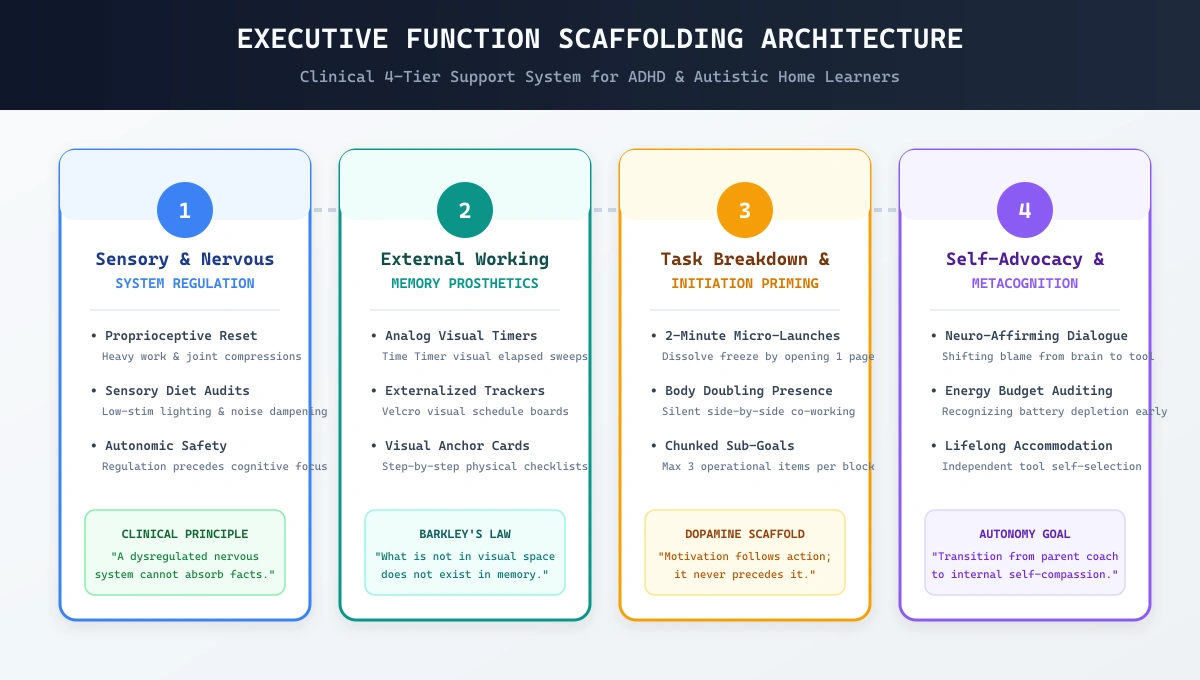
1. The Neurobiology of Executive Dysfunction: Why “Trying Harder” Fails
To coach a neurodivergent learner effectively, home educators must first abandon the moralized lens of institutional education. Terms like “lazy,” “scattered,” “unmotivated,” and “oppositional” represent profound clinical misunderstandings of atypical neurobiology.
Executive dysfunction in ADHD is fundamentally tied to dysregulated tonic and phasic dopamine transmission in the prefrontal-striatal pathways. Dopamine acts as the neurological currency of salience and task initiation. When an ADHD brain evaluates a low-stimulation, high-friction task (such as memorizing spelling lists or copying handwriting passages), the basal ganglia fails to release adequate dopamine to bridge intention into motor execution. The child is not choosing defiance; their neurological engine is literally experiencing an energetic stall.
In autistic learners, executive challenges frequently intertwine with monotropism (an attentional style that allocates intense cognitive resources to a single interest tunnel while resisting rapid task-switching) and intense sensory processing differences[3]. When an autistic student is abruptly demanded to close their robotics project and begin handwriting, the neurological cost of redirecting cognitive inertia is physically exhausting.
| Executive Skill Domain | Clinical Manifestation in Homeschooling | Conventional (Harmful) Interpretation | Neuro-Affirming Clinical Scaffolding |
|---|---|---|---|
| Task Initiation | Paralysis at the beginning of an open-ended essay or multi-step assignment. | “Stubborn refusal to get to work.” | Co-working body doubling and 2-minute physical micro-entry points. |
| Working Memory | Forgetting verbal directions halfway across the room; losing train of thought mid-sentence. | “Not listening” or “careless inattention.” | External visual prompts, step-by-step checklist cards, and voice recorders. |
| Emotional Regulation | Explosive tears or desk-slamming over a minor pencil smudge or calculation error. | “Overdramatic tantrums and emotional fragility.” | Sensory reset zones, co-regulation, and normalizing eraser rehabilitation. |
| Cognitive Flexibility | Intense distress when a daily schedule changes or when a curriculum introduces a novel format. | “Rigidity, stubbornness, and control issues.” | 15-minute advance transition warnings and visual daily roadmap updates. |
| Organization & Space | Chaotic desk surface, lost workbooks, chronic paper crumpling. | “Disrespectful of household supplies.” | Color-coded single-pocket binders and clear desktop organization bins. |
2. Dr. Russell Barkley’s Principle: Scaffolding at the Point of Performance
Renowned neuropsychologist Dr. Russell Barkley formulated what is arguably the foundational law of ADHD coaching: “Executive functions must be replaced at the exact point of performance in the natural environment.”[1]
Teaching executive skills in the abstract—such as lecturing a child about time management during Sunday dinner or buying a leather-bound student planner in August—invariably fails. A neurodivergent student knows what they should do; their disability lies in doing what they know at the exact moment and place of execution.
How to Build Physical Scaffolds at the Point of Performance:
-
Eliminate Mental Time Calculations (Analog Visual Sweeps): Children with executive dysfunction suffer from profound time blindness. They experience only two temporal states: “Now” and “Not Now.” Digital clocks are virtually useless for executive coaching because numbers like “10:42 AM” require abstract arithmetic calculation. Replace digital clocks with mechanical visual timers (such as a 60-minute Time Timer) where a brightly colored disk physically contracts as minutes elapse. The child can glance up and perceive time as a physical quantity shrinking in physical space.
-
Offload Working Memory into the Visual Field: If a task is not in the child’s line of sight, it does not exist in their active cognitive working space. Do not store essential homeschool materials behind closed opaque closet doors or buried inside zippered backpacks. Utilize open horizontal desktop organizers with clear front faces. Hang laminated visual checklist strips directly above the study space at eye level.
-
Externalize Complex Multi-Step Algorithms: When teaching long division or literary analysis, do not expect the child’s working memory to hold both the factual content and the procedural steps simultaneously. Create permanent 4x6 laminated “cheat sheets” displaying the visual roadmap of the algorithm. Freeing the prefrontal cortex from having to remember “What step comes next?” preserves precious dopamine for actual conceptual calculation.
3. Dissolving Task Initiation Paralysis: The Micro-Entry Protocol
For ADHD and autistic learners, the distance between sitting down at a desk and making the first pencil mark on paper can feel like an impassable canyon. This state—frequently termed ADHD paralysis or autistic freeze—is triggered when the prefrontal cortex perceives the task as an unstructured, overwhelming monolith.
To dissolve this friction, implement the Micro-Entry Scaffolding Protocol:
Step 1: The Two-Minute Contract
Never instruct an executive-compromised student to “do your history lesson.” The sheer magnitude of reading three chapters and answering discussion questions triggers immediate fight-or-flight panic. Instead, contract exclusively for the physical micro-step: “Open the book to page 42 and place your blue highlighter on the desk. You do not have to read yet.” By lowering the neurological threshold to a trivial physical gesture, the brain bypasses threat detection.
Step 2: Physical Body Doubling
Body doubling is an empirically validated clinical intervention wherein another individual remains physically present in the shared workspace, engaging in quiet, focused activity alongside the learner. The presence of a calm, regulated parent reading an article or balancing household accounts provides a powerful autonomic mirror. It anchors the neurodivergent child’s wandering nervous system without requiring nagging or continuous verbal instruction.
Step 3: Low-Dopamine Transition Rituals
Transitioning from high-dopamine activities (video games, digital media, high-action play) directly into formal academics is biologically impossible for an ADHD child without triggering immense distress. Establish a low-dopamine bridge: a 10-minute transitional sequence involving kinetic movement, a warm beverage, putting on background instrumental music (lo-fi or 60 BPM baroque), and doing three physical wall push-ups.
4. Sensory Regulation Architecture: Sensory Needs Precede Cognitive Focus
One of the most catastrophic mistakes in classical homeschooling is demanding quiet, seated desk compliance from a child whose vestibular and proprioceptive systems are starving for stimulation. When a sensory-seeking child is forced into static stillness, their entire cognitive bandwidth is consumed merely trying to inhibit their motor impulses. Zero bandwidth remains for reading comprehension.
In contrast, sensory-defensive autistic learners may experience severe cognitive shutdowns triggered by fluorescent light hums, buzzing refrigerator compressors, or scratchy clothing tags.
| Sensory Accommodation Dimension | For Sensory-Seeking Learners (Needs Movement to Engage Brain) | For Sensory-Defensive Learners (Needs Protection from Overload) |
|---|---|---|
| Seating & Posture | Balance ball chairs, wobble stools, or yoga mats on the floor. | Ergonomic, high-back supportive chair with footstool. |
| Kinetic Input | Under-desk pedal exercisers or elastic resistance foot bands. | Silent weighted lap pad or pressure vest during seatwork. |
| Environmental Lighting | Bright, natural daylight or full-spectrum task illumination. | Warm 2700K indirect ambient lamps; zero fluorescent flickering. |
| Auditory Climate | Rhythmic background instrumental music (lo-fi, 60 BPM baroque). | Active noise-canceling headphones or continuous white-noise fan. |
| Gross Motor Breaks | Heavy-work chores: carrying books, mini-trampoline jumping. | Quiet decompression corner, dark tent, or breathing exercises. |
| Oral & Tactile Tools | Textured silicone chewelry, sensory fidget spinners, thinking putty. | Smooth, distraction-free writing instruments; tagless clothing. |
5. Working Memory Prosthetics: Organizing the Learning Ecosystem
Working memory is the mental whiteboard of the mind. In neurotypical learners, this whiteboard holds four to seven items simultaneously. In ADHD and autistic learners, that whiteboard is frequently miniature, smudged, or abruptly wiped clean by the slightest external distraction.
To prevent cognitive overwhelm, home educators must supply permanent physical prosthetics:
-
The Single-Pocket Color-Coded System: Never purchase multi-subject notebooks or accordion files with confusing interior tabs. Neurodivergent students inevitably jam loose papers into the first opening they find. Assign one vibrant color to each core subject (e.g., Red for Mathematics, Blue for Language Arts, Green for Science). Each subject receives a heavy-duty, single-pocket plastic folder. There is only one place for math paper to enter and exit.
-
The “Done” Box (Tactile Dopamine Receipt): A neurotypical child might feel a quiet sense of satisfaction upon completing an assignment. An ADHD child requires tangible, sensory evidence of accomplishment. Place a large wooden or wire basket labeled COMPLETED WORK on the table. Instruct the child to physically drop each finished folder into the bin. The auditory thump and visual pile provide an immediate dopamine receipt that reinforces academic momentum.
-
Externalized Master Visual Timetables: Replace ambiguous verbal schedules (“We will do history after lunch”) with a magnetic or velcro-backed visual schedule board. Each study block is represented by a movable physical card. As tasks finish, the child physically flips the card over or moves it into the “Done” column. This removes the existential anxiety of wondering when their school day will finally conclude.
6. Developing Lifelong Self-Advocacy & Metacognitive Awareness
The ultimate goal of homeschooling an ADHD or autistic child is not to construct a permanent greenhouse that protects them from every life friction. The true mission is to help the child understand their unique neurological architecture with clarity, humor, and self-compassion, equipping them to engineer their own scaffolds into adulthood[4].
When an assignment collapses into tears, teach your child to engage in non-judgmental diagnostic debriefing. Shift the dialogue away from personal blame and toward system engineering:
- “Let’s examine why that math session was so painful. Was the room too loud? Did the timer make you feel anxious? Were the problems too close together on the printed page? Or did your brain run out of blood sugar?”
- “The problem isn’t you. Your brain is brilliant. The problem is our tool. What kind of bridge do we need to build right now?”
When a student learns that their executive challenges are solvable mechanical puzzles rather than permanent character defects, their entire self-concept transforms. They stop viewing themselves as broken students and start recognizing themselves as innovative systems engineers who know exactly how to tailor their environment for peak intellectual flourishing.
Practical Implementation: The First 30 Days
| Week | Focus Area | Actionable Coaching Protocol |
|---|---|---|
| Week 1 | Sensory & Space Audit | Clear the physical desk completely. Install warm ambient lighting, test wobble seating or foot bands, and eliminate clutter from the child’s direct sightline. |
| Week 2 | Point-of-Performance Scaffolding | Introduce the mechanical visual timer. Create laminated cheat sheets for recurring multi-step tasks. Install the color-coded single-folder system. |
| Week 3 | Micro-Initiation & Body Doubling | Institute the 2-minute micro-entry rule for all written assignments. Practice parent body doubling during the first 10 minutes of independent study. |
| Week 4 | Metacognitive Co-Regulation | Conduct weekly collaborative check-ins. Ask the student: “Which tools helped you feel calm this week? Which tools got in your way?” Adjust scaffolds collaboratively. |
By honoring the biological reality of executive development and wrapping your child in compassionate, structured external scaffolds, you cultivate more than just academic competence. You bestow upon them the unshakeable confidence that their neurodivergent mind is capable of extraordinary scholarship, joyful problem-solving, and profound lifelong contributions to the world.
Disclaimer: This post is for informational and educational purposes only, accurate to the best of our knowledge at publication. It does not constitute advice. We do not guarantee accuracy or completeness and accept no liability for any decisions or losses resulting from reliance on this content.