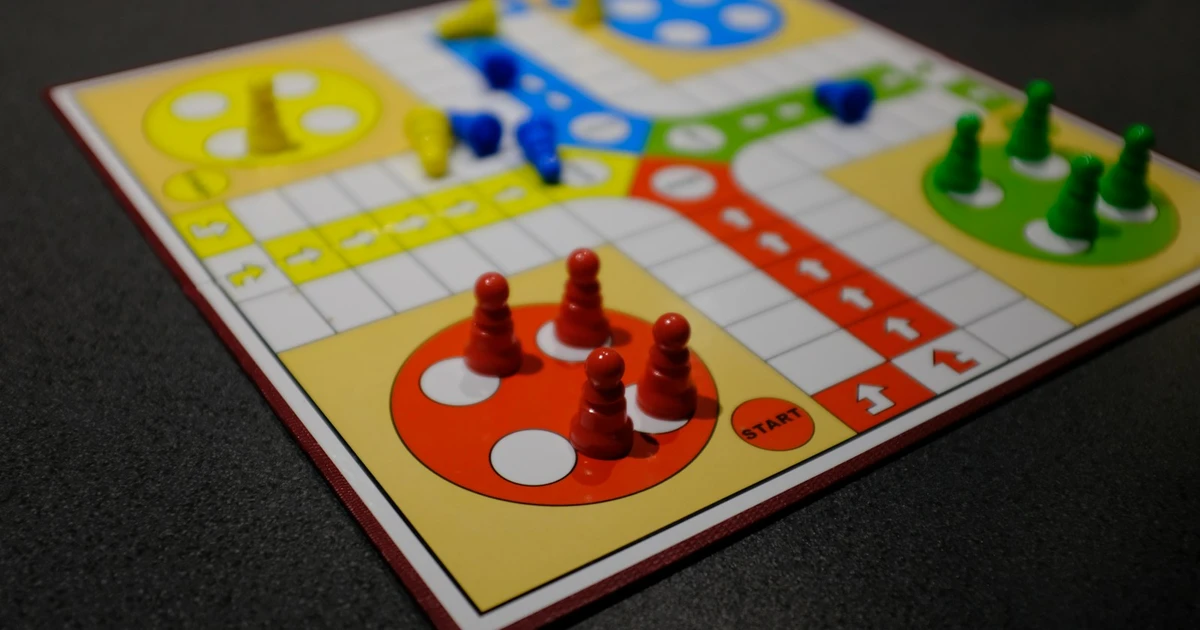
Mention the word “homeschooling,” and the uninitiated imagine rows of open workbooks, flashcards, and silent memorization. Mention the word “board games,” and they picture Monopoly—a roll-and-move endurance test governed almost entirely by luck and family frustration.
Both perceptions are radically obsolete.
Over the past decade, a quiet cognitive revolution known as Gameschooling has transformed home education[1]. Driven by the explosive golden age of modern tabletop game design, home educators have discovered that modern board games are not recreational distractions from learning; they are interactive simulation engines. When a child plays Cytosis, they are not memorizing that the Golgi apparatus packages proteins—they are physically placing worker flasks into the endoplasmic reticulum, expending ATP tokens to assemble amino acid chains, and competing for lipid resources[2].
When a student manages the geopolitical tension of Twilight Struggle, the Cold War ceases to be a list of dates to regurgitate on a Friday test. It becomes a nail-biting calculation of proxy containment, nuclear brinkmanship under the DEFCON track, and the precarious balance between domestic prestige and global non-proliferation.
1. The Cognitive Science of Gameschooling: Situated Learning
In his seminal educational work What Video Games Have to Teach Us About Learning and Literacy, cognitive scientist Dr. James Paul Gee demonstrated that human minds are poorly wired to absorb words divorced from context[1]. Reading a paragraph about “natural selection and ecological niche differentiation” yields fragile, temporary rote memory.
In contrast, playing Wingspan or Evolution places the student inside a situated learning environment. The child directly experiences that evolving a hard defensive shell preserves their species from a predator’s carnivore trait, while increasing body size requires higher food consumption per turn. The rulebook provides the physical laws of a closed ecosystem, and the child’s brain forms robust mental models through immediate, self-generated feedback loops[3].
| Traditional Textbook Instruction | Tabletop Gameschooling Engine | Neurological & Pedagogical Advantage |
|---|---|---|
| Passive Consumption (Reading chapters & underlining dates) | Active Agency (Executing moves, testing hypotheses) | Prefrontal cortex engagement; dopamine reinforcement upon strategy execution. |
| Single Correct Answer (Standardized multiple-choice questions) | Multi-Variate Problem Solving (Multiple viable paths to victory) | Cultivates tactical flexibility, lateral thinking, and heuristic analysis. |
| Punitively Graded Errors (Red pen marks and grade penalties) | Low-Stakes Iteration (Analyzing loss to optimize next play) | Destigmatizes failure; fosters growth mindset and post-game diagnostic debriefing. |
| Isolated Subject Silos (Math at 9:00 AM, History at 10:00 AM) | Cross-Disciplinary Synthesis (Math + History + Social Dynamics) | Replicates real-world cognitive complexity where economics and ethics intertwine. |
2. STEM Tabletop Curricular Matrix: From Arithmetic to Quantum Mechanics
The modern tabletop landscape includes scientifically verified games authored in collaboration with university professors, biochemists, and NASA aerospace engineers[4].
A. Foundational Mathematics & Probability
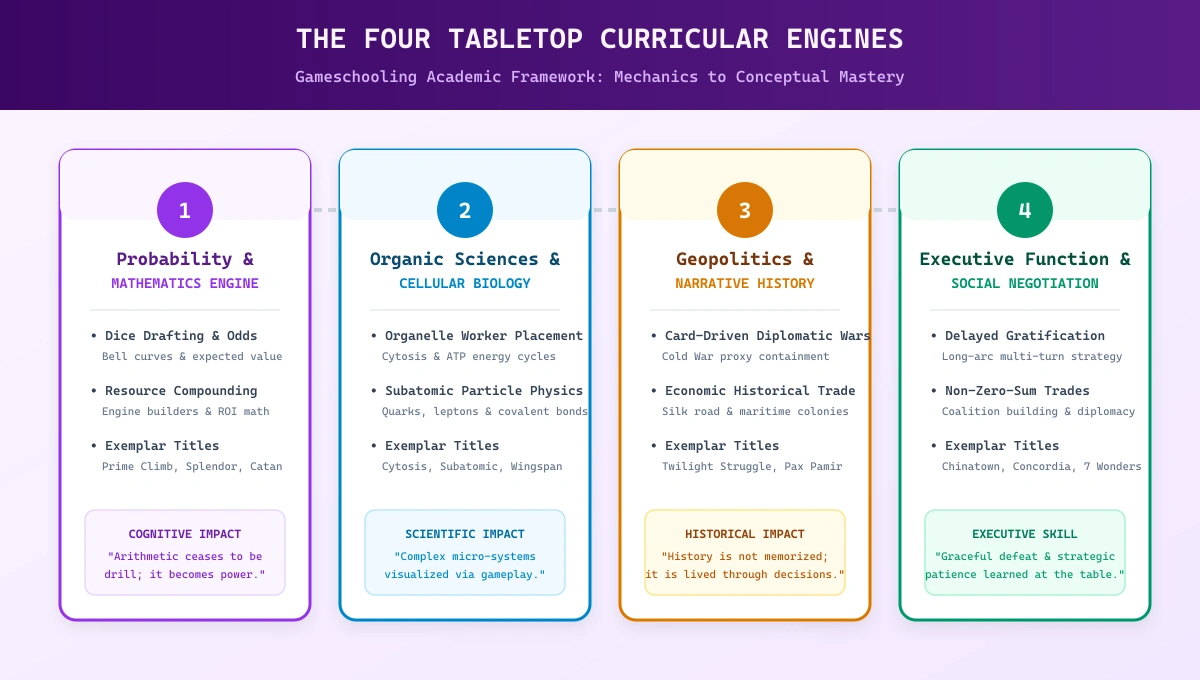
- Prime Climb (Ages 9+): Created by mathematicians Dan Finkel and Katherine Cook, this game completely eliminates math anxiety. Players navigate a 101-number spiral using custom color-coded prime factorization wheels. Multiplication becomes the visual mixing of color segments (e.g., green 3 $\times$ yellow 5 = orange 15), allowing children to intuitively master division and prime numbers without traditional memorization drills.
- Can’t Stop (Ages 7+): The definitive masterclass in probability and expected value. Players roll four six-sided dice, pairing them to advance markers up columns 2 through 12. Children viscerally learn the bell curve distribution of 2d6: why column 7 advances with 16.6% frequency while 2 and 12 advance with only 2.7%.
- Splendor & Catan (Ages 10+): Advanced lessons in compounding interest, liquidity constraints, return on investment (ROI), and resource scarcity.
B. Cellular Biology, Chemistry & Physics
- Cytosis: A Cell Biology Game (Genius Games): A peer-reviewed worker placement game set inside a human pancreatic cell. Players utilize mRNA to build protein enzymes, transport vesicles, and detoxify metabolic waste.
- Subatomic: An Atom Building Game: A deck-building game where players start with up quarks, down quarks, and photons to synthesize protons, neutrons, and electrons, ultimately assembling elements on the periodic table.
- Terraforming Mars (High School STEM): A masterwork in planetary engineering, atmospheric chemistry, thermodynamics, and ecosystem management. Players balance global temperature, oxygen levels, and ocean coverage while managing corporate budgets and resource engines.
3. History & Geopolitics: Walking in the Shoes of Leaders
History curricula frequently reduce millennia of human triumphs and catastrophes to dry recitations of treaties and casualty statistics. Tabletop games breathe narrative life into historical periods by forcing students to confront the actual constraints faced by historical actors.
A. The Card-Driven Historical Engine
In card-driven wargames (CDGs), cards serve a dual function: they can either be spent as raw operational points (moving troops, funding infrastructure) or triggered for their historical event (the Marshall Plan, the Cuban Missile Crisis, the Suez Canal nationalization).
When a teenager holds the Chernobyl card in Twilight Struggle, they face an authentic historical dilemma: Do I bury this embarrassing disaster and suffer diplomatic blowback, or do I burn precious resources to contain the meltdown? History is no longer a foregone conclusion; it is a precarious tightrope of geopolitical decisions.
Curricular Tabletop Match for Historical Eras
| Historical Epoch | Tabletop Integration Titles | Core Conceptual Understandings |
|---|---|---|
| Ancient Civilizations | 7 Wonders, Tigris & Euphrates, Concordia | Irrigation agriculture, Roman trade networks, civic specialization vs. military expansion. |
| Medieval & Renaissance | Castles of Burgundy, Orléans, Carcassonne | Feudal vassalage, monastery scholarship, medieval craft guilds, river trade logistics. |
| Age of Exploration & Colonization | Endeavor: Age of Sail, Lewis & Clark, Puerto Rico | Triangular trade, navigation physics, indigenous diplomacy, ethical critiques of empire. |
| The American Revolution & Civil War | 1775: Rebellion, Freedom: The Underground Railroad | Asymmetric militia warfare vs. regular armies, abolitionist logistics, fugitive rescue networks. |
| 20th Century & Modern Era | Twilight Struggle, 1960: Making of the President, Pandemic | Cold War containment, electoral college demographics, epidemiological containment vectors. |
4. Translating Tabletop Hours into Formal High School Credits
One of the most persistent concerns among homeschooling parents is: “How do I justify playing board games on an official high school transcript?”
Under state homeschool statutes across the United States, high school courses are assessed based on Carnegie Units (120 to 180 hours of instruction for one full academic credit). To convert gameschooling into an accredited, audit-proof high school credit, utilize the Four-Step Academic Conversion Protocol:
| Protocol Step | Practical Homeschool Action | High School Transcript Evidence |
|---|---|---|
| 1. Log Direct Hours | Maintain a detailed tabletop activity log tracking setup, rule analysis, gameplay, and strategic debriefing. | Time-stamped attendance and Carnegie unit accounting (120–180 hours = 1.0 credit). |
| 2. Pair with Non-Fiction Texts | Anchor every game title with college-prep literature (e.g., pair Twilight Struggle with Gaddis’s The Cold War; pair Cytosis with Campbell’s Biology). | Primary source bibliographies and assigned contextual reading lists. |
| 3. Assign Synthesis Debriefs | Require written or verbal post-game analysis comparing game mechanics to historical realities or scientific data. | Student essays, probability lab reports, and strategic reflection portfolios. |
| 4. Professional Course Titles | Formulate rigorous academic course nomenclature reflecting the subject matter. | e.g., “Game Theory & Probability Modeling” (0.5 Math) or “Modern Geopolitical Simulation” (1.0 Social Studies). |
5. Overcoming Gameschooling Roadblocks: Sore Losers & Alpha Players
Gameschooling inevitably brings emotional friction to the family table. Far from being a failure, these moments represent the greatest executive functioning and social-emotional learning opportunities your homeschool will ever encounter.
De-escalating Sore Losers:
- Introduce Cooperative Games First: If a child collapses in tears when defeated, shift exclusively to cooperative titles (Pandemic, Forbidden Island, Ghost Stories, Spirit Island). In cooperative games, the family plays together as a unified team against the game engine. Winning and losing are shared collective experiences, allowing the child to build emotional stamina without personal shame.
- Normalize the “Post-Mortem” Habit: As soon as a game ends, ban immediate victory gloating. Instead, ask the Master De-Briefing Question: “What was the single most pivotal turn of that game, and what alternate decision might have changed the outcome?” This shifts the child’s perspective from emotional ego into objective strategic analysis.
Taming the “Alpha Player” (Quarterbacking):
In cooperative games, older or more aggressive students often attempt to dictate every other player’s turn. Eliminate quarterbacking with the Restricted Communication Rule: Each player’s hand is kept secret, or players may only speak during their own active turn. This forces the dominant player to practice patience and empowers younger siblings to exercise their own strategic agency.
Practical Implementation: The 4-Week Gameschool Launch Plan
| Phase | Weekly Objective | Recommended Game Title | Actionable Family Milestone |
|---|---|---|---|
| Week 1: Foundations | Mathematics & Probability Mechanics | Prime Climb or Can’t Stop | Complete three 30-minute sessions; log probability tally charts. |
| Week 2: Living Science | Cellular Biology or Ecological Systems | Cytosis or Wingspan | Play two full games; diagram organelle functions or bird habitats in science notebook. |
| Week 3: Deep History | Narrative Geopolitics & Tactical War | 1775: Rebellion or Concordia | Play full campaign; write a 1-page essay on logistical supply lines. |
| Week 4: Game Design | Rule-Modding & Mechanical Invention | Student’s choice of base game | Challenge your child to write one new custom expansion rule and test-play it. |
By clearing the dining room table, rolling the dice, and engaging your children in the rich, elegant systems of modern tabletop games, you transform learning from a compulsory chore into an electrifying intellectual adventure. You teach them that intellect is an active, joyful muscle—and that the world’s most intricate problems are simply puzzles waiting to be solved.
Disclaimer: This post is for informational and educational purposes only, accurate to the best of our knowledge at publication. It does not constitute advice. We do not guarantee accuracy or completeness and accept no liability for any decisions or losses resulting from reliance on this content.