

Home education in the Ocean State operates under a cooperative local approval framework codified in Rhode Island General Laws (R.I. Gen. Laws § 16-19-1)[1]. Rhode Island law balances parental educational direction with local school committee oversight, ensuring homeschooled students receive instruction of substantially equal thoroughness and efficiency as resident public schools.
Compulsory school attendance in Rhode Island applies to all children between the ages of six (6) and eighteen (18) under R.I. Gen. Laws § 16-19-1.
Rhode Island Homeschool Legal Pathways: Statutory Overview
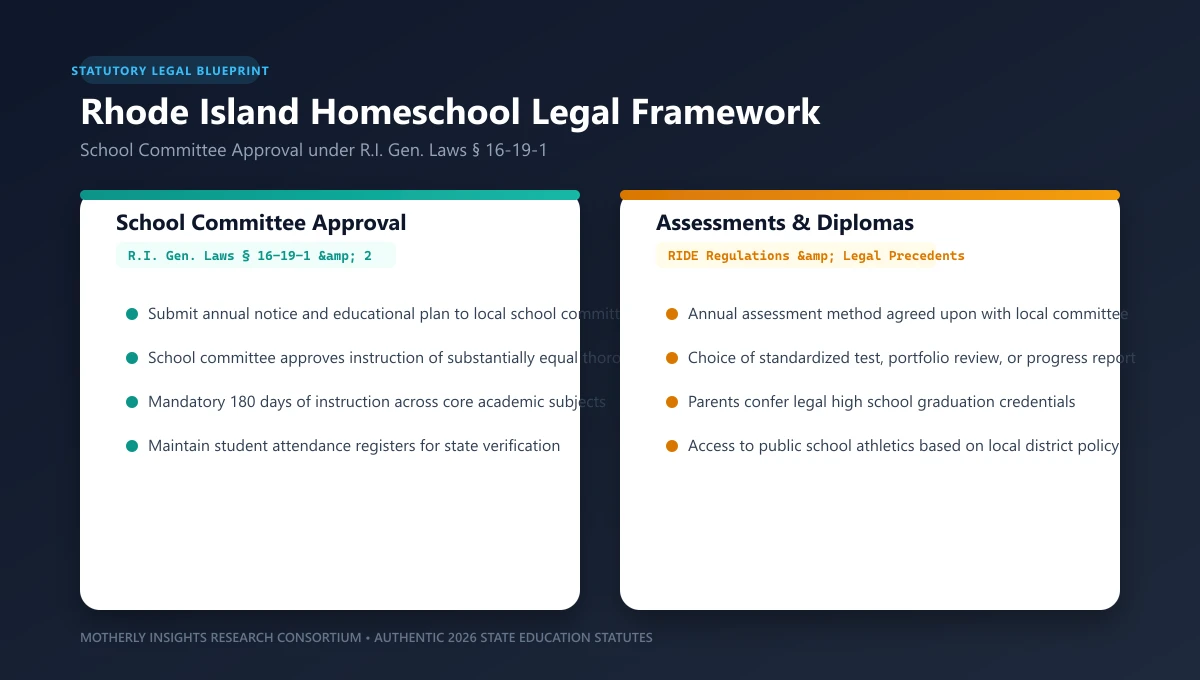
1. Submitting Your Educational Plan to the School Committee
Under R.I. Gen. Laws § 16-19-2, home instruction must be approved by the school committee of the town or city in which the student resides[2]:
- Annual Notice: Parents submit a letter of intent and proposed educational outline prior to the beginning of the school year.
- Legal Approval Standard: The school committee’s approval is governed by state supreme court precedents (City of Pawtucket v. Sundlun), establishing that committees cannot impose arbitrary barriers or demand unapproved testing. Approval must be granted if the proposed plan demonstrates thoroughness comparable to public schools.
- Attendance Registry: Statute requires home educators to keep a register of student attendance verifying completion of the required 180 days of instruction.
2. Mandatory Core Subjects and Instructional Days
Rhode Island statute requires home instruction programs to provide at least 180 days of instruction across mandatory subject areas:
- Required Subjects: Reading, writing, spelling, grammar, mathematics, United States history, Rhode Island history, civics and government, science, health, and physical education.
- Curricular Autonomy: Parents are free to select living books, classical unit studies, or digital curricula matching their educational philosophy.
3. Annual Progress Assessment and Portfolio Reviews
To demonstrate ongoing student progress under RIDE guidelines, families typically provide an end-of-year assessment agreed upon with their local school committee[3]:
- Portfolio Review: A compilation of student work samples, book reading lists, and written essays reviewed by the parent or an independent educator.
- Standardized Testing: Administering a nationally recognized achievement test (such as the TerraNova, Stanford 10, or Iowa Assessments).
- Teacher Narrative Evaluation: A written summary of academic growth provided by a certified Rhode Island educator.
4. High School Diplomas, Transcripts, and College Admissions
In Rhode Island, home educators have full legal authority over secondary graduation credentials:
- Parent-Issued Transcripts: Parents define high school graduation credits, calculate GPA, and confer official diplomas.
- Collegiate Recognition: Brown University, Rhode Island College (RIC), the University of Rhode Island (URI), and Providence College accept homeschool applicants based on parental transcripts and standardized test scores.
5. Interscholastic Sports and Public School Participation
Under Rhode Island Department of Elementary and Secondary Education (RIDE) policy, access to public school extracurriculars is determined locally:
- Extracurricular Programs: Many Rhode Island school districts permit homeschooled students to join marching bands, theater programs, and academic clubs.
- Interscholastic Athletics: Participation in Rhode Island Interscholastic League (RIIL) varsity sports depends on local district school committee policies and athletic director discretion.
6. Neurodivergent Learners in Rhode Island
Rhode Island home instruction allows parents of children with learning differences (dyslexia, autism, ADHD, and sensory processing differences) to tailor learning environments:
- Pacing Flexibility: Tailor daily instruction to match focus and energy levels without high-stakes public classroom stress.
- IDEA Child Find Access: Parents can request diagnostic screenings through their local school district for speech therapy and learning assessments.
7. High School Credit Matrix for Rhode Island Homeschoolers
The recommended college-preparatory credit distribution for Rhode Island homeschoolers includes:
| Academic Area | Recommended High School Credits | Course Examples and Rigor Benchmarks |
|---|---|---|
| English Language Arts | 4 Credits | American Literature, British Literature, Rhetoric, Composition & Research |
| Mathematics | 4 Credits | Algebra I, Geometry, Algebra II, Pre-Calculus, Financial Math |
| Science | 3 - 4 Credits | Biology with Lab, Chemistry with Lab, Marine Science, Physics |
| Social Studies | 3 - 4 Credits | US History, Rhode Island History & Civics, World History, Economics |
| World Languages | 2 - 3 Credits | Italian, Portuguese, Spanish, French, or Latin |
| Physical Education & Health | 2 Credits | Sailing, Personal Fitness, Nutrition, First Aid |
| Electives & Arts | 4 - 5 Credits | Visual Arts, Music Theory, Computer Science, Engineering |
8. Frequently Asked Rhode Island Homeschool Questions
Can a Rhode Island school committee reject my homeschool plan?
A school committee can only withhold approval if the educational plan fails to cover the basic required subjects or lacks substantially equal thoroughness. Arbitrary rejections can be appealed to the Rhode Island Commissioner of Education.
Does Rhode Island require parents to have a college degree?
No. Rhode Island General Laws do not require parents to hold a college degree or teaching certification to homeschool their children.
9. Dual Enrollment at Community College of Rhode Island (CCRI)
Rhode Island high school homeschoolers have outstanding access to higher education through the Community College of Rhode Island (CCRI) High School Dual Enrollment Initiative:
- College Credit While Homeschooling: High school juniors and seniors who demonstrate academic readiness can enroll in college credit courses that fulfill both high school diploma requirements and collegiate associate degree requirements.
- Transfer Pathways to URI and RIC: Credits earned at CCRI transfer seamlessly to the University of Rhode Island (URI) and Rhode Island College (RIC) under state articulation compacts, drastically reducing the cost and duration of a 4-year bachelor degree.
10. Step-by-Step Rhode Island Public School Withdrawal Guide
When transitioning your child from a Rhode Island public school into home education mid-year:
- Draft Written Notice to Superintendent: Prepare a respectful letter of intent addressed to your local town or city school committee and superintendent citing R.I. Gen. Laws § 16-19-1.
- Outline Your Course of Study: Provide a general description of the curriculum, subjects, and instructional materials you plan to use for the remainder of the school year.
- Request Official Cumulative Records: Request certified copies of report cards, diagnostic assessments, standardized test results, and immunization documentation from the school clerk.
- Maintain 180-Day Attendance Log: Immediately establish an attendance calendar documenting 180 days of instruction to ensure full statutory compliance.
💡 Related Educational Pathways: To compare related legal frameworks and recommended study programs, explore our detailed reviews on California homeschool legal guidelines, Ohio homeschool notification regulations, Pennsylvania Act 169 requirements.