
Home-based instruction in the Peace Garden State operates under a structured, predictable legal framework codified in North Dakota Century Code (N.D. Cent. Code § 15.1-23)[1]. North Dakota law recognizes parental rights to direct their children’s education while maintaining clear procedural benchmarks for notification, instructional time, and periodic assessment.
Compulsory attendance in North Dakota applies to all children between the ages of seven (7) and sixteen (16) under N.D. Cent. Code § 15.1-20-01.
North Dakota Homeschool Legal Pathways: Statutory Overview
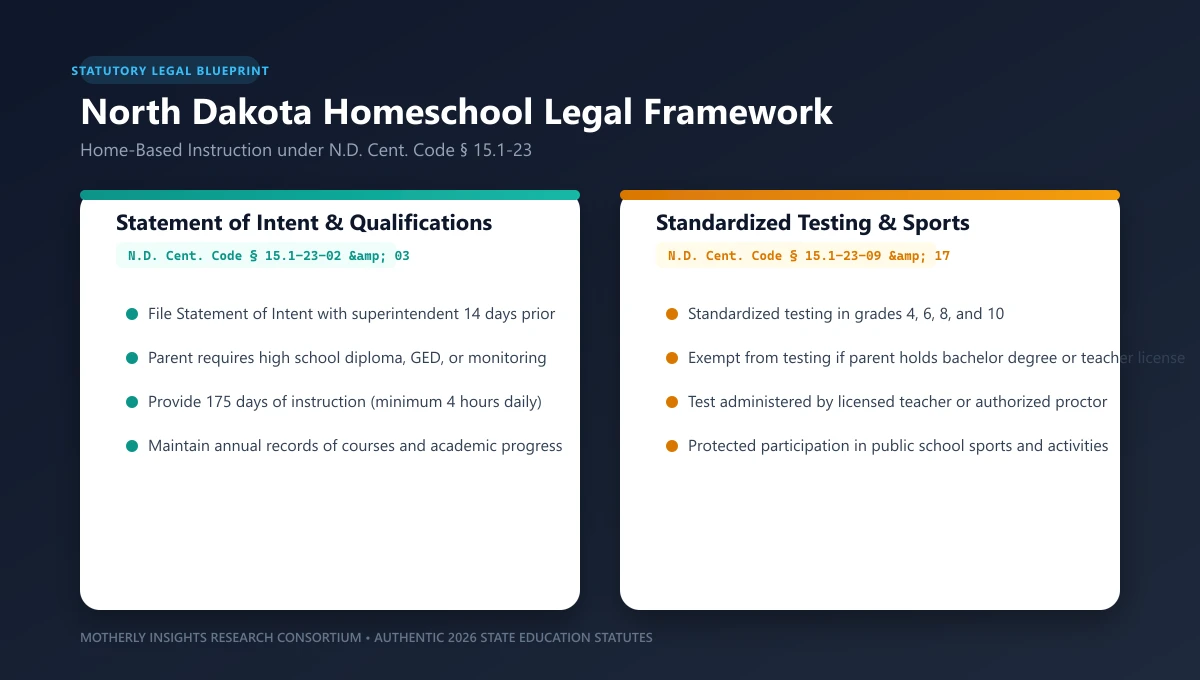
1. Annual Statement of Intent Filing Protocols
Under N.D. Cent. Code § 15.1-23-02, parents must submit a formal Statement of Intent to their local public school district superintendent[2]:
- Filing Deadline: The form must be submitted at least 14 calendar days prior to commencing home instruction, or by August 30 of each academic year.
- Required Information: Includes student name, age, grade level, curriculum materials to be used, parent qualifications, and proof of immunization or religious/philosophical exemption.
- Superintendent Role: The superintendent verifies that the statutory filing criteria are met and maintains the official notification on record.
2. Parent Qualifications and Teacher Monitoring Rules
North Dakota Century Code sets specific parental qualification standards under § 15.1-23-03:
- Standard Qualification: A parent is fully qualified to homeschool if they hold a high school diploma or a general educational development (GED) credential.
- Teacher Monitoring Exemption: If a parent does not possess a high school diploma or GED, they may still homeschool provided their instruction is monitored by a certified North Dakota teacher for the first two years.
3. Instructional Days, Hours, and Mandatory Subjects
Home educators must provide at least 175 days of instruction per school year, averaging at least four (4) hours per instructional day under N.D. Cent. Code § 15.1-23-04 across required subjects:
- Elementary Grades (1-8): English language arts (reading, composition, grammar, spelling), mathematics, social studies (United States history, North Dakota history, civics), science, physical education, and health.
- Secondary Grades (9-12): English language arts (4 units), mathematics (3 units), science (3 units), social studies (3 units including US history and government), physical education, and electives.
4. Standardized Testing and Degree Exemption Rules
Under N.D. Cent. Code § 15.1-23-09, periodic standardized assessment is conducted to evaluate student progress[3]:
- Testing Grades: Standardized achievement tests (such as the Iowa Assessments, Stanford 10, or TerraNova) must be administered to students in grades 4, 6, 8, and 10.
- Proctoring: The test must be administered by a certified teacher, in a public school setting, or by an approved proctor.
- The Bachelor’s Degree Exemption: Under § 15.1-23-09(2), if a parent holds a bachelor’s degree from an accredited college or university (in any subject), or holds a valid teaching license, the family is completely exempt from all standardized testing mandates!
5. Interscholastic Sports and Extracurricular Access
Under N.D. Cent. Code § 15.1-23-17, homeschooled students enjoy protected statutory access to public school sports and activities[4]:
- Athletic Eligibility: Homeschoolers can compete on sports teams governed by the North Dakota High School Activities Association (NDHSAA) at their resident public school.
- Extracurricular Programs: Eligible to join school bands, choir, theater productions, and STEM clubs.
- Dual Credit Opportunities: High school students can access dual-credit college courses through North Dakota University System institutions.
6. High School Diplomas and Official Transcripts
North Dakota home educators maintain sovereign authority over graduation credentials:
- Parent-Issued Credentials: Parents establish graduation requirements, issue official transcripts, and confer legal high school diplomas.
- College Acceptance: North Dakota State University (NDSU), the University of North Dakota (UND), and colleges nationwide recognize and admit homeschool graduates based on parental transcripts and ACT/SAT scores.
7. Teaching Neurodivergent Learners in North Dakota
North Dakota home-based instruction allows parents of children with ADHD, dyslexia, executive dysfunction, or sensory needs to create tailored learning environments:
- Targeted Interventions: Parents can select structured multi-sensory reading curricula, un-timed math programs, and adaptive technologies tailored to their child’s specific neurological profile.
- Teacher Monitoring as Support: For parents navigating early learning difficulties, partnering with a certified teacher under the monitoring pathway can provide valuable diagnostic insights, curriculum recommendations, and encouragement.
- Special Education Child Find: North Dakota school districts remain obligated under federal law to conduct comprehensive evaluations for homeschooled students suspected of having learning disabilities.
8. North Dakota High School Credit Matrix and College Admissions
North Dakota parents determine high school graduation standards and confer official diplomas. The North Dakota Department of Public Instruction and state universities recommend the following secondary course breakdown:
| Subject Area | Required High School Units | Course Sequences and Academic Requirements |
|---|---|---|
| English Language Arts | 4 Units | English I, English II, American Literature, Advanced Writing & Rhetoric |
| Mathematics | 3 Units | Algebra I, Geometry, Algebra II, or Integrated Secondary Mathematics |
| Science | 3 Units | Physical Science, Biology with Lab, Chemistry or Environmental Science |
| Social Studies | 3 Units | United States History, North Dakota History, Civics & Government, Economics |
| Physical Education & Health | 1 Unit | Physical Fitness (0.5 unit) and Health Education (0.5 unit) |
| Foreign Language / Career Tech | 2 Units | Spanish, German, French, Agriculture, or Computer Programming |
| Electives | 9 Units | Fine Arts, Music Theory, Business Math, Advanced STEM Electives |
9. North Dakota Dual Credit and University System Opportunities
High school homeschoolers in North Dakota can jumpstart their higher education through state university partnerships:
- Dual Credit Programs: Juniors and seniors can enroll in on-campus or distance learning courses through North Dakota State University (NDSU), University of North Dakota (UND), and local community colleges.
- Bank of North Dakota Dual-Credit Assistance: Financial assistance programs help qualifying high school students cover tuition and textbook costs for college courses taken during high school.
10. Step-by-Step Public School Withdrawal Protocol
To withdraw your child from a North Dakota public school:
- Submit Statement of Intent: File your official Statement of Intent with the local school district superintendent at least 14 days before home instruction begins.
- Submit Formal Withdrawal Notice: Provide written notification to your child’s current school administration citing N.D. Cent. Code § 15.1-23.
- Collect Academic Records: Request complete cumulative student records, health documents, and standardized assessment score histories.
💡 Related Educational Pathways: To compare related legal frameworks and recommended study programs, explore our detailed reviews on California homeschool legal guidelines, Ohio homeschool notification regulations, Pennsylvania Act 169 requirements.
💡 Related Educational Pathways: To compare related legal frameworks and recommended study programs, explore our detailed reviews on Georgia homeschool compliance framework, Michigan homeschool statutory rules, Indiana homeschool attendance laws.