
The Last Frontier offers what is universally recognized as the most liberated home education environment in the United States. Under Alaska Statutes (AS) 14.30.010(b)(1)(B), parents have the absolute statutory right to educate their children independently without registering with the state or seeking local government permission[1].
Compulsory school attendance in Alaska applies to children between the ages of seven (7) and sixteen (16) under AS 14.30.010.
Alaska Homeschool Legal Pathways: Freedom vs Allotment Blueprint
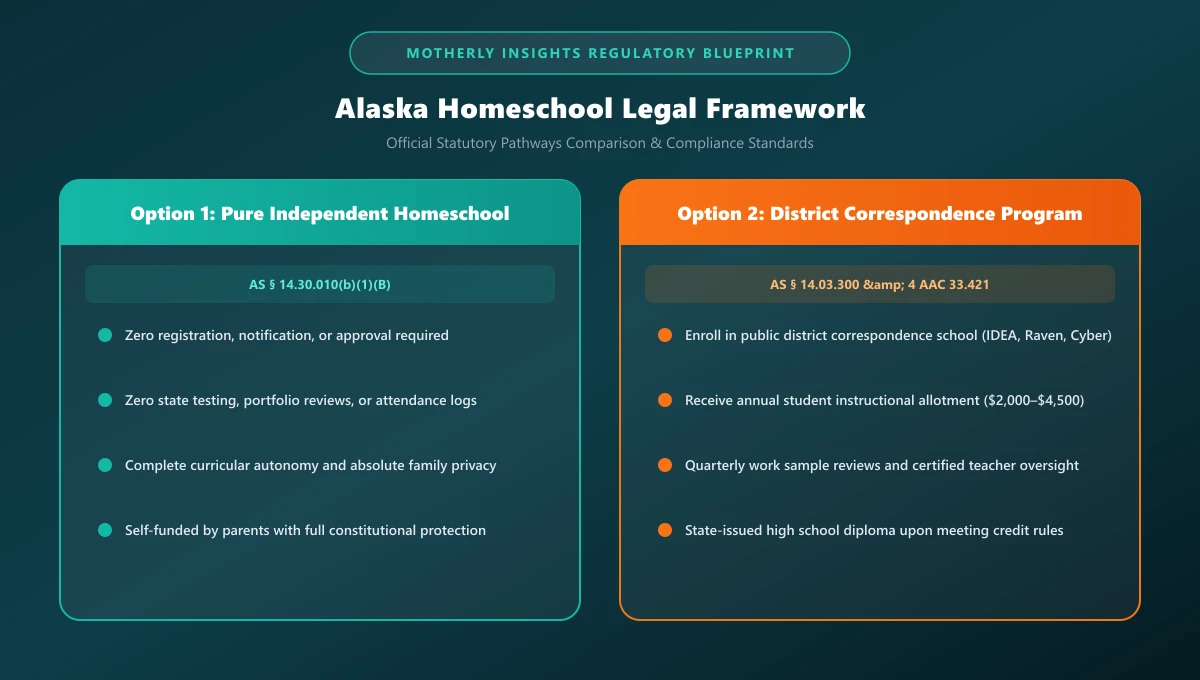
1. Option 1: Pure Independent Home Education (Exemption B)
Under AS 14.30.010(b)(1)(B), a child is exempt from compulsory public school attendance if they are being educated in the home by a parent or legal guardian[2]:
- Zero Notice: You are not required to notify the Alaska Department of Education & Early Development (DEED), register with your local borough school district, or file an intent form.
- Zero Testing or Evaluations: Alaska imposes no standardized testing, no portfolio reviews, and no mandatory home inspections.
- Zero Teacher Credentials: Parents do not need college degrees or teaching certifications.
- Complete Privacy: Families self-fund all curriculum materials and maintain total educational autonomy.
2. Option 2: State-Funded Public Correspondence Schools
For families seeking financial support, Alaska operates popular public school District Correspondence Programs (such as IDEA, Raven Homeschool, CyberLynx, and Alaska Interior Correspondence Teacher):
- Annual Student Allotments: Families receive an educational allotment (typically $2,000 to $4,500+ per student annually) to reimburse approved secular curriculum, textbooks, music lessons, technology, and tutoring.
- Accountability Requirements: Correspondence students must submit quarterly work samples to a certified advisory teacher, take required state standardized tests, and adhere to district educational plans.
3. High School Transcripts, Graduation, and the Alaska Performance Scholarship
Whether independent or correspondence, Alaska homeschoolers have robust pathways to post-secondary success:
- Parental Diplomas: Independent homeschool parents issue official transcripts and confer legal high school diplomas accepted by universities nationwide.
- Alaska Performance Scholarship (APS): Homeschool graduates can earn the Alaska Performance Scholarship (providing up to $4,755 per year) by achieving benchmark scores on the SAT (1060+) or ACT (21+) and completing rigorous high school curricula.
4. Interscholastic Sports Access Under ASAA Bylaws
Under ASAA Bylaws Article 12, homeschooled students have clear legal avenues to compete on athletic teams and join music, drama, and debate programs at their zoned public high school.
5[3]. Navigating District Correspondence Programs: Allotments and Audits
Alaska’s public correspondence programs provide families with significant educational funding:
- Instructional Allotments: Reimbursing up to $4,500+ per student for textbooks, STEM equipment, tutoring, art instruction, and music lessons.
- Advisory Teacher Consultations: Certified teachers assist in developing Individual Learning Plans (ILPs) and review student work samples quarterly.
- Secular Purchasing Rules: State constitutional provisions require that public allotment funds be used exclusively for non-sectarian educational materials.
6[3]. Homeschooling Neurodivergent Learners in Alaska
The extreme flexibility of Alaska homeschool law allows parents of neurodivergent learners (ADHD, autism, dyslexia) to flourish:
- Tailored Pacing: Customize daily lessons according to attention spans, incorporating outdoor wilderness exploration and active physical play.
- Specialized Programs: Correspondence families can allocate allotments toward specialized reading therapies, speech therapy, and sensory equipment.
7[3]. Alaska Homeschool Recordkeeping and Portfolio Best Practices
Independent homeschool families maintain private portfolios to ensure smooth transitions to college:
- Curriculum Booklists: Document living books, classical texts, and online platforms used.
- Representative Work Portfolios: Archive writing essays, math assessments, and science project logs.
- High School Transcripts: Track 21 to 24 credits standard for Alaska high school graduation and college readiness.
8[3]. Frequently Addressed Alaska Homeschool Legal Inquiries
Do independent homeschoolers ever interact with school district officials?
No[3]. Under AS 14.30.010(b)(1)(B), independent home educators have zero reporting obligations to local school districts or state authorities.
Can independent homeschoolers participate in public school sports?
Yes[3]. Under ASAA Bylaws, homeschooled students can compete in interscholastic sports and activities at their local public high school.
9[3]. Rural and Remote Homeschooling Across the Alaska Bush
Homeschooling in rural Alaska presents unique opportunities and logistical strengths:
- Subsistence Curriculum Integration: Families weave traditional subsistence skills (hunting, fishing, gathering, dog mushing) into biology, ecology, and cultural history curricula.
- Distance Technologies: Satellite internet (Starlink) and correspondence platforms allow students in remote villages to access advanced placement calculus, foreign languages, and live seminars.
- Community Co-ops: Remote families frequently organize regional science camps, winter sports leagues, and fine arts intensives.
10[3]. Military Families Homeschooling in Alaska
Alaska is home to major military installations (Joint Base Elmendorf-Richardson, Fort Wainwright, Eielson AFB)[3]. Military families transitioning into Alaska can immediately commence home education under AS 14.30.010(b)(1)(B) without waiting for district administrative approvals or processing delays, ensuring unbroken academic continuity for military-connected children.
11[3]. Step-by-Step Protocols for Exiting Alaska Public Schools
If your child is currently enrolled in a neighborhood brick-and-mortar public school and you wish to transition to independent homeschooling:
- Notify School Administration: Submit a formal letter of withdrawal citing your intent to educate under AS 14.30.010(b)(1)(B).
- Collect Official Student Files: Request cumulative academic records, standardized test histories, and health cards.
- Commence Home Education: Begin your home learning journey immediately without waiting for state processing or administrative approvals.
💡 Related Educational Pathways: To compare related legal frameworks and recommended study programs, explore our detailed reviews on California homeschool legal guidelines, Ohio homeschool notification regulations, Pennsylvania Act 169 requirements.
12. University of Alaska Dual Enrollment and UA Scholars Award
Homeschooled high school students in Alaska enjoy streamlined access to dual credit through the University of Alaska System (including UAA, UAF, and UAS):
- Secondary Student Enrollment: High school sophomores, juniors, and seniors may register for undergraduate courses, earning dual high school and university credit.
- UA Scholars Award: Homeschool graduates who rank in the top 10 percent of their graduating cohort or achieve designated benchmark academic scores qualify for the prestigious UA Scholars Award, providing $12,000 distributed over eight semesters of study at any University of Alaska campus.
- Vocational Certifications: Students can also enroll in workforce credential programs, including maritime technology, aviation maintenance, welding, and healthcare certifications.
13. Summary of Alaska Homeschool Compliance Standards
| Metric / Legal Area | Independent Homeschool (AS 14.30.010) | District Correspondence Program |
|---|---|---|
| State Registration | Zero filing required | Enrolled in local public school district |
| Allotment Funding | Self-funded by parents | $2,000–$4,500+ per student annually |
| Testing Mandates | Zero state testing | State-administered assessments required |
| Curriculum Control | 100% parental discretion | Secular materials approved by district |
| Diploma Authority | Conferred directly by parents | Official state public high school diploma |
| Sports Eligibility | Full access under ASAA Bylaws | Full access under ASAA Bylaws |
💡 Related Educational Pathways: To compare related legal frameworks and recommended study programs, explore our detailed reviews on Georgia homeschool compliance framework, Michigan homeschool statutory rules, Indiana homeschool attendance laws.