Every morning across thousands of homeschool households, an exhausting ritual plays out. A parent announces that it is time for math or reading. Within ninety seconds, their ADHD child has fallen out of their chair, sharpened five pencils that were already sharp, complained of sudden acute hunger, stared at the ceiling for twenty minutes, and ended in tears over a five-problem worksheet.
Parents frequently blame themselves, wondering: “Did I choose the wrong curriculum? Am I being too lenient? Why can my child focus on Minecraft for four hours, but cannot focus on three sentences of handwriting?”
The answer lies in neuropsychology. As world-renowned ADHD researcher Dr. Russell Barkley has repeatedly demonstrated, ADHD is not a deficit of attention, nor is it a deficit of intelligence[1]. A child with ADHD does not lack knowledge; they lack the executive neurological bridge required to execute that knowledge across time.
ADHD is a chronic disorder of the brain’s executive functioning system—specifically self-regulation, working memory, and temporal orientation. When parents stop treating ADHD as behavioral rebellion and start designing an executive function prosthetic environment, the homeschool day transforms from chaotic burnout into steady, joyful academic progress.
The ADHD Homeschool Executive Function Blueprint
1. The Neurochemical Foundation: Low-Dopamine Morning Architecture
The single most consequential structural decision in an ADHD homeschool routine occurs before the first textbook is even opened.
In an ADHD brain, baseline tonic dopamine levels in the prefrontal cortex are chronically deficient. When a child wakes up and is permitted even fifteen minutes of high-dopamine digital media—such as YouTube, tablet games, or video consoles—their brain receives an immediate flood of hyper-stimulating dopamine spikes.
When that screen is powered off, the child’s dopamine levels do not return to a healthy baseline; they plummet into a profound neurochemical deficit. Asking that child’s brain to transition from the hyper-saturated sensory world of video games to the low-dopamine reality of a printed phonics or math page is neurologically excruciating. The result is instant defiance, brain fog, and explosive emotional dysregulation[2].
The Low-Dopamine Morning Rules:
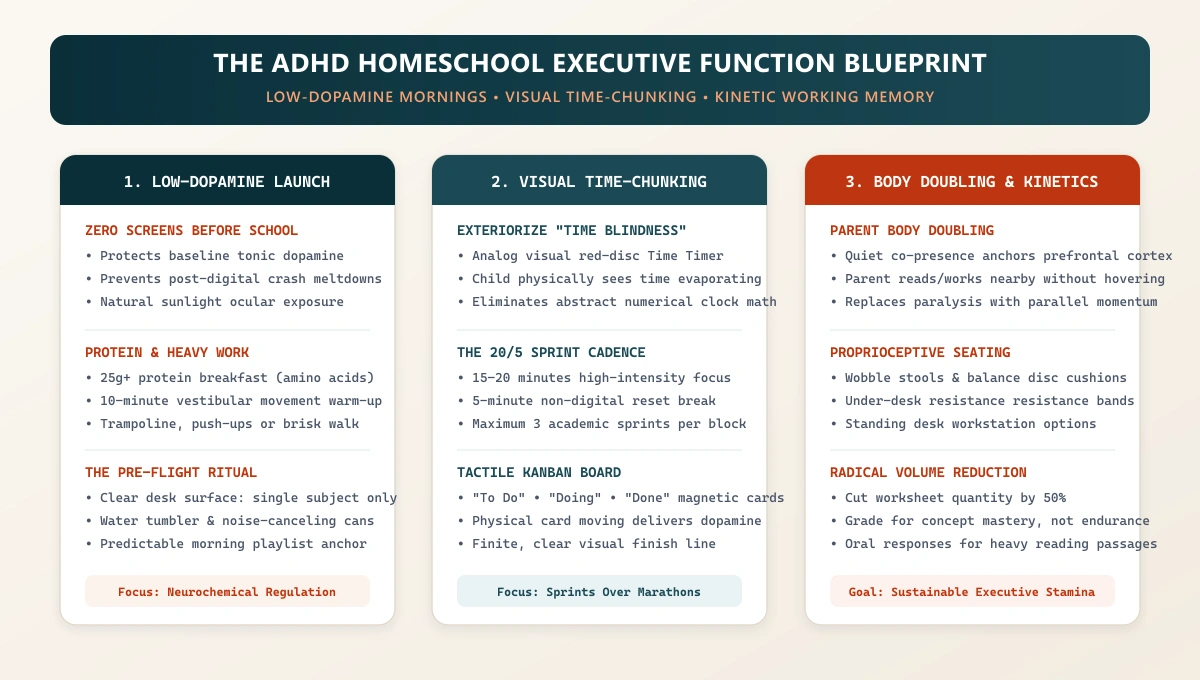
- Zero Screens Before School: Digital devices remain powered down and stored out of sight until the day’s core academic blocks are 100% complete.
- Protein-Dense Breakfast: Neurotransmitters (dopamine and norepinephrine) are synthesized from amino acids like tyrosine. Provide 20–25 grams of protein (eggs, Greek yogurt, nut butter, turkey sausage) to prevent mid-morning glucose-crash agitation.
- Vestibular & Proprioceptive Movement: Ten minutes of intense physical input—bouncing on a mini-trampoline, doing bear crawls, or taking a brisk walk in direct morning sunlight—stimulates natural dopamine release and resets circadian alertness.
2. Exteriorizing Time: Curing “Time Blindness”
Dr. Russell Barkley famously observed that individuals with ADHD suffer from severe time blindness: they do not experience time as a continuous linear progression. To an ADHD child, there are only two temporal zones: “NOW” and “NOT NOW”[1].
Telling an ADHD child, “You have twenty minutes to finish this page,” is meaningless because they have no internal sensory mechanism to measure what twenty minutes feels like. The solution is to exteriorize time into physical space.
The Visual Time Timer
Ditch traditional digital clocks and standard wall clocks. Invest in an analog Time Timer (the physical clock with a disappearing red disc):
- As time elapses, the bright red wedge physically shrinks.
- The child can glance up from their desk and see: “The red wedge is half gone; I need to keep moving.”
- Time is transformed from an abstract number into a concrete, visible object.
The 20/5 Sprint Method
Never assign open-ended work sessions. An ADHD child faced with an indefinite mountain of work experiences instant executive paralysis. Instead, structure the morning into crisp, predictable sprints:
- 20 Minutes of Focused Effort: The timer is set. The goal is pure focus on a micro-task (e.g., “We are doing exactly eight math problems”).
- 5 Minutes of Non-Digital Sensory Reset: When the timer beeps, work stops immediately, even if mid-sentence. The child gets five minutes to jump on the trampoline, get a drink, or stretch.
- Maximum 3 Sprints per Academic Block: After three sprints, transition to a completely different physical environment or take a 20-minute outdoor break.
3. The Power of “Body Doubling”
One of the most powerful executive function tools in adult ADHD coaching—which works wonders in homeschooling—is Body Doubling[3].
Body doubling is the practice of having another person quietly present in the same physical space while a task is being performed.
Many well-meaning homeschool parents give their ADHD child an assignment and walk away to fold laundry or prep dinner, assuming this fosters “independence.” Within forty-five seconds, the child’s working memory drops the task, and they are found spinning their chair or examining a pencil eraser.
When a parent sits at the table parallel working—reading their own book, folding napkins, or budgeting on a laptop:
- The parent’s physical presence serves as an external prefrontal anchor.
- The child’s peripheral vision registers focused adult presence, which gently pulls drifting attention back to center without verbal scolding.
- When the child hits a momentary road-bump, the parent can provide a two-second prompt (“You’re on number four; what’s the next step?”) before catastrophic frustration sets in.
4. Workspaces and Radical Volume Reduction
Two physical adjustments immediately double an ADHD child’s daily stamina:
The Minimalist Visual Workspace
ADHD brains have impaired sensory gating: they cannot filter out background visual noise. A schoolroom covered in colorful educational posters, overflowing book baskets, and scattered craft supplies bombards their nervous system with non-stop distraction.
- Clear the child’s desk completely.
- Place only one item on the desk at a time: the single book and the single pencil needed for the current 20-minute sprint.
- Face the desk toward a blank wall or use cardboard trifold study carrels to block peripheral movement.
Radical Volume Reduction (The 50% Rule)
An ADHD child’s working memory depletes rapidly during repetitive tasks. If a math curriculum assigns thirty practice problems on double-digit addition, the child often masters the concept on problem six, and spends problems seven through thirty melting down from cognitive exhaustion.
- Cut Drill Volume in Half: Assign odd-numbered problems only. If the child solves six problems correctly with conceptual precision, they have demonstrated mastery. Forcing thirty problems yields diminishing returns and builds deep emotional resentment toward learning[4].
- Substitute Handwriting with Oral Narration: When assessing history, science, or literature, do not force an ADHD child with co-occurring dysgraphia to write full essays by hand. Let them record an audio memo, explain the concept into a voice-typing app, or act out the historical battle with LEGO figures.
Sample ADHD Homeschool Daily Pacing Schedule
| Time Window | Focus Block | Structure & Sensory Scaffolding |
|---|---|---|
| 8:00 AM – 8:45 AM | Low-Dopamine Launch | 25g Protein breakfast, outdoor sunlight, 10 min trampoline movement (Zero screens) |
| 8:45 AM – 9:00 AM | Morning Meeting / Kanban | Review visual checklist, set daily sprint goals, calibrate Time Timer |
| 9:00 AM – 9:45 AM | High-Cognitive Block (Math) | Two 20-min sprints with 5-min movement break; Singapore/Beast Academy; parent body doubling |
| 9:45 AM – 10:15 AM | Sensory & Outdoor Recess | Free movement, backyard swing, brisk scooter ride, water hydration |
| 10:15 AM – 11:00 AM | Language Arts & Phonics | 15-min Orton-Gillingham sprint + 15-min audio narration/voice typing; wobble cushion seating |
| 11:00 AM – 11:45 AM | Living History / Science | Interactive hands-on experiment, living literature read-aloud while child sketches or builds |
| 12:00 PM | Academic Completion | Core academic day concluded; lunch followed by self-directed passion projects |
Frequently Asked Questions About ADHD Homeschool Routines
How many total hours should an ADHD homeschool day take? ↓
What should I do when my ADHD child has an explosive task-refusal meltdown? ↓
Is it bad if my child constantly fidgets, stands, or paces while learning? ↓
How do I teach independent study skills to a child who needs constant body doubling? ↓
Disclaimer: This post is for informational and educational purposes only, accurate to the best of our knowledge at publication. It does not constitute advice. We do not guarantee accuracy or completeness and accept no liability for any decisions or losses resulting from reliance on this content.