One of the most agonizing scenes in home education takes place at the kitchen table: a tearful child staring at a workbook page filled with two-digit subtraction problems, while a frustrated parent repeats, “You cross out the seven, make it a six, and carry the one to the tens place—don’t you remember?”
When a child freezes or breaks down during math, parents frequently assume their student has a “math block,” dyscalculia, or lacks a “math brain.” Yet cognitive science tells an entirely different story. In nearly every case, the breakdown is pedagogical: the child was forced directly into abstract symbolic notation before their brain built a physical or pictorial mental anchor.
The antidote is the Concrete-Representational-Abstract (CRA) instructional framework. Developed from cognitive psychologist Jerome Bruner’s seminal research into human learning stages (Enactive, Iconic, Symbolic), the CRA sequence is the foundational architecture behind high-performing global math programs like Singapore Math and RightStart Mathematics[1].
This guide explains how each stage operates, which manipulatives are truly worth buying, how to teach the Singapore bar model, and how to pace transitions to foster effortless mathematical intuition.
The Concrete-Representational-Abstract (CRA) Cognitive Architecture
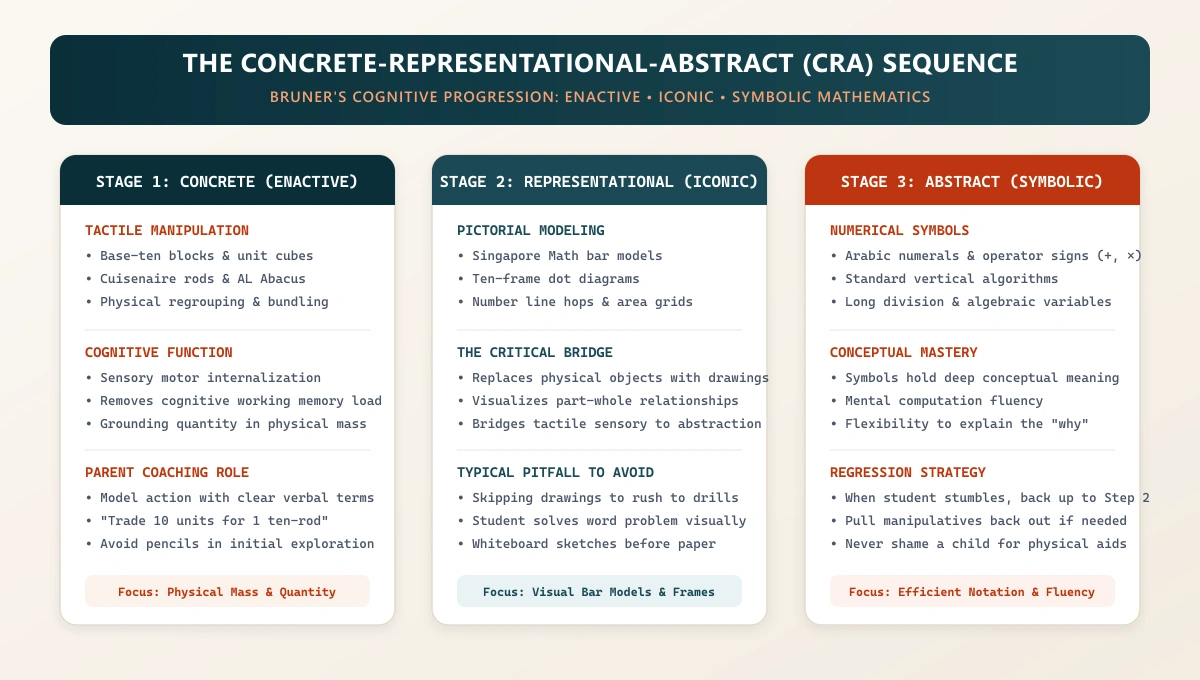
1. Stage 1: The Concrete Stage (Enactive Learning)
In the Concrete stage, mathematical quantities are not written as abstract black ink on paper. They exist as physical matter that can be touched, rotated, snapped together, and weighed in the hands.
Why the Concrete Stage Is Non-Negotiable
Young children’s working memory is neurologically immature. When a seven-year-old looks at the symbol 7, their prefrontal cortex must exert cognitive energy just to translate that squiggle into a concept of “sevenness.” If you then ask them to add 8, hold the running sum in memory, regroup a ten, and write 15, cognitive overload occurs.
By contrast, when a child handles physical Base-ten blocks:
- A single wooden cube is
1. - A ten-rod is physically ten times longer than the unit cube.
- A hundred-flat is physically ten times larger than the rod.
Regrouping (carrying or borrowing) ceases to be a mysterious incantation. To solve 24 + 18, the child physically takes 4 unit cubes and 8 unit cubes, counts 12, bundles 10 cubes together, exchanges them at the “bank” for a physical ten-rod, and places it into the tens column. Place value is no longer a rule to memorize; it is an undeniable physical law[2].
The Essential Homeschool Manipulative Toolkit:
You do not need a closet full of expensive plastic trinkets. Four versatile tools will carry your family from Kindergarten through Middle School:
- Base-Ten Blocks (Interlocking Wooden or Plastic): Mandatory for understanding place value, multi-digit addition, subtraction with regrouping, and long division.
- Cuisenaire Rods: Colored rectangular rods ranging from 1cm to 10cm. Ideal for discovering number bonds, commutative properties, and fraction ratios without counting individual tick marks.
- The AL Abacus (RightStart Style): A two-sided abacus with contrasting beads grouped in fives and tens. Eliminates childish finger-counting by training the brain to visualize quantities instantly (subitizing).
- Fraction Tiles / Fraction Circles: Demonstrates why
1/8is smaller than1/2, proving visually that a larger denominator signifies smaller individual slices.
2. Stage 2: The Representational Stage (The Missing Bridge)
The single greatest mistake made by traditional American math textbooks is jumping directly from plastic blocks to numerical worksheets. The student plays with blocks on Monday, and on Tuesday is expected to solve column equations on paper.
This bypasses Stage 2: The Representational (or Pictorial) Stage, which serves as the indispensable bridge to abstract fluency[3].
How Representational Thinking Works:
In this stage, physical objects are put away, and the child learns to represent quantities through simple, quick sketches:
- Ten-Frames: Simple 2x5 grids where dots or circles represent counters. A child instantly recognizes
8as five filled boxes on top and three on the bottom, noting that2empty boxes remain to make a full ten. - Part-Whole Number Bonds: Two circles connecting to a larger circle, showing that two parts combine to form a whole (e.g.,
4and3connect to7). - The Singapore Bar Model (Tape Diagrams): Rectangular bars drawn on a whiteboard to represent known and unknown values.
The Power of Bar Modeling in Complex Word Problems:
Consider this classic elementary word problem that frustrates thousands of students:
“Liam has 3 times as many marbles as Maya. Together they have 48 marbles. How many marbles does Liam have?”
In high school algebra, this requires setting up a system of equations: L = 3M and L + M = 48.
Through the Representational stage, a 4th grader draws:
- Maya’s bar:
[ 1 unit ] - Liam’s bar:
[ 1 unit ][ 1 unit ][ 1 unit ] - Total bracket:
48
The child instantly sees 4 equal boxes totaling 48. They divide 48 ÷ 4 = 12 (one unit), and multiply 12 × 3 = 36 for Liam. Zero algebra required. The visual diagram made the problem transparent.
3. Stage 3: The Abstract Stage (Symbolic Fluency)
Only when a child has manipulated the concept with their hands and sketched it with their eyes are they ready for the Abstract Stage: working purely with Arabic numerals, mathematical operators (+, -, ×, ÷), and standard vertical algorithms.
Because the student already holds a rich mental movie of the mathematics, the algorithm is recognized as merely an efficient shorthand.
When multiplying 23 × 4, the child knows:
- They are not just multiplying
3 × 4and2 × 4. - They are calculating four groups of three (
12) and four groups of twenty (80), summing them to92. - If their pencil slips and produces
812, their internal number sense sounds an immediate alarm because they know four twenties cannot equal eight hundred.
4. The Diagnostic Reset: What to Do When a Student Gets Stuck
The beauty of the CRA model is that it provides parents with an instant diagnostic roadmap:
💡 The Golden CRA Rule: Whenever a student exhibits confusion, anxiety, or error at the Abstract stage, never repeat the algorithm louder or assign more drill worksheets. Immediately step back one level to the Representational stage. If they still struggle, step back to the Concrete stage.
- If a 5th grader cannot grasp adding fractions with unlike denominators (
1/3 + 1/4), close the workbook. - Pull out fraction tiles (Concrete). Lay the
1/3tile next to the1/4tile. Ask: “Can we name this total with a single piece?” - Let them test sixths, eighths, and tenths until they discover that four
1/12pieces fit perfectly over1/3, and three1/12pieces fit over1/4. - Draw the 12-segment bar on a dry-erase board (Representational).
- Only then write
4/12 + 3/12 = 7/12(Abstract).
Ten minutes of tactile and pictorial discovery cures what six weeks of tears and worksheet drills fail to accomplish.
Top Homeschool Math Curricula Ranked by CRA Alignment
| Curriculum | Concrete Integration | Representational Focus | Best Suited For | Parent Teaching Load |
|---|---|---|---|---|
| Singapore Math (Dimensions / Primary) | High (Hands-on activities per chapter) | Exceptional (World-leader in Bar Modeling) | Visual thinkers, strong conceptual foundation | Moderate (Requires 20 min lesson guidance) |
| RightStart Mathematics | Maximum (Heavy AL Abacus & math games) | High (Cards, abacus diagrams) | Kinesthetic learners, preventing finger counting | High (Scripted, parent-intensive lessons) |
| Math-U-See | Maximum (Proprietary integer block sets) | Moderate (Drawings in student book) | Dyscalculia, ADHD, tactile-first mastery | Low to Moderate (Video instruction included) |
| Beast Academy | Low (Minimal physical manipulatives) | Exceptional (Comic-based visual puzzles) | Gifted math minds, deep spatial problem solvers | Low (Self-directed reading / online) |
| Math Mammoth | Moderate (Parent provides manipulatives) | High (Visual models on every page) | Independent learners, budget-conscious families | Low (Worktext contains all teaching notes) |
Frequently Asked Questions About the CRA Math Framework
Will using manipulatives make my child dependent on physical crutches? ↓
How do I know when my child is ready to move from blocks to paper? ↓
Should older middle school students still use manipulatives? ↓
How does CRA instruction compare to traditional memorization of math facts? ↓
Disclaimer: This post is for informational and educational purposes only, accurate to the best of our knowledge at publication. It does not constitute advice. We do not guarantee accuracy or completeness and accept no liability for any decisions or losses resulting from reliance on this content.