In Volume 1 of her foundational series, Home Education, Charlotte Mason observed that children are naturally responsive to melodic beauty, declaring that “all children are capable of learning to sing, and that they should be taught to sing from notes just as they are taught to read from print.”[1] Rather than relegating music to an expensive extracurricular luxury or mindless background noise, the Parents’ National Educational Union (PNEU) made vocal sight-reading, hymnody, and folksong singing daily staples of the morning schoolroom.
For modern home educators, establishing a Charlotte Mason music routine does not require expensive private conservatory lessons or an advanced music degree. By pairing John Curwen’s intuitive Tonic Sol-fa ear-training framework with a deliberate, termly hymn study rotation, parents can nurture true pitch accuracy, poetic literacy, and deep musical appreciation within 15 to 20 minutes a day.
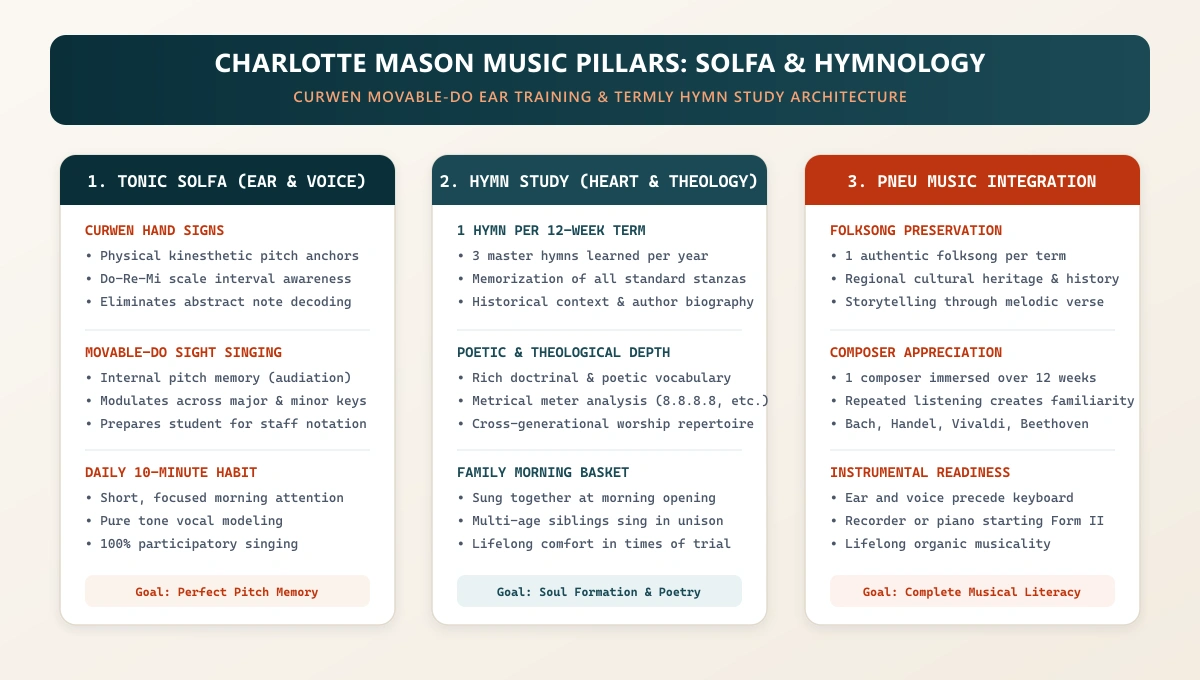
Charlotte Mason Music Framework: Solfa & Hymnology Overview
1. The Power of Curwen Tonic Sol-fa in Early Childhood
Before children learn to decode complex musical clefs, key signatures, and accidentals on a five-line musical staff, they must develop internal pitch awareness—a cognitive capability that modern music educators term audiation.
In the 19th century, John Curwen refined the Tonic Sol-fa method, using the syllables Do, Re, Mi, Fa, Sol, La, Ti paired with distinct physical hand gestures[2]. Charlotte Mason adopted Curwen’s exact system for PNEU students because it respects child development:
- Kinesthetic Anchoring: Each pitch syllable corresponds to a clear physical hand sign held in front of the chest. A clenched fist represents Do (stability, tonic rest), an upward tilted open hand represents Re (striving upward), and a flat palm represents Mi (calm, resting). These tactile cues allow young children to feel melodic intervals before seeing them written down.
- The Movable-Do Advantage: Tonic Sol-fa is a “movable-do” system, meaning that whatever key a piece of music is written in (whether C major, G major, or F major), the root home-tone of the scale is always designated as Do. This teaches children to recognize functional musical relationships—such as the pull from Sol to Do—transposing melodies effortlessly across registers.
- Voice Before Instrument: Mason insisted that the child’s natural singing voice is their primary musical instrument. Teaching a child to sing on pitch protects them from the mechanical, button-pressing detachment that often occurs when young beginners are placed prematurely at a keyboard or violin.
2. Structuring Daily 10-Minute Solfa Lessons
One of the great advantages of Charlotte Mason pedagogy is the discipline of short, focused lessons. Solfa lessons should never devolve into tedious drills. A 10-to-15 minute session held three mornings a week yields far greater vocal agility and attentiveness than a grueling hour-long weekend practice.
A Typical 12-Minute Lesson Blueprint:
- Minute 0–3: Posture & Breath Modeling: Guide children to sit tall with relaxed shoulders, taking slow, deep diaphragmatic breaths through the nose. Hum gently on a single pitch (such as middle C or D) to place the vocal tone forward in the nasal mask.
- Minute 3–7: Hand Sign Pitch Echoes: The teacher produces a pitch with a hand sign (e.g., Do - Mi - Sol), and children sing the notes back while duplicating the hand gesture. Progressively introduce skips and stepwise intervals (Do - Re - Mi - Re - Do).
- Minute 7–10: The Blind Pitch Guessing Game: Sing a short phrase using a neutral vowel like “la,” asking children to identify the solfa syllables by holding up the correct hand signs. This trains mental audiation without visual mimicry.
- Minute 10–12: Solfa Staff Translation: Using a simple dry-erase two-line or three-line staff (or steps drawn on paper), show children how the notes climb higher or step lower, demonstrating that note heads on a line represent the physical heights of the sounds.
By keeping these sessions playful, brisk, and consistent, students develop near-perfect relative pitch within two academic terms[3].
3. The Architecture of Termly Hymn Study
While Solfa trains the ear and vocal mechanism, hymn study feeds the heart, mind, and spiritual imagination. Classic Christian hymnody is high literature set to timeless melody: it possesses rich meter, theological precision, robust historical narratives, and poetic language that expands a child’s vocabulary far beyond modern commercial songs.
The 12-Week Term Cadence: One Hymn at a Time
In typical public school classrooms, songs are often cycled through so quickly that children merely mouth phonetic sounds without understanding the words. In contrast, the PNEU assigned one hymn per 12-week school term (three hymns per school year).
Pacing a single hymn across three months achieves several critical educational milestones:
- Complete Memorization Without Stress: By singing one or two stanzas each morning during the Morning Basket, children commit all four to six verses of great hymns—such as Be Thou My Vision, A Mighty Fortress Is Our God, or Holy, Holy, Holy—effortlessly to memory.
- Theological & Historical Grounding: During the first week of the term, parents share the biographical background of the hymn writer (e.g., Horatio Spafford penning It Is Well With My Soul after the tragic loss of his daughters at sea, or John Newton composing Amazing Grace after renouncing the transatlantic slave trade). The hymn ceases to be abstract; it becomes a living historic testimony.
- Metrical and Poetic Appreciation: Classic hymns follow traditional poetic meters (such as Common Meter 8.6.8.6 or Long Meter 8.8.8.8)[4]. Examining these rhyme schemes and metrical beats provides an organic bridge into classical poetry analysis.
4. Completing the Feast: Folksongs and Composer Appreciation
To ensure the homeschool morning remains vibrant, Charlotte Mason balanced sacred hymnody with two additional musical pillars:
Termly Traditional Folksongs
Alongside the term hymn, PNEU students learned one traditional folksong per term. Folksongs preserve cultural heritage, humor, regional dialect, and narrative storytelling. Selections such as The Ash Grove, Scarborough Fair, Erie Canal, or The Minstrel Boy introduce students to historical eras, maritime culture, and frontier pioneer life through memorable ballads.
Termly Classical Composer Appreciation
Composer study in a Charlotte Mason home requires no formal musicological lecturing. For each 12-week term, choose one composer (such as Johann Sebastian Bach, Antonio Vivaldi, Wolfgang Amadeus Mozart, or Ludwig van Beethoven).
During lunch, quiet play, or handicrafts, play three or four major compositions by that master repeatedly across the weeks. When a child listens to Vivaldi’s The Four Seasons twenty times over a season, its phrasing and instrumentation become lifelong internal companions, establishing an instinctive ear for orchestral balance.
Charlotte Mason Music Rotation Schedule (Sample 36-Week Year)
| Term | Solfa Focus | Term Hymn (12 Weeks) | Term Folksong (12 Weeks) | Composer Study (12 Weeks) |
|---|---|---|---|---|
| Term 1 (Weeks 1–12) | Major scale Do-Re-Mi-Fa-Sol with Curwen hand signs | Holy, Holy, Holy (Reginald Heber) | The Ash Grove (Welsh Folk Song) | Johann Sebastian Bach (Brandenburg Concertos) |
| Term 2 (Weeks 13–24) | Full diatonic scale (add La & Ti); stepwise sight-singing | Be Thou My Vision (Dallán Forgaill) | The Water is Wide (English/Scottish) | Wolfgang Amadeus Mozart (Symphony No. 40, Clarinet Concerto) |
| Term 3 (Weeks 25–36) | Minor intervals (La-based minor); simple two-part rounds | A Mighty Fortress Is Our God (Martin Luther) | The Erie Canal (American Folk) | Antonio Vivaldi (The Four Seasons, Gloria) |
Frequently Asked Questions About Charlotte Mason Music Education
Can I teach Solfa and hymns if I cannot sing well or play an instrument? ↓
What is the difference between Curwen Tonic Sol-fa and the Kodály Method? ↓
At what age should a child start formal piano or instrumental lessons? ↓
How do I teach hymns to a family with widely differing age groups? ↓
Disclaimer: This post is for informational and educational purposes only, accurate to the best of our knowledge at publication. It does not constitute advice. We do not guarantee accuracy or completeness and accept no liability for any decisions or losses resulting from reliance on this content.