
In modern progressive education, memorization has been largely relegated to the dustbin of outdated pedagogical techniques. Critics deride it as “drill and kill,” arguing that because every student carries a smartphone with instant search capabilities, committing facts, dates, poetry, and mathematical formulas to memory is a waste of intellectual bandwidth.
Classical home educators recognize this modern assumption as a catastrophic misunderstanding of cognitive development. You cannot think critically about information you do not possess. When a child attempts to analyze the causes of the American Civil War, evaluate a scientific hypothesis, or write a persuasive essay without having facts readily accessible in their working memory, their analytical mind is forced to halt every forty seconds to search for basic data.
British essayist Dorothy Sayers, in her seminal 1947 Oxford address The Lost Tools of Learning, identified the elementary years (ages 5 to 10) as the “Poll-Parrot Stage”—today known as the Grammar Stage of the classical Trivium. During these golden years, a child’s brain is biologically primed for memorization. They memorize commercial jingles, nursery rhymes, and dinosaur names with effortless, infectious joy.
By channeling this natural biological gift through structured classical memory work, home educators construct an intellectual “hard drive” packed with rich historical, scientific, linguistic, and cultural pegs that support collegiate-level critical thinking for the rest of the child’s life.
The Seven Pillars of Classical Memory Work
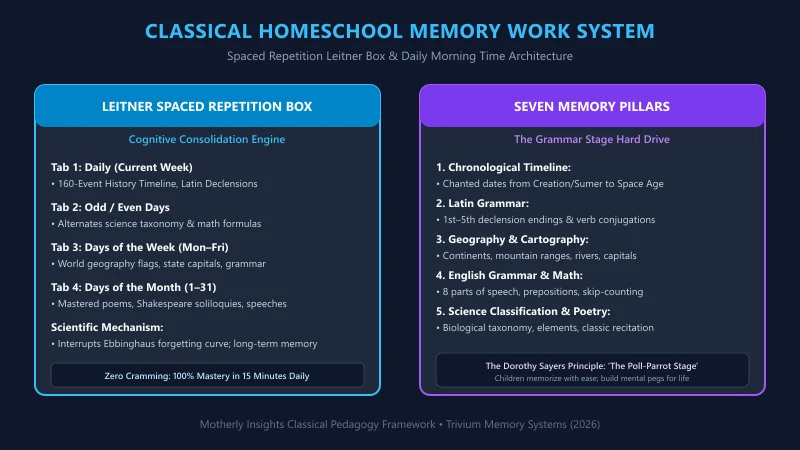
A robust home education memory program does not focus on trivial pop-culture facts; it systematically builds mastery across seven core academic domains:
1. The Chronological Global History Timeline
The crown jewel of classical memory work is a complete, chanted world history timeline spanning approximately 160 major historical events from ancient Sumer, Egypt, and the Code of Hammurabi to the American founding, the World Wars, and the modern space age.
- The Cognitive Benefit: When a child memorizes the chronological spine of human history, every historical novel, biography, and museum exhibit they encounter for the rest of their lives snaps instantly into an established chronological grid.
2. Latin Grammar Paradigms
Long before children study complex Latin translation, they memorize the foundational inflected endings of the Latin language:
- The 1st through 5th noun declension case endings (-a, -ae, -ae, -am, -a).
- The active and passive verb conjugations across present, imperfect, and future tenses.
- The Cognitive Benefit: Latin declensions train the brain in rigorous categorization, spatial ordering, and grammatical precision, drastically improving English vocabulary and reading comprehension.
3. Comprehensive World Geography & Cartography
- Continents, oceans, world mountain ranges, major river basins, and deserts.
- All 50 U.S. states and capitals, followed by the sovereign nations of Europe, Asia, Africa, and the Americas.
- The Cognitive Benefit: Global literacy. When world news reports on unrest in the Strait of Hormuz or the Horn of Africa, the classically educated student visualizes the exact geopolitical landscape.
4. English Grammar & Syntax
- The eight parts of speech and their definitions.
- Comprehensive lists of prepositions, helping verbs, linking verbs, and conjunctions recited in rhythmic chants.
- The Cognitive Benefit: Eliminates grammar confusion in middle and high school writing. When a student knows all 48 English prepositions by heart, identifying prepositional phrases and resolving dangling modifiers becomes second nature.
5. Mathematical Skip-Counting & Formulas
- Skip-counting multiplication sequences (twos through fifteens).
- Squares up to 25 and cubes up to 10.
- Conversion formulas (metric to imperial, geometric area, volume, and the Pythagorean theorem).
- The Cognitive Benefit: Math fact automaticity. When a student doesn’t need to count on their fingers to calculate $7 imes 8$, their full cognitive working memory remains available to tackle multi-step algebraic equations.
6. Scientific Taxonomy & Physical Laws
- Biological classification (Domain, Kingdom, Phylum, Class, Order, Family, Genus, Species).
- Major elements of the periodic table, atomic numbers, and chemical symbols.
- Newton’s three laws of motion, thermodynamics principles, and geological strata.
7. Poetry, Scripture & Historical Oratory
- Recitation of classic poems (Robert Frost, Emily Dickinson, William Wordsworth, Alfred Lord Tennyson).
- Historic political documents and speeches (The Preamble to the Constitution, Lincoln’s Gettysburg Address, Patrick Henry’s speech).
- The Cognitive Benefit: Instills sublime linguistic cadence, elevated rhetoric, and moral fortitude into the student’s inner monologue.
The Science of Retention: Interrupting the Ebbinghaus Forgetting Curve
Many parents ask: “If my child memorizes 24 weeks of facts this year, won’t they forget everything by next summer?”
In 1885, German psychologist Hermann Ebbinghaus conducted pioneering research demonstrating the Forgetting Curve: humans forget roughly 70% of newly memorized information within 48 hours unless that information is actively reviewed at spaced intervals.
The solution is not endless cramming; it is Spaced Repetition.
The Leitner Box System: 100% Retention in 15 Minutes Daily
Originally developed by German science journalist Sebastian Leitner in the 1970s, the Leitner Box is an analog flashcard index box divided into five graduated compartments:
- Tab 1: Daily: Contains all newly introduced memory work for the current week (e.g., this week’s timeline segment, 4 new prepositions, and skip-counting the sevens).
- Tab 2: Odd / Even Days: Cards that have been recited successfully 5 days in a row graduate here. You review “Odd” cards on odd calendar days and “Even” cards on even days.
- Tab 3: Days of the Week (Monday–Friday): Cards recited successfully in Tab 2 graduate to a specific weekday (e.g., all geography is reviewed on Tuesdays; Latin is reviewed on Thursdays).
- Tab 4: Days of the Month (1–31): Cards recited successfully for several weeks graduate to a numerical day of the month. A card placed behind “Day 14” is reviewed only once a month on the 14th.
- Tab 5: Retired Mastered: Permanent mental storage.
The Golden Leitner Rule: If a student ever stumbles on a card in Tab 4, it instantly demotes back to Tab 1 for daily review. This dynamic feedback loop guarantees that the child spends 90% of their time practicing what is fragile while maintaining mastered knowledge with minimal effort.
Memorization Techniques: Chants, Rhythm & Hand Motions
Children do not memorize effectively by staring silently at printed index cards. Successful classical memory programs engage multiple sensory modalities simultaneously:
1. Musical Mnemonics & Folk Tunes
The human brain encodes musical melody and linguistic lyric in different hemispheres. When facts are set to catchy, rhythmic folk tunes (such as Yankee Doodle, Twinkle Twinkle, or traditional Irish jigs), memorization happens almost instantaneously.
2. Kinesthetic Hand Motions
Pairing abstract concepts with physical gestures creates a muscle-memory anchor. For example, when chanting the timeline entry “Julius Caesar assassinated, 44 BC,” children form a toga with one arm and mimic a dramatic theatrical gasp.
3. Call-and-Response Chanting
The educator leads with an energetic call, and children respond in unison. The social rhythm of group recitation transforms memory drill into a high-energy, joyful team chant.
DIY Memory Work vs. Expensive Franchise Communities
Many homeschooling families are introduced to memory work through corporate franchise programs like Classical Conversations (CC). While these programs provide helpful community and pre-packaged audio CDs, they can be remarkably expensive—often costing between $1,500 and $3,000 per year in tuition, administrative fees, and required curriculum guides for a family with multiple children.
You do not need to join a paid franchise community to give your children an elite classical memory education.
Sourcing Independent Memory Curricula
- The Classical Acts & Facts Binder (DIY): Build your own family memory binder utilizing free or low-cost curricula:
- Claritas Publishing (Cross Seven): A superb four-cycle classical memory curriculum featuring four 28-week cycles with professionally recorded songs, app access, and laminated memory cards.
- Memoria Press Core Knowledge: Outstanding, dignified memory work integrated seamlessly into standard classical grade-level packages.
- AmblesideOnline Recitation Lists: Free, beautifully curated poetry, scripture, and hymn rotations for every grade level.
- The Timeline Song: Classic audio resources like Veritas Press History Cards or Story of the World timeline recordings.
The Daily 20-Minute Morning Time Workflow
Memory work should never drag out into an exhausting battle of wills. It is most effective when executed as the spirited, joyful opening ceremony of your homeschool morning:
- 08:30 AM (5 Minutes): Sing the current historical timeline chant with hand motions.
- 08:35 AM (5 Minutes): Review Tab 1 (new memory work for the week: Latin declension chant and weekly poem stanza).
- 08:40 AM (10 Minutes): Open the Leitner Box to today’s date and review the scheduled maintenance cards (Geography, Science taxonomy, Math facts).
- 08:50 AM: Close the box! Celebrate enthusiastic effort and transition seamlessly into your academic core.
By dedicating just twenty focused minutes each morning to the art of memory work, you furnish your student’s mind with an expansive, permanent tapestry of human knowledge—equipping them to navigate higher academics with effortless confidence, discernment, and eloquence.
Disclaimer: This post is for informational and educational purposes only, accurate to the best of our knowledge at publication. It does not constitute advice. We do not guarantee accuracy or completeness and accept no liability for any decisions or losses resulting from reliance on this content.