

Home education in the First State provides families with substantial instructional autonomy within a streamlined nonpublic school reporting structure. Under Title 14 of the Delaware Code (§ 2703 and § 2703A), home schools are legally defined as nonpublic schools operated by parents[1].
Compulsory school attendance in Delaware applies to all children between the ages of five (5) and sixteen (16) under 14 Del. C. § 2702.
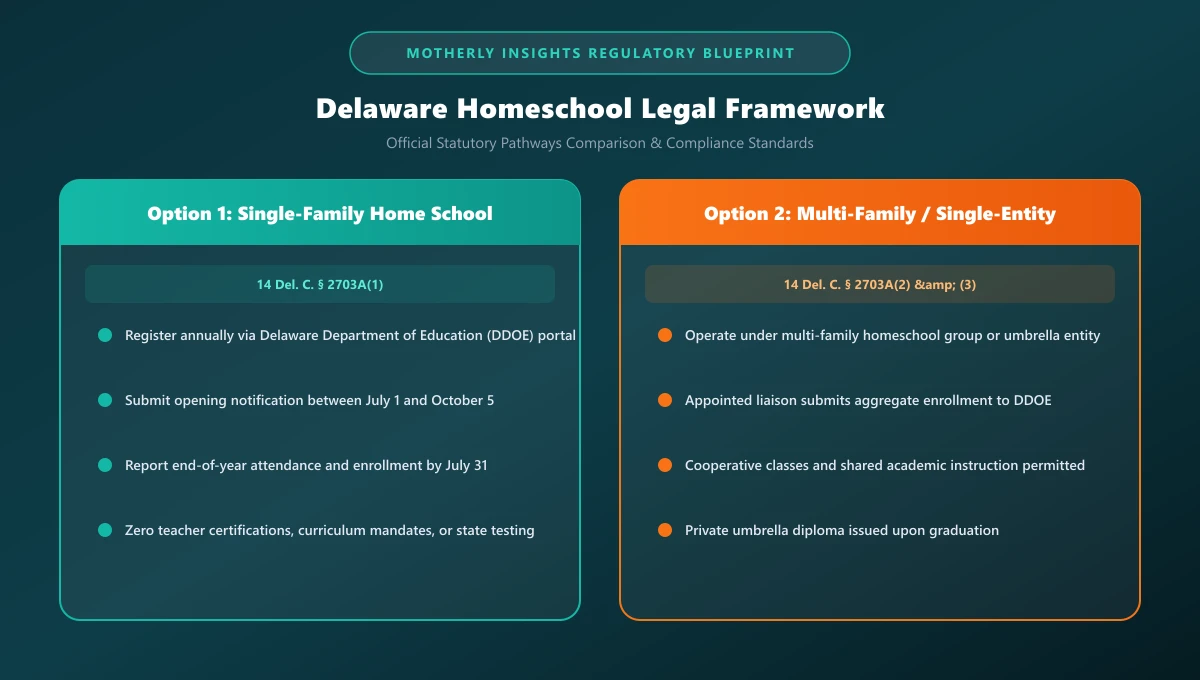
Delaware Homeschool Legal Pathways: Statutory Overview
1. Selecting Your Delaware Homeschool Classification
Under 14 Del. C. § 2703A, Delaware recognizes three distinct structural options:
- Single-Family Home School: Educating exclusively your own children within your home. This is the pathway chosen by over 90% of Delaware home educators.
- Multi-Family Home School: A group of parents educating their children cooperatively with a designated liaison who handles reporting.
- Single-Entity Home School: An all-inclusive educational program operated with a single coordinator.
2. DDOE Portal Registration and Annual Reporting Protocols
Compliance in Delaware is managed entirely online via the Delaware Department of Education (DDOE) Nonpublic School Portal[2]:
- Opening Report Window: Parents submit their online opening notification between July 1 and October 5 of each school year. If withdrawing mid-year, the notification must be filed prior to commencing home instruction.
- End-of-Year Attendance Report: Between July 1 and July 31, parents log into the portal to report total days attended and verify continued enrollment.
- DDOE Acknowledgment Letter: Once submitted, the portal provides an official confirmation letter acknowledging your lawful nonpublic status. Keep this document on file permanently.
3. Parent Qualifications, Curriculum, and Testing Freedom
Delaware maintains a strictly hands-off approach to daily instruction:
- No Degree Mandates: Parents do not need a high school diploma, college degree, or teaching certificate to instruct their children.
- Zero Curriculum Mandates: The state does not dictate textbooks, daily hours, or lesson plans. Parents select materials tailored to their family values and student learning styles.
- No Mandatory Standardized Testing: Delaware law does not mandate standardized achievement tests, portfolio reviews, or district evaluations[3].
4. Delaware SEED Scholarship and College Access
Homeschool graduates in Delaware are fully eligible for post-secondary opportunities, including the Student Excellence Equals Degree (SEED) Scholarship, which provides tuition-free associate degree coursework at Delaware Technical Community College (DelTech) and the University of Delaware’s Associate in Arts Program (AAP).
5. Homeschool Driver Education and DMV Licensing
When a Delaware homeschooled student reaches age 16 and applies for a Level 1 Learner’s Permit, parents must provide:
- Verification of enrollment from the DDOE nonpublic portal.
- Certificate of completion from a state-approved nonpublic driver education program.
- Standard proof of identity and legal presence.
6. Organizing the Delaware Nonpublic Homeschool Binder
While the state does not audit homeschool records on-site, maintaining an organized compliance portfolio protects your nonpublic status and facilitates college admissions:
- DDOE Acknowledgments: Store your annual opening and end-of-year confirmation printouts from the DDOE portal.
- Attendance Ledger: Document a minimum of 180 educational days or equivalent hours.
- Curriculum Syllabi: Maintain lists of primary literature, textbooks, and laboratory science resources.
- Student Work Samples: Retain representative writing compositions, mathematics problem sets, and science projects.
- High School Transcript: Maintain a running four-year transcript recording courses, grades, credits, and cumulative GPA.
7. Dual Enrollment at Delaware Colleges and Universities
Delaware homeschoolers have broad access to dual enrollment through local higher education institutions:
- Delaware Technical Community College (DelTech): High school juniors and seniors may take concurrent college courses in general education subjects.
- University of Delaware (UD) & Wilmington University: Flexible admission criteria allow homeschoolers to earn transferable undergraduate credits.
8. Special Education Services and IDEA Child Find
Under federal IDEA regulations, Delaware public school districts are required to locate, identify, and evaluate homeschooled children suspected of having learning disabilities. Parents can request comprehensive diagnostic psychoeducational assessments, speech-language evaluations, and occupational therapy screenings at zero parental expense.
9. Frequently Addressed Delaware Homeschool Inquiries
Does Delaware require teacher certification for homeschooling?
No. Under 14 Del. C. § 2703A, parents instructing their own children are exempt from teacher certification and college degree mandates.
When must mid-year public school withdrawals be reported?
If withdrawing during the active school year, submit your opening report through the DDOE portal before withdrawing your child to avoid truancy confusion.
10. Interscholastic Sports and Extra-Curricular Regulations in Delaware
Under regulations established by the Delaware Interscholastic Athletic Association (DIAA), nonpublic students (including homeschooled students) may access public school athletic teams under specific cooperative agreements. While DIAA rules generally grant local school boards discretion, many districts welcome homeschoolers for non-athletic extracurricular activities, including marching band, science olympiad, and drama productions.
11. Homeschooling Neurodivergent Learners in Delaware
Delaware’s flexible nonpublic statutory environment offers tremendous benefits for twice-exceptional and neurodiverse students:
- Freedom from Standardized Pacing: Parents can slow down reading instruction using evidence-based phonics or accelerate mathematics according to mastery.
- Therapeutic Accommodations: Parents can customize sensory environments, eliminating classroom noise and visual overstimulation.
- Holistic Development: Time saved on institutional routines can be directed into hands-on nature exploration, equine therapy, or community apprenticeships.
12. Step-by-Step Delaware Public School Withdrawal Protocols
When withdrawing a student from a Delaware public school:
- File Opening Report in Portal: First submit your Single-Family Home School opening report on the DDOE website and print the official acknowledgment.
- Submit Formal Withdrawal Notice: Provide written notice to your school principal stating that your child is transferring to a nonpublic home education program under 14 Del. C. § 2703A.
- Obtain Complete Cumulative Records: Request certified copies of report cards, diagnostic assessments, and immunization documents for your family binder.
💡 Related Educational Pathways: To compare related legal frameworks and recommended study programs, explore our detailed reviews on California homeschool legal guidelines, Ohio homeschool notification regulations, Pennsylvania Act 169 requirements.
💡 Related Educational Pathways: To compare related legal frameworks and recommended study programs, explore our detailed reviews on Georgia homeschool compliance framework, Michigan homeschool statutory rules, Indiana homeschool attendance laws.