

Disclaimer: This post is for informational and educational purposes only, accurate to the best of our knowledge at publication. It does not constitute advice. We do not guarantee accuracy or completeness and accept no liability for any decisions or losses resulting from reliance on this content.
In March 2023, Arkansas Governor Sarah Huckabee Sanders signed into law the landmark Arkansas LEARNS Act (Act 237 of 2023), dramatically reorganizing the state’s K–12 educational funding landscape. Codified under Arkansas Code Annotated (A.C.A.) § 6-18-2501 through § 6-18-2512, the Act created the Arkansas Children’s Educational Freedom Account (EFA) program.
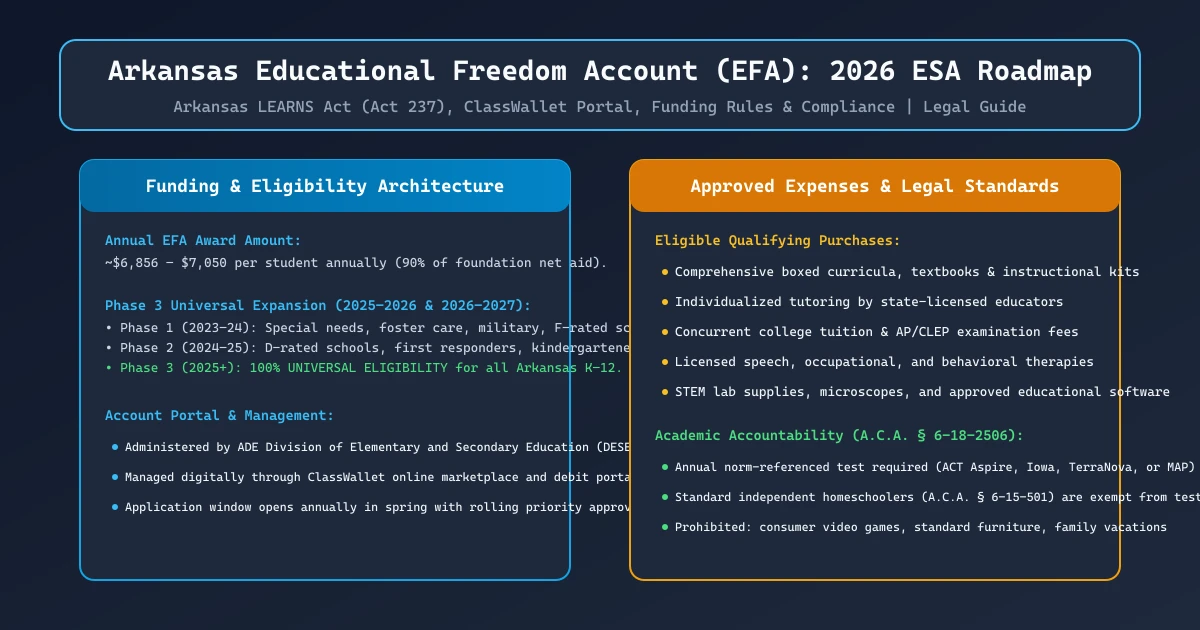
The EFA operates as a state-funded Education Savings Account (ESA), transferring approximately 90% of the statewide foundation funding net aid per student (averaging between $6,856 and $7,050+ annually) directly into dedicated digital accounts for participating families.
While initially launched through tiered eligibility phases prioritizing low-income students, children with disabilities, foster youth, and military dependents, the Arkansas LEARNS Act enters its climactic final phase: Universal Eligibility for all Arkansas K–12 students, including home-educated learners.
However, accepting EFA public scholarship dollars establishes an essential legal fork in the road for Arkansas families. Participating in the EFA requires complying with A.C.A. § 6-18-2506, which mandates annual standardized testing and financial documentation through the ClassWallet portal. In contrast, standard Arkansas independent homeschooling under A.C.A. § 6-15-501 offers near-absolute parental autonomy with zero state testing mandates.
This definitive legal analysis—authored by homeschool statutory compliance counsel—breaks down the EFA funding mechanism, approved educational purchases, annual testing requirements, and the step-by-step ClassWallet application process.
1. How Much Funding Does the Arkansas EFA Provide?
Under A.C.A. § 6-18-2503, the annual scholarship disbursement per student is tied directly to the state’s foundation funding formula. The Arkansas General Assembly recalibrates this baseline annually:
| School Year | Annual Award Per Student | Disbursement Mechanism | Rollover Policy |
|---|---|---|---|
| 2023–2024 (Phase 1) | $6,672 | Quarterly digital deposits via ClassWallet | Rolled over into following academic year. |
| 2024–2025 (Phase 2) | $6,856 | Quarterly digital deposits via ClassWallet | Balances roll over continuously until graduation or age 21. |
| 2025–2026 (Phase 3 Universal) | ~$7,015 (Projected) | Quarterly digital deposits via ClassWallet | Unspent funds return to state upon program withdrawal. |
| 2026–2027 (Ongoing) | ~$7,150+ (Estimated) | Quarterly digital deposits via ClassWallet | Funds accumulate for high school concurrent enrollment. |
Funds are deposited into parent accounts managed by ClassWallet, the state’s designated financial technology vendor. Parents can either purchase materials directly through verified marketplace vendors or submit itemized invoices and receipts for reimbursement.
2. Eligibility Phasing: The Path to Universal Arkansas School Choice
The LEARNS Act established a deliberate three-year phase-in to prevent fiscal bottlenecks while school choice infrastructure matured:
Phase 1 (2023–2024 School Year)
Eligible participants included students with documented disabilities (IEP or 504 plans), children in foster care, active-duty military dependents, students attending “F”-rated public schools on the state accountability index, and incoming kindergarteners.
Phase 2 (2024–2025 School Year)
Eligibility broadened to include students enrolled in “D”-rated public schools, children of active-duty military veterans and law enforcement/first responders, and students transitioning out of public school into accredited non-public learning environments.
Phase 3 (2025–2026 and 2026–2027 School Years: 100% Universal)
Under statutory mandate, all restrictions based on prior school performance, household income, or parental occupation expire. Every single school-age child residing in Arkansas who is eligible for public school enrollment is fully eligible to apply for an Educational Freedom Account.
3. Approved vs. Prohibited Educational Expenses Under LEARNS
The Arkansas Department of Education (ADE) Division of Elementary and Secondary Education (DESE) enforces strict expenditure compliance. Under ADE rules, funds must be used exclusively for bona fide educational needs:
Approved Qualifying Expenditures (Green Light)
- Comprehensive Boxed Curricula: Core curriculum packages (e.g., Singapore Math, Math-U-See, Timberdoodle, BookShark, All About Reading, Saxon, Memoria Press).
- Textbooks and Literary Reference Texts: Historical non-fiction, classic literature, reference encyclopedias, and workbooks.
- Accredited Tutoring and Academic Coaching: Services provided by certified teachers, licensed tutors, or state-approved tutoring organizations.
- Concurrent College Enrollment: Tuition, registration fees, and textbooks for dual-credit college courses taken through Arkansas universities or community colleges.
- National Standardized Examinations: Fees for Advanced Placement (AP) exams, College Board CLEP tests, the ACT, SAT, and approved norm-referenced testing batteries.
- Clinical Therapies: Speech-language pathology, occupational therapy, and behavioral therapies provided by licensed healthcare professionals.
- STEM Laboratory Equipment: Dissection instruments, compound microscopes, robotics kits, and physical science lab packages.
- Instructional Software and Digital Subscriptions: Subscriptions to educational software platforms (e.g., MiaPrep, Beast Academy, CTCMath, Rosetta Stone).
Prohibited Expenditures (Red Light)
- Standard home entertainment hardware, television monitors, general-use smartphones, or gaming consoles.
- Recreational family travel, lodging, airfare, meals, and automotive transportation.
- General domestic home furniture, home improvement materials, or general household office decor.
- Community youth sports league registrations (e.g., Little League, recreational soccer) that are not part of an accredited physical education curriculum.
- Consumable goods or consumer supplies that can be diverted for general adult domestic household use.
4. Legal Comparison: Arkansas EFA vs. Standard Independent Homeschooling
Arkansas families must recognize the stark legal differences between schooling under standard state homeschool statutes versus accepting EFA funding:
| Statutory Dimension | Standard Arkansas Homeschool (A.C.A. § 6-15-501) | Arkansas EFA Program (A.C.A. § 6-18-2501) |
|---|---|---|
| Notice Requirement | Submit one-time or annual Notice of Intent (NOI) online to local superintendent by August 15. | Execute annual EFA participant contract and register through the ADE/ClassWallet portal. |
| State Funding | $0.00 (100% self-funded by parent). | ~$6,856 – $7,050+ annually deposited into student account. |
| Testing Mandates | None. Standardized testing is 100% voluntary; no scores are reported to the state. | Mandatory annual norm-referenced testing; scores must be submitted to ADE. |
| Curriculum Scrutiny | Total sovereign parental freedom; zero curriculum review by state or county officials. | Expenditures audited via ClassWallet; purchases must conform to state educational criteria. |
| Recordkeeping Requirements | Private parental records; no portfolio submission or state review. | Itemized receipts, invoices, and expense documentation retained for state financial audit. |
| Tim Tebow Sports Access | Protected statutory right to try out for public school sports teams under A.C.A. § 6-15-509. | Protected rights to participate in interscholastic athletics and extracurriculars under ADE rules. |
If a family prefers total regulatory privacy and desires zero state standardized testing oversight, remaining a standard independent homeschooler under A.C.A. § 6-15-501 is the superior legal choice. Conversely, for families seeking thousands of dollars in annual curriculum and therapy funding, the EFA provides transformative financial support.
5. Academic Accountability and Annual Testing Requirements
Under A.C.A. § 6-18-2506, academic accountability is an explicit condition of receiving EFA funds. To renew scholarship eligibility annually:
- Approved Testing Batteries: Students must take a nationally norm-referenced standardized achievement test approved by the Arkansas State Board of Education. Commonly approved assessments include:
- Iowa Assessments (Form E)
- Stanford 10 Achievement Test (SAT-10)
- TerraNova 3
- NWEA MAP Growth
- ACT or SAT (for high school students)
- Administration Standards: Tests must be proctored by an independent certified test administrator or completed through an accredited testing service.
- Score Reporting Deadline: Parents must upload the official student score report to the DESE portal before the annual renewal deadline (typically June 30).
- Academic Progress Standard: Students are expected to demonstrate academic growth commensurate with their grade level. If a student experiences dramatic academic regression, the state may require an educational improvement plan as a condition of continued scholarship renewal.
6. How to Apply: The Step-by-Step EFA Application Roadmap
The application cycle for the upcoming academic school year operates on a predictable schedule managed through the Arkansas Department of Education portal at dese.ade.arkansas.gov:
Step 1: Verification of Arkansas Residency
Gather official proof of Arkansas residency, such as a state driver’s license, current property tax assessment, residential utility bill, or mortgage statement.
Step 2: Establish Your ClassWallet Account
Once the ADE approves your preliminary eligibility application, you will receive an invitation to set up your digital wallet on the ClassWallet online platform.
Step 3: Select Your Educational Providers
Parents can designate approved Service Providers and Qualified Education Service Providers (QESPs). This includes private tutors, specialized therapy clinics, and accredited independent curriculum vendors.
Step 4: Execute the Annual Student Learning Agreement
Sign the digital parent agreement affirming that you will educate your child in the core subject areas (English language arts, mathematics, science, and social studies) and adhere to all expenditure rules.
Step 5: Receive Quarterly Allocations
Funds are released in four quarterly installments:
- First Quarter: August
- Second Quarter: October
- Third Quarter: January
- Fourth Quarter: March
7. Strategic Advice for Arkansas Homeschool Families
The Arkansas Educational Freedom Account provides families with unparalleled financial freedom to tailor an elite educational journey.
To maximize the benefits of the EFA while remaining fully compliant:
- Maintain Meticulous Digital Records: Archive every invoice, receipt, and curriculum purchase order within your personal filing system as backup for ClassWallet audits.
- Order Core Curricula Early: Submit curriculum purchase requests through ClassWallet in July or early August to ensure materials arrive well before fall instruction begins.
- Schedule Spring Testing in Advance: Reserve standardized test dates in March or April so score reports are certified and uploaded before the June 30 reporting window closes.
Sources & Statutory Citations
- Arkansas General Assembly: Act 237 of 2023 (The Arkansas LEARNS Act).
- Arkansas Code Annotated: A.C.A. Title 6, Chapter 18, Subchapter 25 (Arkansas Children’s Educational Freedom Account Program).
- Arkansas Department of Education (ADE) DESE: Rules Governing the Educational Freedom Account Program and Approved Expenditures.
- Arkansas Supreme Court: Legal Precedents Governing Private Educational Choice and Foundation Net Aid Allocation.