

Disclaimer: This post is for informational and educational purposes only, accurate to the best of our knowledge at publication. It does not constitute advice. We do not guarantee accuracy or completeness and accept no liability for any decisions or losses resulting from reliance on this content.
In 2021, the New Hampshire General Court enacted House Bill 2, establishing the Education Freedom Accounts (EFA) program codified under New Hampshire Revised Statutes Annotated (RSA) Chapter 194-F. Designed to empower Granite State parents with financial flexibility, the program allows families to direct state educational adequacy aid toward custom educational alternatives.
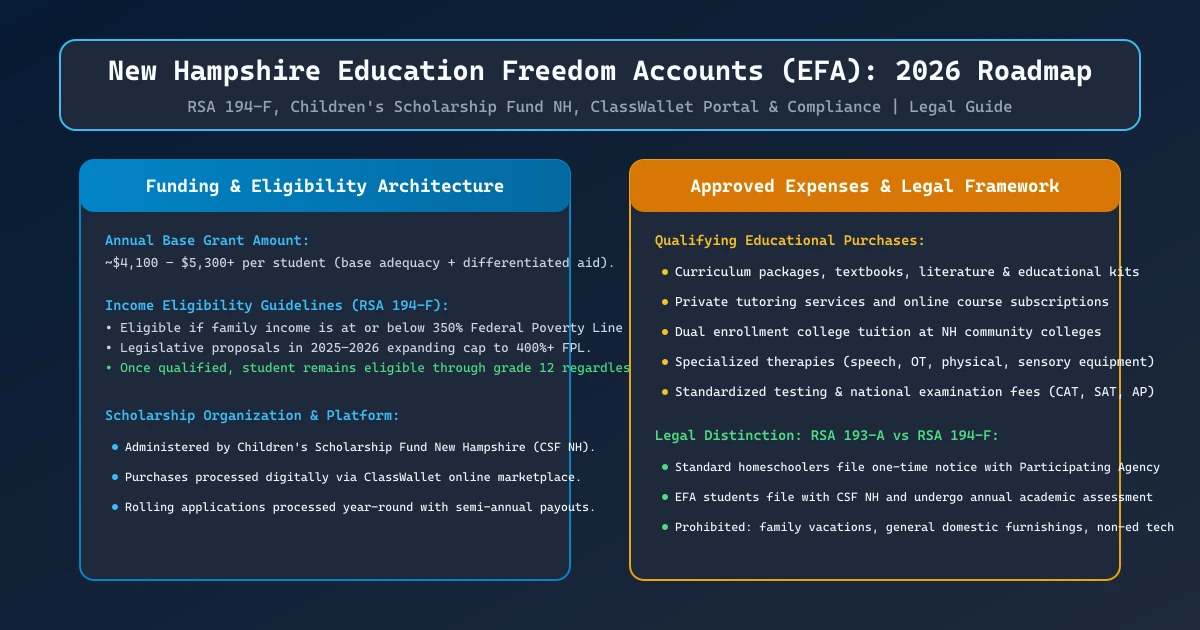
Under RSA 194-F, eligible students receive an average of $4,100 to $5,300+ annually, with additional differentiated aid allocated for students with specialized learning needs, English language learners, or families qualifying for free or reduced-price lunch. The program is administered on behalf of the New Hampshire Department of Education (NHED) by the Children’s Scholarship Fund New Hampshire (CSF NH), with financial transactions executed through the ClassWallet digital platform.
For New Hampshire homeschool families, the EFA provides substantial financial support for high-quality curricula, tutoring, science equipment, and specialized therapies. However, accepting state EFA funding establishes a distinct regulatory category under RSA 194-F, which includes annual assessment requirements and spending oversight that differ from traditional independent homeschooling under RSA 193-A.
This comprehensive guide—authored by homeschool statutory compliance counsel—explains the EFA funding formula, income eligibility parameters, approved expenditures, ClassWallet management, and the legal interaction between RSA 193-A and RSA 194-F.
1. How Much Funding Does the New Hampshire EFA Provide?
Under RSA 194-F:2, each student’s Education Freedom Account grant is composed of the state’s base per-pupil adequacy aid plus any applicable differentiated aid categories:
| Funding Component | Statutory Citation | Typical Annual Grant | Eligibility Requirement |
|---|---|---|---|
| Base Adequacy Grant | RSA 198:40-a(II)(a) | ~$4,182 | All approved EFA students. |
| Free/Reduced Lunch Aid | RSA 198:40-a(II)(b) | +$2,300+ | Household income under federal FRL thresholds. |
| Special Education Aid | RSA 198:40-a(II)(c) | +$2,100+ | Documented IEP, 504 plan, or certified diagnosis. |
| English Language Learner | RSA 198:40-a(II)(d) | +$800+ | Non-native English proficiency qualification. |
| Total Average Award | RSA 194-F:2 | ~$4,500 – $5,300+ | Cumulative per-student annual allocation. |
Grant funds are deposited digitally in quarterly disbursements into the family’s ClassWallet online account. Unspent funds roll over from year to year, allowing families to save for high school dual-enrollment college coursework or advanced laboratory science curricula.
2. Who is Eligible? (Income Caps & The “Grandfather” Rule)
Under current statute, eligibility for the New Hampshire EFA program centers on state residency and household income:
1. Income Qualification Threshold
Under RSA 194-F:1, a student is eligible if their household annual income does not exceed 350% of the federal poverty guidelines at the time of application. For a family of four, 350% FPL exceeds $109,000 annually, making the vast majority of Granite State working families eligible.
2. The “Once In, Always In” Provision
A pivotal statutory protection under RSA 194-F:2(VII) is the “grandfather” clause: once a student is approved for an EFA, they remain eligible until high school graduation or age 20, regardless of whether household income rises in subsequent years. Families must complete a brief annual re-affirmation, but they do not lose scholarship eligibility due to income growth.
3. Student Age and Residency
The student must be a bona fide resident of New Hampshire and between the ages of 5 and 20 who has not yet graduated from high school. Incoming kindergarteners qualify automatically.
3. Approved vs. Prohibited Educational Expenditures
The New Hampshire Department of Education and CSF NH enforce clear guidelines regarding qualified educational expenses under RSA 194-F:2:
Approved Qualifying Expenditures (Green Light)
- Comprehensive Boxed Curricula: Full-year homeschool curricula (e.g., Timberdoodle, BookShark, All About Reading, Saxon Math, Singapore Math, Memoria Press).
- Textbooks and Living Literature: Non-fiction historical texts, classic literature, reference encyclopedias, and workbooks.
- Accredited Tutoring Services: Individualized instruction provided by certified educators or approved educational tutoring centers.
- Dual Enrollment College Tuition: Tuition and course fees for concurrent college classes taken through the Community College System of New Hampshire (CCSNH) or Granite State universities.
- National Standardized Testing: Registration fees for nationally norm-referenced tests (Iowa Assessments, Stanford 10, California Achievement Test), AP exams, and College Board CLEP tests.
- Specialized Clinical Therapies: Occupational, speech-language, physical, or behavioral therapy services provided by licensed specialists.
- STEM Laboratory Equipment: Compound microscopes, dissection supplies, chemistry kits, and educational robotics hardware.
- Approved Educational Software: Digital subscriptions to core academic learning platforms (e.g., CTCMath, Beast Academy, Rosetta Stone).
Prohibited Expenditures (Red Light)
- Consumer home electronics, entertainment televisions, general-purpose smartphones, and home video gaming systems.
- Non-educational domestic furniture, home remodeling, and general household decor.
- Recreational family vacations, non-educational travel, fuel, airfare, and hotel accommodations.
- Community youth athletic leagues that are not integrated into an accredited physical education curriculum.
- Consumable goods or supplies that can be diverted for general adult domestic household use.
4. Legal Architecture: RSA 193-A vs. RSA 194-F
New Hampshire families must recognize the statutory relationship between schooling under the state’s traditional home education statute versus participating in the EFA:
| Legal Parameter | Standard NH Home Education (RSA 193-A) | NH Education Freedom Account (RSA 194-F) |
|---|---|---|
| Notification Requirement | File a one-time Notice of Intent with a Participating Agency (local superintendent or private school). | Apply annually online through the Children’s Scholarship Fund NH portal. |
| State Funding | $0.00 (100% self-funded by parent). | ~$4,500 – $5,300+ annually deposited into ClassWallet. |
| Annual Assessment | Required; parent keeps results privately in portfolio. (Testing, teacher review, or parent-chosen method). | Mandatory annual assessment submitted directly to CSF NH (standardized test or teacher portfolio). |
| Financial Oversight | Zero financial reporting or audit exposure. | All expenditures tracked, documented, and audited via ClassWallet. |
| Interscholastic Sports Access | Protected statutory right under RSA 193:1-c to participate in public school sports and curricular activities. | Equal access to local public school sports and academic co-curriculars under RSA 194-F. |
If a family ever decides to exit the EFA program, they can simply resume pure independent homeschooling under RSA 193-A by maintaining their original Participating Agency notification.
5. Annual Assessment and Accountability Requirements
To maintain continuous EFA funding under RSA 194-F:2(VIII), parents must provide documentation of academic progress annually by July 15:
- Option A: Nationally Norm-Referenced Testing: The student takes an approved standardized test (such as the Iowa Assessments, Stanford 10, or TerraNova). The student must score at or above the 40th percentile composite score.
- Option B: Certified Teacher Portfolio Evaluation: A New Hampshire certified teacher (or an educator certified in another state) conducts a portfolio evaluation and student interview, signing a formal written letter certifying that the child has demonstrated academic progress commensurate with their ability.
- Option C: State Assessment: The student participates in the statewide New Hampshire Department of Education assessment at their local school district.
Score reports or evaluation letters are uploaded directly into the CSF NH parent portal.
6. How to Apply via the CSF NH Portal
The application process is managed online through the Children’s Scholarship Fund New Hampshire website at nh.scholarshipfund.org:
Step-by-Step Application Roadmap:
- Gather Required Documentation:
- Proof of New Hampshire residency (driver’s license, utility bill, or lease).
- Household income verification (federal tax return Form 1040, W-2s, or SNAP/TANF documentation).
- Student birth certificate or official proof of birth date.
- Submit Online Application: Complete the online profile on the CSF NH portal. Applications are processed on a rolling basis, but applying between March and May ensures timely funding for fall coursework.
- Sign Student Learning Agreement: Execute the digital EFA contract agreeing to provide education in the required core subjects (science, mathematics, language arts, and social studies).
- Access Your ClassWallet Account: Once approved, CSF NH issues your digital credentials for the ClassWallet marketplace to begin purchasing approved educational materials.
7. Practical Recommendations for Granite State Families
The New Hampshire Education Freedom Account provides home educators with extraordinary flexibility to build a bespoke academic pathway.
To maintain compliance and maximize your grant:
- Keep Digital Backups: Retain PDFs of all curriculum invoices and therapy documentation for at least three years.
- Schedule Spring Evaluations Early: Book portfolio reviews with certified teachers by April or May to avoid deadline crunches before the July 15 reporting date.
- Leverage Community College Dual Credits: Use high school EFA funds to pay for dual-credit coursework through CCSNH, allowing your student to graduate high school with transferable college credits.
Sources & Statutory Citations
- New Hampshire General Court: New Hampshire Revised Statutes Annotated (RSA) Chapter 194-F (Education Freedom Accounts).
- New Hampshire General Court: RSA Chapter 193-A (Home Education).
- New Hampshire Department of Education (NHED): Education Freedom Account Administrative Rules and Adequacy Funding Guidelines.
- Children’s Scholarship Fund New Hampshire (CSF NH): EFA Parent Handbook and Qualified Expense Catalog.