Disclaimer: This post is for informational and educational purposes only, accurate to the best of our knowledge at publication. It does not constitute advice. We do not guarantee accuracy or completeness and accept no liability for any decisions or losses resulting from reliance on this content.
Homeschooling a child with Auditory Processing Disorder (APD)—sometimes termed Central Auditory Processing Disorder (CAPD)—is one of the most clinically rewarding transitions a neurodivergent family can undertake. In a conventional classroom, a child with APD is subjected to an acoustic nightmare: ambient background noise reaching 65 to 70 decibels (dBA), HVAC reverberations, desk scraping, and multiple overlapping voices. Because their brain struggles to separate meaningful speech from ambient room noise, up to 50% of instructional input is lost or distorted between the ear canal and the auditory cortex.
At home, you possess complete sovereign control over the acoustic environment. By transforming your homeschool room into a low-reverberation acoustic sanctuary and replacing auditory-heavy lectures with multi-sensory visual scaffolding, you can eliminate auditory fatigue, restore academic self-esteem, and unlock remarkable intellectual potential.
This clinical blueprint—authored from the perspective of pediatric speech-language pathology and educational audiology—outlines the diagnostic subtypes of APD, acoustic room modifications, assistive listening systems, and subject-by-subject curriculum adaptations.
1. Demystifying APD: The Ear Hears, But the Brain Scrambles
The first fundamental truth every homeschooling parent must internalize is that APD is not a hearing impairment.
When evaluated by an audiologist on a standard pure-tone audiogram, children with APD almost invariably demonstrate normal peripheral hearing thresholds (0 to 15 dB across 250 Hz to 8000 Hz). The mechanical structures of the ear—the tympanic membrane, the ossicular chain, and the cochlear hair cells—function flawlessly.
The breakdown occurs downstream, along the central auditory nervous system (CANS), spanning the brainstem, the thalamus, the corpus callosum, and the primary auditory cortex in the temporal lobes. The auditory signal arrives intact at the cochlea, but as neural impulses travel to the brain, timing delays, binaural integration deficits, and acoustic degradation garble the message.
To a child with APD, listening in an echoey or noisy room feels like listening to an AM radio station tuned just slightly off-frequency, mixed with static and competing chatter. They do not need you to shout; shouting merely increases acoustic distortion. What they require is enhanced signal-to-noise ratio (SNR), visual redundancy, and cognitive processing time.
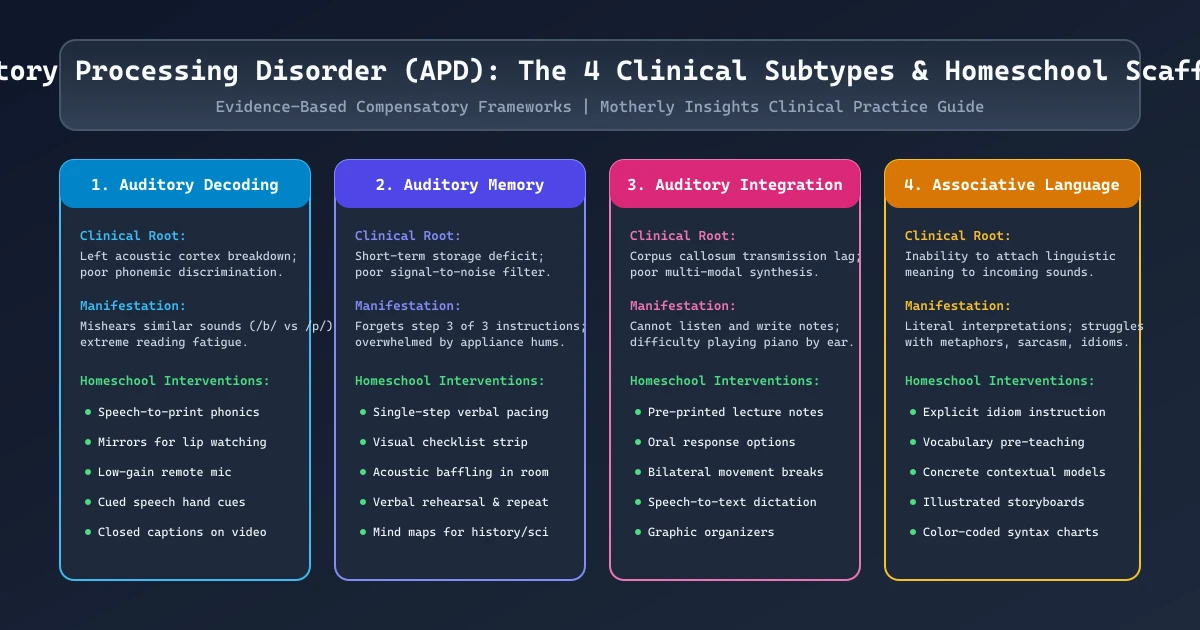
2. The Four Clinical Subtypes (The Buffalo Model Framework)
Dr. Jack Katz’s widely validated Buffalo Model categorizes auditory processing deficits into four distinct functional profiles. Tailoring your homeschool routine requires identifying which subtype predominantly impacts your child:
| APD Subtype | Neurobiological Locus | Core Behavioral Symptoms | Priority Homeschool Interventions |
|---|---|---|---|
| 1. Auditory Decoding | Left primary auditory cortex (Heschl’s gyrus) | Mishears similar consonants (/p/ vs /b/, /th/ vs /f/); severe phonics struggles; slow processing speed; extreme fatigue after reading. | Speech-to-print linguistic phonics; lip-reading mirrors; low-gain remote microphone systems; closed captions on all instructional video. |
| 2. Tolerance-Fading Memory (TFM) | Anterior brainstem & central auditory pathways | Cannot retain more than 1 or 2 spoken instructions; poor short-term auditory memory; catastrophic breakdown in presence of appliance hums. | Strict 1-step visual directions; visual checklist strips; noise-dampening acoustic baffles; daily verbal rehearsal & chunking games. |
| 3. Auditory Integration | Corpus callosum (interhemispheric transfer pathway) | Inability to listen to a speaker and write simultaneously; difficulty combining auditory instructions with motor output (e.g., piano by ear). | Pre-printed guided lecture notes; speech-to-text dictation software; oral evaluations; cross-body bilateral motor warm-ups prior to study. |
| 4. Associative Language | Left temporoparietal associative cortex | Struggles to extract meaning from complex syntax; takes idioms literally; misses humor, sarcasm, or vocal inflections. | Explicit idioms curriculum; pre-teaching vocabulary before reading historical texts; illustrated graphic concept maps; color-coded grammar syntax. |
Most children present with a hybrid profile, frequently combining Auditory Decoding and Tolerance-Fading Memory. Recognizing these underlying mechanisms prevents parents from mistakenly attributing auditory processing failures to willful disobedience, laziness, or ADHD.
3. Acoustic Environmental Engineering: Designing the Quiet Room
In public school classrooms, the signal-to-noise ratio (the difference in volume between the teacher’s voice and background noise) frequently dips to +4 dB or even negative figures. For an APD child to comfortably comprehend speech, clinical guidelines recommend an SNR of at least +15 to +20 dB with a reverberation time ($RT_{60}$) under 0.4 seconds.
Here is how to engineer an optimal acoustic learning sanctuary in your home without spending thousands of dollars:
Strategic Acoustic Scaffolding
- Eliminate Hard Surface Echoes: Hardwood, tile, bare drywall, and large windows reflect sound waves, creating micro-reverberations that smear phoneme boundaries. Introduce high-pile area rugs with dense felt underlayment, floor-to-ceiling velvet or thermal blackout curtains, and fabric-covered cork bulletin boards.
- Mitigate Ambient Mechanical Noise: Position your homeschool desk far away from kitchen refrigerators, dishwashers, HVAC air returns, and laundry rooms. If forced-air heating generates low-frequency rumble, place dynamic acoustic absorption panels behind the learning station.
- Face-to-Face Sightlines: Never instruct your child while walking around the room, facing a whiteboard with your back turned, or speaking from another room. Up to 40% of phonemic disambiguation in APD learners occurs visually through unconscious speech-reading (observing lip shapes, tongue placement, and teeth contact). Ensure your face is evenly illuminated with natural front-facing light.
- Use Personal Sound Amplification / Remote Mic Systems: For severe decoding deficits, invest in a low-gain personal FM system (such as the Phonak Roger Focus II). The parent wears a small lapel transmitter microphone, which beams pure, crystal-clear vocal frequencies directly into discrete ear receivers worn by the child. This raises the signal-to-noise ratio by up to +20 dB, eliminating auditory strain instantly.
4. Subject-by-Subject Homeschool Adaptations
Reading & Language Arts: Shift from Auditory-First to Speech-to-Print
Traditional phonics programs (such as Orton-Gillingham) rely heavily on auditory drills: listening to isolated phonemes and blending them mentally. For an Auditory Decoding APD child, hearing whether a fast-spoken sound is /m/ or /n/ is extraordinarily taxing.
- Implement Linguistic Phonics: Adopt speech-to-print approaches (such as Reading Simplified or All About Reading paired with tactile tiles). Connect the spoken sound directly to visible mouth articulation and grapheme tiles immediately.
- Use an Articulation Mirror: Keep a small handheld mirror at the desk. When teaching subtle vowel contrasts (short /i/ as in pin versus short /e/ as in pen), have the child observe the physical widening of their jaw and tongue height.
- Subtitles on Everything: Ensure that any educational documentary, literature adaptation, or video instruction has high-contrast closed captions permanently enabled. This reinforces auditory-grapheme binding simultaneously.
Mathematics: Externalize Working Memory to the Page
Math word problems represent the ultimate cognitive overload for an APD child: they must decode linguistic phrasing, hold numerical values in working memory, filter syntax, and perform arithmetic operations.
- Color-Code Numbers and Operations: Use highlighters to separate operational verbs (“increased by” = green; “take away” = red) from numerical data.
- Provide Concrete Manipulatives: Defer mental math. Utilize Base-Ten blocks, Math-U-See integer blocks, or Cuisenaire rods so the mathematical relationship is physically visible rather than held in a fragile auditory loop.
- Step-by-Step Graphic Checklists: Post a laminated index card detailing the algorithmic sequence for multi-digit multiplication or long division. When auditory memory fades, the visual sequence keeps the child moving forward without panic.
History & Science: Living Narrations and Graphic Organizers
Long verbal lectures or extended audiobook read-alouds without accompanying visuals will cause an APD child to glaze over within four minutes due to cognitive exhaustion.
- Visual Mind Maps: Before reading a chapter on ancient Rome or cellular biology, preview the lesson using illustrated concept charts, diagrams, and bold vocabulary placards.
- Chunked Narration: Read exactly one paragraph or two sentences at a time. Pause, prompt the child to rephrase the core thought, and record key keywords on a shared dry-erase board.
- Tactile Notebooking: Allow the child to draw, sketch, sculpt, or assemble dioramas to demonstrate historical comprehension rather than demanding lengthy oral narrations or written essays under time pressure.
5. Daily Cognitive Energy Budgeting: Preventing Auditory Meltdowns
Children with APD expend double or triple the cognitive horsepower of their neurotypical peers simply parsing conversational speech. By 1:00 PM, their central nervous system is frequently operating on empty, leading to irritability, sensory meltdowns, emotional withdrawal, or tearful outbursts.
Structure your homeschool day around the Auditory Battery Model:
| Time Block | Focus & Energy State | Clinical Environmental Scaffolding |
|---|---|---|
| Morning Peak (8:30 AM – 10:30 AM) | High-concentration phonics, decoding, and mathematics. Full cognitive auditory battery. | Quietest room environment; 1-on-1 direct visual instruction; 5-minute silent movement breaks every 20 minutes. |
| Acoustic Recovery (10:30 AM – 11:15 AM) | Recharge auditory fatigue; silent independent exploration. | Complete acoustic rest: solo drawing, building toys, or reading with noise-canceling headphones. Zero verbal demands. |
| Multi-Sensory Applied (11:15 AM – 12:30 PM) | Hands-on science experiments, nature study, and gross motor games. | Concrete tactile manipulatives, physical outdoor engagement, low verbal pacing with visual demonstrations. |
| Low-Auditory Afternoon (1:30 PM – 2:30 PM) | Visual arts, keyboarding, audiobooks paired with illustrated print. | Subtitles and closed captions enabled; speech-to-text dictation; zero high-stakes verbal questioning or quizzes. |
6. Assistive Tech & Clinical Interventions
Beyond domestic environmental changes, specific clinical therapies and assistive devices offer targeted neuroplastic rehabilitation:
- Acoustic Pioneer Programs: Software-based auditory training games (such as Fast ForWord, Capdots, or HearBuilder) utilize digitally altered, acoustically stretched speech signals to systematically train the brainstem and auditory cortex to separate rapid phonemic transitions.
- Low-Gain Remote Microphones: As mentioned, frequency-modulated (FM) or digital remote microphone systems worn during academic blocks yield massive boosts in comprehension, test scores, and sustained attention.
- Speech-Language Therapy: A licensed pediatric SLP specialized in auditory processing can administer targeted phonemic awareness drills, prosody training, and compensatory memory strategies that carry over seamlessly into home instruction.
7. Legal Rights & State Compliance Considerations
When homeschooling a child with APD in the United States, parents frequently ask whether their child qualifies for public school special education resources:
- IDEA / Equitable Services: Under the Individuals with Disabilities Education Act (IDEA), parentally placed private school and homeschool students in many states are entitled to “proportionate share” equitable services. In states like Alaska, Iowa, Nebraska, and California, local school districts or charter homeschool umbrellas provide speech therapy, assistive technology consultations, or audiological evaluations at no charge.
- Medical vs. Educational Diagnosis: Note that public schools evaluate under IDEA categories (such as “Other Health Impairment” or “Speech/Language Impairment”), whereas a formal APD diagnosis must be rendered by a licensed audiologist using sound-treated diagnostic booth protocols. Maintaining an audiological evaluation portfolio protects your family during state portfolio reviews or standardized testing exemption requests.
By stepping out of the noisy, reverberant institutional classroom and curating an acoustic sanctuary at home, you offer your child the ultimate clinical gift: the quiet, clarity, and visual scaffolding they need to thrive academically and love learning.
Sources & Clinical Citations
- American Speech-Language-Hearing Association (ASHA): Central Auditory Processing Disorders: Technical Report and Guidelines for Practice (ASHA Working Group on CAPD).
- Katz, J., & Smith, P.: The Buffalo Model of Central Auditory Processing Disorders: Assessment and Remediation Strategies.
- Bellis, Teri James: When the Brain Can’t Hear: Unraveling the Mystery of Auditory Processing Disorder. Pocket Books, 2002.
- American Academy of Audiology (AAA): Clinical Practice Guidelines: Diagnosis, Treatment, and Management of Children and Adults with Central Auditory Processing Disorder.