
Disclaimer: This post is for informational and educational purposes only, accurate to the best of our knowledge at publication. It does not constitute advice. We do not guarantee accuracy or completeness and accept no liability for any decisions or losses resulting from reliance on this content.
Finding high-quality, strictly secular science curriculum that prioritizes genuine scientific inquiry over rote memorization is one of the most celebrated challenges in home education. In a marketplace saturated with faith-based texts or superficial public school digital workbooks, two programs stand out as the premier gold standards for secular homeschoolers:
- Building Foundations of Scientific Understanding (BFSU) by Dr. Bernard Nebel (Nebels Science / Pressdogs).
- Real Science Odyssey (RSO) by Pandia Press (authored by Blair Lee, Paige Hudson, and team).
Both programs are uncompromisingly scientific, evidence-based, and hands-on. Both reject fill-in-the-blank vocabulary sheets in favor of active experimentation, physical observation, and critical inquiry.
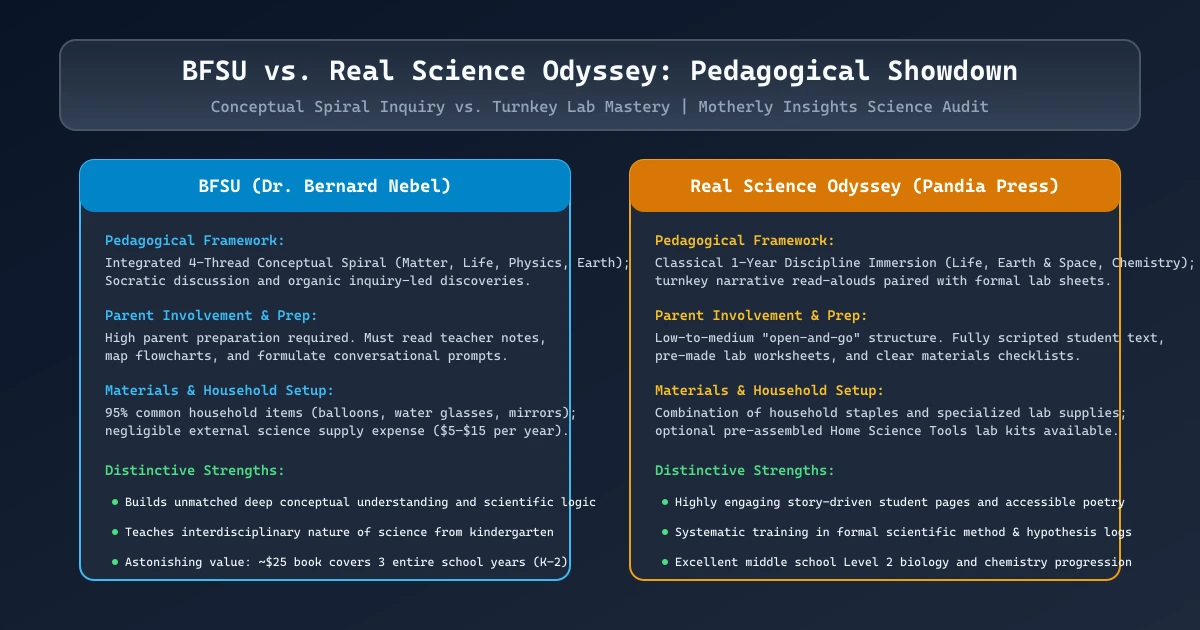
Yet their pedagogical philosophies could not be more polar opposites. BFSU is an interconnected four-thread spiral inquiry system requiring heavy parent facilitation and Socratic dialogue; RSO is a structured, open-and-go, classical discipline-by-year model with scripted student reading and pre-formatted laboratory notebooks.
This detailed curriculum comparison provides an unvarnished audit of parent prep time, experiment practicality, conceptual depth, grade-band trajectories, and long-term academic retention.
1. Executive Summary: Core Strengths & Ideal Family Profiles
| Core Metric | Choose BFSU (Dr. Nebel) If… | Choose Real Science Odyssey (RSO) If… |
|---|---|---|
| Pedagogical Philosophy | You believe science disciplines are inherently interconnected and should be taught concurrently via Socratic questioning. | You prefer the classical model: dedicating one full school year to a single discipline (Biology, Earth, Chemistry, Physics). |
| Parent Preparation Time | You have 45–60 minutes per week to read teacher notes, internalize concepts, and guide conversational experiments. | You want an “open-and-go” curriculum where the lesson text, materials list, and lab sheets are completely turnkey. |
| Student Work Materials | You prefer blank science notebooks, student sketches, nature observations, and oral synthesis over pre-printed worksheets. | You want beautifully illustrated, engaging student pages, rhymes, and structured lab worksheets with pre-printed data tables. |
| Materials Budget | You want to spend almost nothing on kits: 95% of experiments use kitchen supplies, cardboard, mirrors, and flashlights. | You prefer the convenience of ordering pre-packaged experiment kits (available through Home Science Tools) or structured checklists. |
| Annual Program Cost | ~$25 – $35 total per volume (each book spans 3 full academic school years; ~$10/year). | ~$50 – $95 per subject per year (student coursebook + teacher guide or pre-assembled kit). |
2. Pedagogical Architecture: Spiral Web vs. Classical Immersion
The BFSU Model: The Four-Thread Interconnected Spiral
Dr. Bernard Nebel, an environmental biochemist and university professor, designed BFSU around a fundamental insight: nature does not segregate itself into rigid academic boxes. A child cannot deeply understand plant biology without understanding photosynthesis (chemistry), solar radiation (physics), and soil composition (earth science).
BFSU organizes all of K–8 science into Four Concurrent Threads:
- Thread A: Nature of Matter (states of matter, molecular theory, density, air pressure, chemical reactions).
- Thread B: Life Science (plant/animal structures, fungi, habitats, human body, cell biology, genetics, evolutionary adaptation).
- Thread C: Physical Science, Energy, and Mechanics (gravity, friction, sound waves, magnetism, electricity, simple machines).
- Thread D: Earth and Space Science (water cycle, seasons, geology, plate tectonics, weather, solar system).
Rather than finishing all of Thread A before starting Thread B, parents follow a master flowchart, rotating between threads. For example, a student completes Lesson A-1 (Organizing Solids, Liquids, and Gases), then moves to B-1 (Characteristics of Living Things), then C-1 (Inertia), and D-1 (Gravity and the Earth).
Every lesson explicitly builds upon prior concepts, creating a dense, unbreakable cognitive web of scientific understanding.
The Real Science Odyssey (RSO) Model: Classical Mastery by Discipline
Pandia Press structures RSO around the classical four-year science rotation outlined in Susan Wise Bauer’s The Well-Trained Mind:
- Year 1 (Grades 1–4): RSO Biology 1 (animal kingdoms, human body systems, plant classification).
- Year 2 (Grades 2–5): RSO Earth & Space 1 (weather, geology, atmosphere, solar system exploration).
- Year 3 (Grades 3–6): RSO Chemistry 1 (atoms, molecules, periodic table, chemical bonding, acids and bases).
- Year 4 (Grades 4–7): RSO Physics 1 (motion, force, light, sound, magnetism, electrical circuits).
In RSO, a family immerses themselves in a single domain for 36 weeks. Each week follows a predictable, reassuring rhythm:
- The Reading Lesson: A 1-to-2 page narrative explanation written directly to the child in an upbeat, conversational, accessible voice.
- The Laboratory Experiment: 1 to 2 hands-on labs with clear step-by-step directions.
- The Lab Sheet: The child records their hypothesis, logs observations into pre-formatted tables, draws diagrams, and writes a conclusion.
3. Parent Prep Time & Feasibility: The Reality Check
The single biggest reason homeschooling families abandon BFSU—and the number one reason they celebrate RSO—is Parent Preparation Demand.
Living with BFSU: High Mental Effort, High Intellectual Reward
BFSU is not a student textbook; it is a teacher training manual. There are no student workbooks.
To teach a BFSU lesson effectively:
- The parent must sit down on Sunday evening and read 8 to 15 pages of Dr. Nebel’s dense academic commentary.
- The parent must understand the conceptual target, review the prerequisite flowcharts, and plan Socratic discussion prompts.
- During the lesson, the parent leads the conversation: asking guiding questions (“What happened to the water on the sidewalk after the sun came out? Where did the molecules go?”), prompting the child to deduce the scientific principle themselves.
For parents who love science or enjoy deep intellectual engagement, BFSU is unmatched. But for an exhausted parent homeschooling three kids while working part-time, preparing BFSU lessons week after week can become a major friction point.
Living with RSO: Open-and-Go Turnkey Simplicity
Real Science Odyssey is engineered for maximum family ease:
- The teacher guide provides a complete supply checklist organized by week, allowing parents to prep supplies in 5 minutes at the start of the week.
- The student text is completely self-contained. You can sit down on the living room sofa, hand the book to your 4th grader, read the lesson together, and immediately walk into the kitchen to execute the lab.
- The lab sheets guide the scientific method explicitly: Hypothesis $ ightarrow$ Materials $ ightarrow$ Procedure $ ightarrow$ Observation $ ightarrow$ Conclusion.
If you need a science program that gets done reliably without demanding weekend lesson planning, RSO is the clear practical winner.
4. Experiment Practicality & Lab Equipment
Both programs pride themselves on hands-on science, but their experimental philosophies diverge:
| Experiment Factor | Building Foundations of Scientific Understanding (BFSU) | Real Science Odyssey (RSO) |
|---|---|---|
| Apparatus Type | Kitchen & household items: baking soda, vinegar, straws, string, flashlights, water glasses, ice cubes, toy cars. | Mix of household items and authentic lab tools: test tubes, pipettes, graduated cylinders, rock specimens, chromatography paper. |
| Lab Kit Availability | No official commercial kits exist (none needed; nearly everything is in your pantry). | Optional pre-assembled kits available via Home Science Tools (containing all specialized chemicals, minerals, and hardware). |
| Inquiry Style | Deductive / experiential. The child observes a phenomenon first, questions it, and discovers the rule through guided dialogue. | Formal Scientific Method. The child learns the rule first, forms a written hypothesis, conducts the procedure, and records data. |
| “Fluff” Factor | Zero busywork or crafts. Every demonstration directly illustrates a foundational thermodynamic, biological, or chemical law. | Highly engaging. Occasional craft-like models (e.g., clay cell models, cookie plate tectonics) that kids adore. |
5. Scope, Sequence & Long-Term Trajectory (K Through 8th Grade)
The BFSU Three-Tier Progression
Dr. Nebel has authored three comprehensive volumes covering elementary and middle school:
- Volume 1 (Grades K–2): Building Foundations of Scientific Understanding (41 lessons; foundational concepts of matter, life, mechanics, earth).
- Volume 2 (Grades 3–5): Elementary Science Education (intermediate atomic structure, cellular respiration, electromagnetic waves, erosion).
- Volume 3 (Grades 6–8): Middle School Science Education (rigorous pre-high school chemistry, genetics, Newton’s laws, plate tectonics).
Students who complete BFSU Volume 3 transition into high school Honors Biology and Chemistry with a conceptual foundation that routinely outperforms public school AP students.
The RSO Level 1 vs. Level 2 Progression
Pandia Press divides RSO into two distinct developmental tiers:
- RSO Level 1 (Grades 1–5): Life 1, Earth & Space 1, Chemistry 1, Physics 1. Light, fun, highly visual, accessible to young learners.
- RSO Level 2 (Grades 6–9): Biology 2, Astronomy 2, Chemistry 2.
RSO Level 2 represents a massive, rigorous step up. Authored as a collegiate-prep middle school curriculum, Level 2 includes substantial student coursebooks, rigorous microscope labs (oil immersion lenses, cellular staining), formal lab write-ups, and challenging unit exams. RSO Biology 2 is widely regarded as one of the finest secular middle school life science courses ever published.
6. The Hybrid Compromise: How Savvy Homeschoolers Combine Both
Because many homeschooling parents love the conceptual depth of BFSU but crave the structured lab worksheets and narrative prose of RSO, a thriving community practice has emerged: The Hybrid Approach.
- Use BFSU’s Flowchart as the Master Spine: Consult Dr. Nebel’s flowchart to determine the conceptual sequence of topics.
- Use RSO Lab Sheets and Narratives for Execution: When BFSU reaches Lesson A-3 (Air is a Substance) or B-4 (Plant Cells), pull the corresponding illustrated lab pages from RSO Chemistry or RSO Life.
- Supplement with Science Living Books: Pair lessons with high-quality library literature (such as the Let’s-Read-and-Find-Out Science series, Basher Science, or Seymour Simon non-fiction).
This hybrid model delivers the cognitive brilliance of Nebel’s spiral framework with the turnkey ease of Pandia Press’s lab architecture.
7. Cost Analysis & Budget Comparison
BFSU Investment
- Textbook (Hardcover or PDF): ~$25 – $35 per volume.
- Because each volume spans three full school years, your curriculum cost is effectively $8 to $12 per year.
- Lab supplies: Negligible ($10–$20 per year in household items).
- Three-year total investment: $35 – $55.
Real Science Odyssey Investment
- Student Coursebook + Teacher Guide (Print or PDF): ~$50 – $80 per year.
- Lab Kits (Home Science Tools optional kit): ~$60 – $130 per year.
- Three-year total investment: $200 – $400.
8. Final Verdict: Which Curriculum Belongs in Your Home?
Choose BFSU if you want the absolute highest standard of conceptual scientific literacy, if you love conversational Socratic teaching, if you want an unbeatable budget-friendly program, and if you are willing to spend 45 minutes on the weekend reading teacher prep material.
Choose Real Science Odyssey if you value your time, if you want an open-and-go curriculum that your children can engage with independently or with minimal parent stress, if you prefer the classical one-discipline-per-year structure, and if your children thrive on formal lab sheets, data charts, and colorful illustrated lessons.
Sources & Reference Materials
- Nebel, Bernard J., Ph.D.: Building Foundations of Scientific Understanding: A Science Curriculum for K–8. Nebels Science / Outskirts Press.
- Lee, Blair, M.S.: Real Science Odyssey: Biology, Chemistry, and Earth & Space Series. Pandia Press.
- National Science Teaching Association (NSTA): Standards for Science Education and Inquiry-Based Science Learning.
- Next Generation Science Standards (NGSS): Crosscutting Concepts and Disciplinary Core Ideas Framework.