Ask a twelve-year-old child with dysgraphia to tell you about the Peloponnesian War, and they will speak for fifteen uninterrupted minutes with astonishing eloquence. They will analyze the naval strategy of Themistocles, contrast the agrarian oligarchy of Sparta with the maritime democracy of Athens, and cite historical casualties with effortless fluency.
Now hand that same brilliant child a piece of wide-ruled notebook paper and instruct them: “Write a three-paragraph summary of what you just said.”
Watch their body language transform instantly. Their shoulders tense and hike toward their ears. Their fingers grip the pencil with white-knuckle intensity, choking the barrel until the knuckles turn crimson. Their face contorts in visceral agony. After thirty agonizing minutes of silent suffering, punctuated by tears and broken pencil leads, they hand you three fragmented, illegible sentences:
“Sparta and Athen fought. Ships were used. Many dyed.”
To the untrained eye, this looks like laziness, defiance, or regression.
To a pediatric Occupational Therapist (OT), this is the classic, tragic signature of Developmental Dysgraphia[1].
1. The Clinical Anatomy of Dysgraphia: The Orthographic Bottleneck
Dysgraphia is not merely “poor handwriting.” Dysgraphia is an acute neurological impairment in the orthographic loop—the brain’s internal network that coordinates visual working memory, fine motor planning (praxis), and the kinesthetic sequence of letter formation[1].
When a neurotypical student writes, graphomotor execution is entirely automated. Their prefrontal cortex is 100% free to focus on vocabulary, rhetoric, and sentence structure. Their hand moves effortlessly below conscious awareness.
For a dysgraphic student, nothing is automated. Every single stroke of every letter requires deliberate, exhausting conscious calculation:
- Where does the lowercase ‘d’ begin? At the top or the middle?
- Which direction does the circle point? Left or right?
- How much physical pressure should I exert so the graphite does not snap?
- How much space must I leave between words?
By the time the child finishes drawing the fifth letter of a word, their working memory has been wiped completely clean. The brilliant sentence they formulated in their mind has vanished. To survive the trauma of physical writing, the child engages in expressive truncation: they deliberately choose the shortest, simplest, most infant-like words possible simply because their hand cannot physically bear the labor of transcription[2].
| Dysgraphia Subtype | Primary Neurological Root | Clinical Presentation in Homeschooling |
|---|---|---|
| 1. Motor Dysgraphia | Deficient fine motor coordination & muscle tone (hypotonia). | Illegible print and cursive; white-knuckle pencil grip; hand cramps within 3 minutes; normal oral spelling. |
| 2. Spatial Dysgraphia | Impaired spatial perception & visual-spatial organization. | Inability to stay on printed lines; wildly inconsistent letter sizing and spacing; words colliding into page margins. |
| 3. Dyslexic Dysgraphia | Phonological processing deficit disrupting orthographic retrieval. | Spontaneous written work is severely misspelled and illegible; copied text from a book looks neat; oral reading is impaired. |
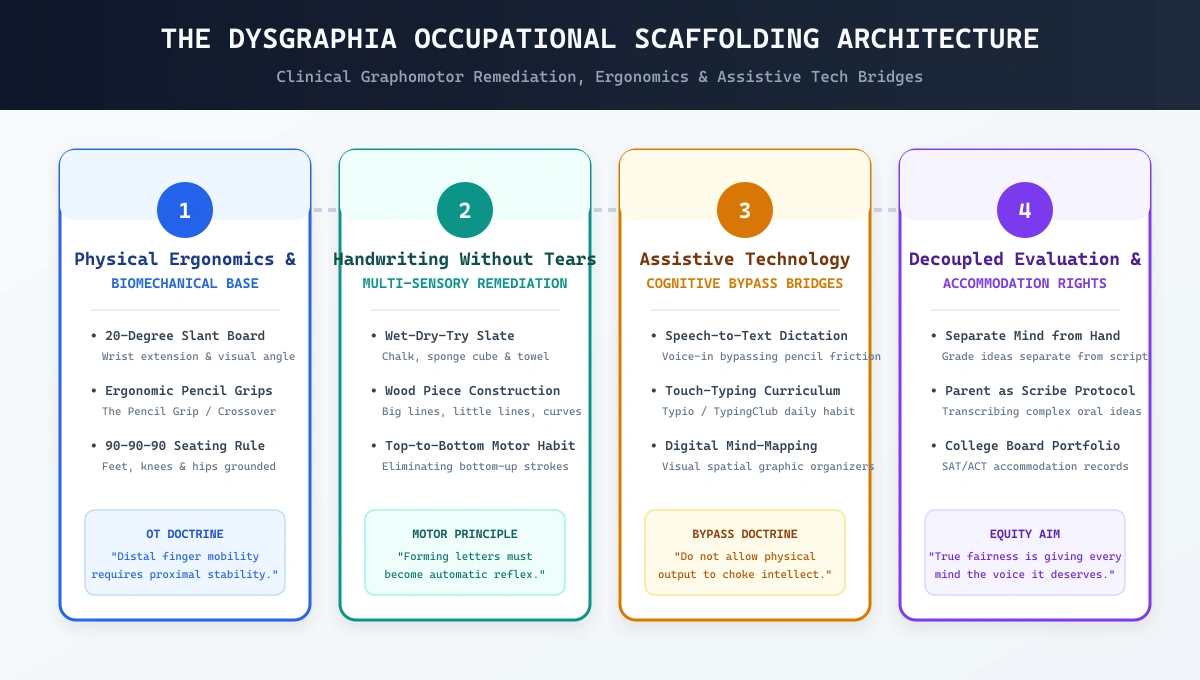
2. The Golden Rule of Home Coaching: Decouple Composition from Transcription
In traditional school classrooms, children are graded on a composite score where ideas, spelling, grammar, and handwriting neatness are lumped together into a single red-pen grade. For a dysgraphic learner, this pedagogical practice is psychologically devastating.
The supreme commandment of home education for dysgraphia is: NEVER evaluate cognitive composition and physical transcription on the same piece of paper[3].
How to Implement Decoupling:
- Act as Your Child’s Scribe: When your child is outlining an essay, writing a history report, or brainstorming a science hypothesis, remove the pencil from their hand entirely. Let them pace the room or sit on an exercise ball while you type their spoken words verbatim into a document. Seeing their complex, sophisticated thoughts appear on screen restores their academic self-worth.
- Designate Pure Handwriting as an Isolated 10-Minute Motor Lab: When practicing handwriting mechanics, do not ask the child to think creatively. Have them trace three letters on a slate or write three discrete words. When the focus is motor mechanics, remove cognitive load. When the focus is cognitive load, remove motor friction.
3. Occupational Therapy Biomechanics: Setting the Physical Foundation
Distal finger mobility (the fine movement of fingertips) requires proximal stability (a sturdy, grounded trunk, shoulder girdle, and wrist). You cannot fix messy handwriting if the child’s body is slumping in an unsupportive chair[4].
A. The 90-90-90 Seating Rule
Ensure your child’s study chair supports their anatomy at three right angles:
- Feet resting flat on a solid surface (use a footstool or wooden yoga blocks if their legs dangle).
- Knees bent at 90 degrees.
- Hips seated fully back against the chair at 90 degrees. When feet dangle, the core abdominal muscles engage constantly to prevent falling, stealing vital energy from the fine motor muscles of the writing hand.
B. The 20-Degree Slant Board
Place all writing paper on a 20-degree wooden or acrylic slant board (or a sturdy 3-inch three-ring binder turned sideways). The slant board naturally forces the wrist into functional extension (tilted back slightly toward the forearm), which automatically stabilizes the arch of the hand and promotes a relaxed dynamic tripod grasp. It also elevates the text closer to eye level, preventing visual fatigue and neck strain.
C. Ergonomic Pencil Grips & Heavy Implements
- The Pencil Grip (Ultra / Crossover): Soft silicone grips with molded finger pockets that prevent thumb-wrapping and force the thumb and index finger into an open web space.
- Weighted Pencils: For children with proprioceptive processing deficits who press too hard or too lightly on paper, a weighted pencil provides deep sensory feedback directly to the joints of the hand.
4. Multi-Sensory Graphomotor Remediation: Handwriting Without Tears (HWT)
Developed by occupational therapist Jan Olsen, the Handwriting Without Tears system is the undisputed clinical standard for dysgraphia intervention[2]:
| HWT Multi-Sensory Tool | Clinical Method | Neurological Function |
|---|---|---|
| Wet-Dry-Try Slate | 1. Parent writes letter with chalk on 4x6 slate. 2. Child traces with damp sponge cube (Wet). 3. Child traces with crumpled paper towel (Dry). 4. Child writes with tiny chalk bit (Try). |
Simultaneous tactile, thermal, and kinesthetic repetition without paper friction. |
| Wood Piece Construction | Child physically snaps Big Lines, Little Lines, Big Curves, and Little Curves onto a blue foam mat to construct capital letters. | Eliminates visual spatial confusion; teaches that letters are modular physical shapes. |
| Top-to-Bottom Habit | Teach the universal motor rule: “Letters always start at the top!” Sing the iconic HWT song. | Eliminates inefficient, exhausting bottom-up pencil strokes that cause handwriting fatigue. |
5. The Assistive Technology Bridge: Empowering the Modern Thinker
While occupational remediation improves handwriting stamina, parents must accept a biological reality: handwriting may never become a frictionless medium for a severely dysgraphic teen. Assistive technology is not “cheating”; it is an essential cognitive prosthesis[1].
| Assistive Tech Category | Recommended Software & Tools | Practical Homeschool Workflow |
|---|---|---|
| Speech-to-Text (STT) | Google Docs Voice Typing, Apple Dictation, Dragon Professional. | Train the child to vocalize punctuation (“comma,” “period,” “new line”) while speaking thoughts. |
| Touch-Typing Instruction | Typio, TypingClub, Nessy Fingers. | Practice 15 minutes daily; achieving 25 WPM permanently bypasses handwriting fatigue. |
| Digital Mind-Mapping | MindMeister, Inspiration Maps, Canva Whiteboards. | Drag-and-drop ideas visually into bubble webs before expanding into sentences. |
| Smartpens & Note Capture | Livescribe Symphony, Rocketbook, iPad + Apple Pencil. | Audio-records parent explanations synced to handwritten strokes, relieving panic note-taking. |
6. Securing Official Accommodations: College Board & SAT/ACT
One of the great advantages of homeschooling a dysgraphic learner is building a comprehensive, audit-proof paper trail that guarantees their legal right to testing accommodations on the PSAT, SAT, ACT, and AP exams:
| Educational Milestone | Essential Documentation Action | College Board Accommodations Secured |
|---|---|---|
| Middle School (Grades 6–8) | Obtain a formal psychoeducational or OT evaluation confirming graphomotor deficits. Document daily homeschool accommodations in your annual educational plan. | Establishes the required longitudinal history of disability required by testing boards. |
| Freshman Year (Grade 9) | Formulate a formal Homeschool Student Accommodation Plan (SAP) detailing: 50% extended time on essay exams, use of a word processor, and speech-to-text. | Meets the requirement that accommodations must be standard school practice for $ge 4$ months. |
| Sophomore Year (Grade 10) | Submit the accommodation request to the College Board Services for Students with Disabilities (SSD) portal prior to taking the PSAT. | Secures 50% Extended Time (Time and a Half), Computer for Essays, and Scribe for bubbling answer sheets. |
Practical Implementation: The First 30 Days
| Week | Primary Focus | Actionable Occupational Therapy Protocol |
|---|---|---|
| Week 1: Biomechanics | Desk & Seating Ergonomics | Install the 20-degree slant board. Adjust chair height for 90-90-90 posture. Test Crossover pencil grips. |
| Week 2: Scribing Relief | Decoupling Composition | Declare a 1-week moratorium on pencil writing for all academic subjects. Act as full-time scribe for all essays. |
| Week 3: Multi-Sensory HWT | Top-to-Bottom Slate Work | Introduce the Wet-Dry-Try slate for 10 minutes daily. Target the most frequently reversed letters (b/d, p/q). |
| Week 4: Tech Transition | Voice-to-Text & Typing | Set up Google Docs Voice Typing with a noise-canceling headset. Complete the first three lessons of Touch Typing. |
Dysgraphia does not mean your child cannot write; it simply means their extraordinary thoughts travel along a different biological pathway than their pencil. When you remove the shame, adapt the biomechanics, and hand them modern assistive tools, you unleash their authentic intellectual voice—freeing them to craft powerful, eloquent, and fearless contributions to the world.
Disclaimer: This post is for informational and educational purposes only, accurate to the best of our knowledge at publication. It does not constitute advice. We do not guarantee accuracy or completeness and accept no liability for any decisions or losses resulting from reliance on this content.