When parents withdraw a child with Attention-Deficit/Hyperactivity Disorder (ADHD), dyslexia, dyscalculia, or dysgraphia from institutional public school, they are often recovering from years of academic trauma. In traditional classrooms, neurodivergent children are routinely mislabeled as “lazy,” “careless,” or “unmotivated” because standard educational materials are fundamentally mismatched with their neurological architecture.
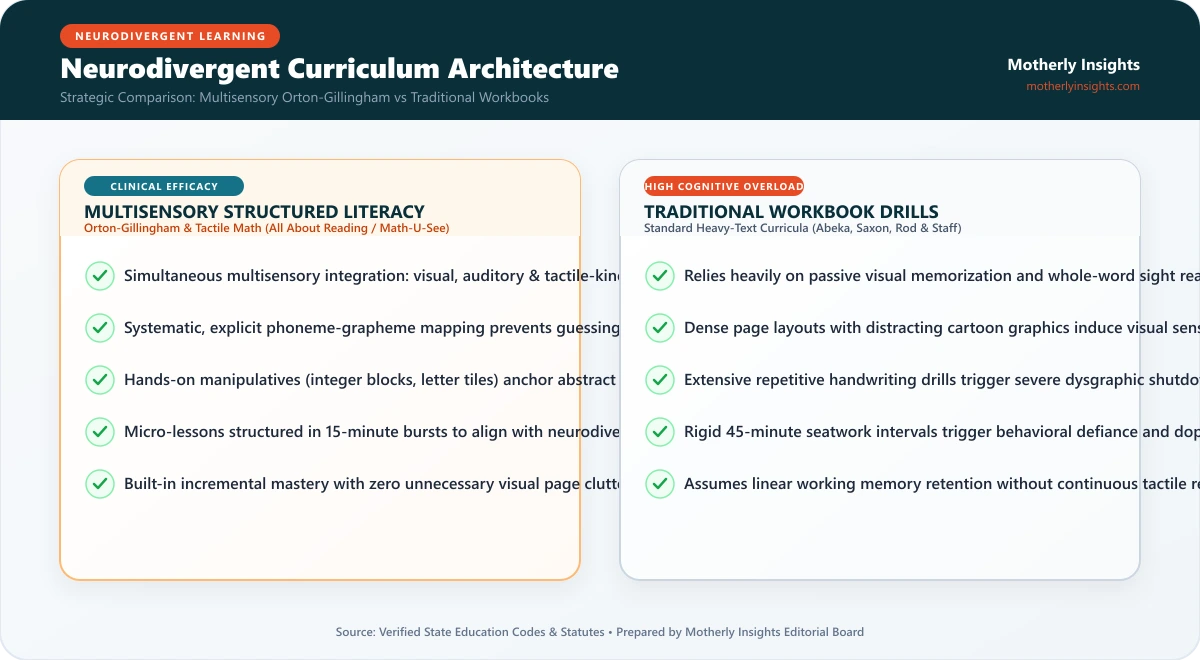
Standard textbooks rely on linear working memory, prolonged sedentary focus, dense page layouts filled with distracting cartoon illustrations, and rapid-fire visual memorization. For a brain characterized by dopamine regulation challenges, phonological processing deficits, or spatial working memory constraints, this approach triggers cognitive shutdown and emotional defiance.
At home, parents hold the extraordinary power to rebuild their child’s confidence using evidence-based multisensory curricula, structured literacy, and executive function scaffolds. This guide reviews the top-performing homeschool curricula for ADHD and dyslexia, backed by clinical research and practical home instructional strategies.
1. The Neurodivergent Learning Profile: Why Traditional Curricula Fail
To choose effective curriculum, parents must understand the neurological bottlenecks specific to ADHD and dyslexia:
1. Working Memory Constriction
Working memory is the brain’s mental scratchpad—the ability to hold and manipulate information while completing a task. Children with ADHD and dyslexia possess significantly smaller working memory capacities. When a curriculum requires a child to simultaneously remember a math formula, write a digit on paper, hold a pencil, and resist auditory distractions, their scratchpad overflows, resulting in catastrophic frustration.
2. Dopamine Deficiency & Attention Pacing
ADHD is primarily an executive function impairment driven by irregular dopamine signaling in the prefrontal cortex. Children with ADHD do not lack attention; rather, they lack the neurochemical mechanism to regulate attention on tasks that lack intrinsic novelty, urgency, or multisensory feedback.
3. Phonological Deficit (The Reading Gap)
Dyslexia is not a visual problem involving “seeing letters backward.” It is a neurobiological deficit in the phonological processing system of the brain—the ability to isolate, segment, and blend the individual sound units (phonemes) that map onto written letters (graphemes).
2. Premier Dyslexia Curricula: Orton-Gillingham Structured Literacy
Children with dyslexia cannot learn to read through sight words, exposure, or contextual guessing (“cueing” systems). They require Orton-Gillingham (OG) instruction: systematic, explicit, cumulative, and multisensory phoneme-grapheme instruction.
1. All About Reading (AAR) & All About Spelling (AAS)
- Methodology: Orton-Gillingham (Marie Rippel).
- Format: Parent-led, scripted lessons with magnetic letter tiles, flashcards, and hardcover decodable readers.
- Why It Works for Dyslexia & ADHD:
- Zero Guessing: Readers contain 100% decodable text; children are never asked to read a word containing phonics patterns they have not explicitly mastered.
- Tactile Engagement: Children physically move color-coded phonogram tiles to construct words, engaging touch, sight, and sound simultaneously.
- Uncluttered Visuals: Workbooks and readers feature clean, minimalist layouts with soothing illustrations that eliminate visual overwhelm.
- Parent Lift: Moderate. The lessons are completely scripted (“open-and-go”), eliminating prep work for parents.
2. Logic of English (Foundations & Essentials)
- Methodology: Systematic Linguistic Phonics (Denise Eide).
- Format: Comprehensive Language Arts (Phonics, Reading, Handwriting, Spelling, Grammar).
- Why It Works for Dyslexia & ADHD:
- Answers the “Why”: Teaches the 75 basic phonograms and 31 spelling rules that explain 98% of the English language. Highly inquisitive children who hate rote memorization thrive when taught the logical rules governing silent final E and hard/soft C.
- High-Kinesthetic Games: Incorporates active gross-motor games (jumping on phonogram cards, swatting sounds with flyswatters) that channel ADHD energy productively.
- Integrated Cursive: Teaches lowercase cursive first, which significantly reduces letter reversals (such as
bandd) by eliminating pencil-lift starting points.
3. Barton Reading & Spelling System
- Methodology: Pure Clinical Orton-Gillingham (Susan Barton).
- Format: Intensive 10-level intervention system with script manuals and color-coded wooden/app tiles.
- Why It Works: Widely regarded by clinical neuropsychologists as the gold standard for moderate to severe dyslexia. Designed specifically so that parents with zero background in education can deliver one-on-one dyslexia tutoring equivalent to a certified private clinician charging $100/hour.
3. Premier Math Curricula for ADHD & Dyscalculia
Standard math curricula (such as Saxon or Abeka) rely on dense worksheets with 30 to 50 repetitive problems per page, tiny fonts, and abstract memorization. For children with ADHD and dyscalculia, this format triggers visual fatigue and working memory failure.
1. Math-U-See (Demme Learning)
- Methodology: Concrete-Representational-Abstract (CRA) Mastery.
- Why It Dominates Special Needs Homeschooling:
- Manipulative Integer Blocks: Students build every concept physically before drawing it on paper or writing mathematical symbols. Adding fractions, multi-digit multiplication, and polynomial factoring are learned by locking tactile blocks together.
- Visually Minimalist Workbooks: Pages are black-and-white, feature generous white space, and contain only 15 to 20 problems per page. This single design feature prevents visual crowding meltdowns.
- Short Video Instruction: Engaging 5-minute video lessons taught by founder Steve Demme explain complex concepts with humor and clarity.
2. RightStart Mathematics
- Methodology: Dr. Joan A. Cotter, Hands-On Cognitive Development.
- Why It Works:
- The AL Abacus: Bypasses finger-counting by training children to visualize numbers in groups of five and ten (subitizing).
- Card Games Instead of Worksheets: Fact fluency and addition/subtraction drills are conducted through interactive card games rather than timed flashcards or timed worksheets, eliminating performance anxiety for ADHD learners.
4. Head-to-Head Neurodivergent Curriculum Matrix
| Curriculum | Primary Subject | Target Differences | Key Strengths | Considerations |
|---|---|---|---|---|
| All About Reading | Reading / Phonics | Dyslexia, ADHD | 100% decodable, magnetic tiles, zero page clutter | Separate spelling program required |
| Logic of English | Full Language Arts | Dyslexia, ADHD | High gross-motor games, systematic spelling rules | Fast-paced; requires teacher prep |
| Barton Reading | Reading / Spelling | Severe Dyslexia | Clinical-grade OG, foolproof parent scripts | High financial investment ($300+/level) |
| Math-U-See | K–12 Mathematics | ADHD, Dyscalculia | Manipulative integer blocks, uncluttered pages | Non-traditional subject sequencing |
| RightStart Math | Elementary Math | ADHD, Working Memory | Math card games, abacus visualization | High daily parent interaction |
5. Accommodating Dysgraphia & Executive Dysfunction
Dysgraphia (a neurological impairment in fine-motor transcription) and executive dysfunction frequently co-occur with ADHD and dyslexia. Parents must implement strategic accommodations:
1. The Oral Scribe Strategy
When a child is learning history, science, or literature, never let handwriting become the gatekeeper of their intellect.
- If a 4th-grader has brilliant ideas but writes at a Kindergarten level, act as their scribe: the child dictates their thoughts aloud while the parent types or writes them down.
- Separate handwriting instruction (practiced for 10 minutes separately) from composition and intellectual thinking.
2. Early Touch-Typing & Speech-to-Text
Introduce typing by 3rd or 4th grade using specialized gamified programs like Typefully or TypingClub. By middle school, train students to utilize speech-to-text dictation tools (such as Google Voice Typing or Dragon) to draft long essays effortlessly.
3. The 15-Minute Rule (Micro-Lessons)
The attention span of an ADHD child for direct instruction is approximately their chronological age in minutes (capped at 15–20 minutes maximum):
- Conduct a 15-minute high-intensity sprint (e.g., 5 math problems with integer blocks).
- Follow immediately with a 5-minute “heavy-work” proprioceptive break: jumping on a rebounder trampoline, hanging from monkey bars, or wheelbarrow walks. Heavy physical work activates joints and muscles, releasing serotonin and dopamine to reset the nervous system.
4. Environmental Optimization
- Ditch the Traditional Desk: Allow your child to complete math on a large dry-erase whiteboard while standing, read literature while swinging in a sensory hammock, or sit on an active balance ball.
- Visual Timers: Use a physical Time Timer where a red disk visually shrinks as time passes. Children with ADHD suffer from “time blindness”; seeing time physically disappear provides immediate cognitive grounding.
When you tailor curriculum to your child’s neurological strengths rather than punishing their developmental wiring, their anxiety dissolves, their innate intelligence shines, and home education becomes the transformative gift it was always meant to be.
*Disclaimer: This post is for informational and educational purposes only, accurate to the best of our knowledge at publication. It does not constitute medical or clinical advice. We do not guarantee accuracy or completeness and accept no liability for any decisions or losses resulting from reliance on this content.*