
Standardized testing is one of the most polarizing milestones in the homeschooling calendar. For parents in high-regulation states—such as New York, Pennsylvania, North Carolina, Georgia, Minnesota, and Oregon—annual or periodic testing is a statutory legal mandate required to maintain lawful home education status. For others in low-regulation states, testing is a voluntary diagnostic tool used to identify academic gaps, confirm curriculum effectiveness, or prepare children for high-stakes college entrance exams.
However, choosing the right assessment instrument can be overwhelming. Test publishers utilize dense psychometric terminology—norming samples, stanines, percentile ranks, scaled scores, and grade equivalents—while offering drastically different administration formats (paper-and-pencil bubble sheets vs. dynamic computer-adaptive algorithms).
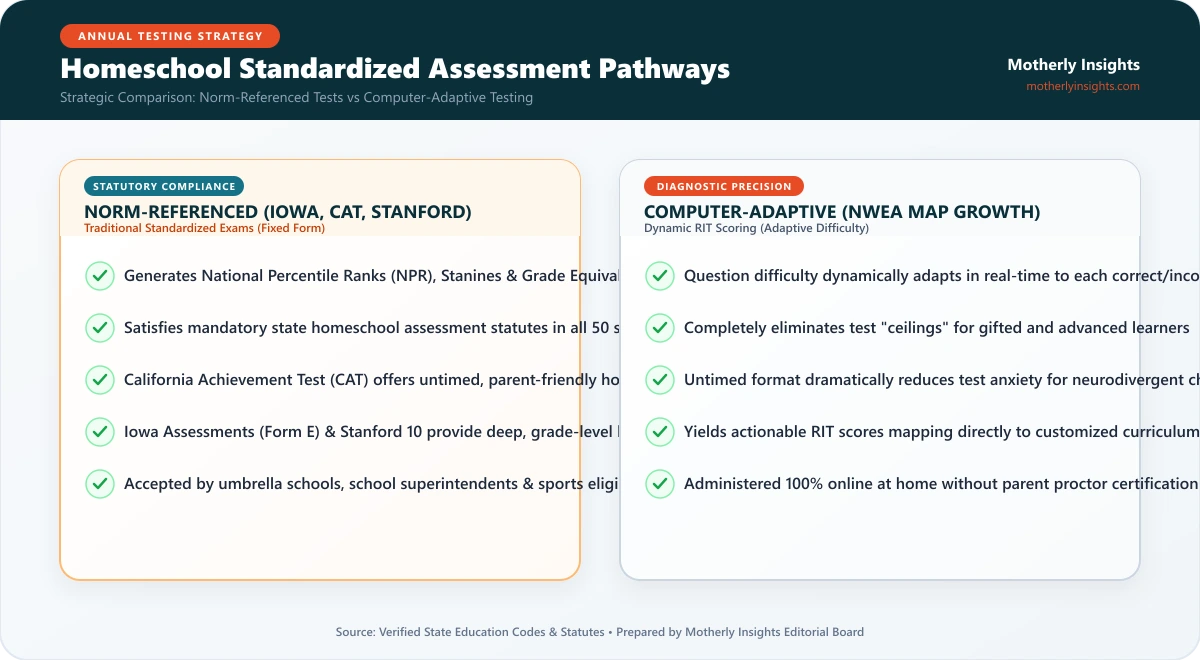
This guide delivers an authoritative, comparative breakdown of the premier homeschool standardized tests: the Iowa Assessments, Stanford 10, California Achievement Test (CAT), and NWEA MAP Growth, detailing state compliance rules, proctor qualifications, score interpretation, and accommodations for neurodivergent learners.
1. Statutory State Testing Requirements
Across the 50 United States, statutory assessment mandates generally fall into three distinct regulatory tiers:
1. Mandatory Annual Testing (Strict Submission or Retention)
- North Carolina (G.S. § 115C-564): Homeschoolers must administer a nationally standardized achievement test annually to every enrolled student covering reading, language arts, and mathematics. Scores must be retained on file for one year and presented to state division inspectors upon request.
- New York (8 CRR-NY § 100.10): Testing is required every other year in grades 4–8 (alternating with written narrative evaluations) and annually in grades 9–12. Composite scores must be submitted to the local superintendent.
- Georgia (O.C.G.A. § 20-2-690): Students must take a nationally normed achievement test every three years beginning at the end of third grade. Results are retained privately by parents with no requirement to submit to school districts.
- Pennsylvania (Act 169 / Act 196): Standardized testing is required in grades 3, 5, and 8, with scores submitted to the annual evaluator.
2. The Statutory Benchmark Threshold
In states requiring test score submission, the statutory definition of “adequate academic progress” is typically set at the composite 33rd or 40th percentile.
If a student scores above the 33rd percentile nationally, they are legally compliant. A score below the statutory threshold rarely triggers immediate revocation of homeschool rights; rather, states typically provide a one-to-two-year probationary remediation period or permit a certified teacher’s narrative evaluation to override anomalous test anxiety.
2. In-Depth Test Comparison: Which Test Fits Your Student?
Each standardized assessment is built upon a distinct pedagogical philosophy and testing format. Selecting the appropriate test depends on your child’s anxiety threshold, attention span, and your state’s proctoring rules.
1. California Achievement Test (CAT)
- Format: Paper-and-pencil or 100% online.
- Timing: Available in both Timed and Untimed formats.
- Grade Levels: Grades K–12.
- Proctor Requirements: None. Can be administered by parents in their living room.
- Strengths: The CAT (particularly through vendors like Christian Liberty Press, Seton Testing Services, or Academic Excellence) is the most popular homeschool test in America due to its speed, low cost ($25–$40), and flexibility. The untimed version eliminates speed pressures, allowing children with ADHD, dyslexia, or processing speed challenges to demonstrate genuine mastery.
- Considerations: The traditional 1970 CAT edition utilizes older norming data. While legally accepted in states requiring nationally normed tests, parents seeking deep diagnostic alignment with modern STEM standards often prefer newer versions like the TerraNova (CAT/6).
2. Iowa Assessments (Form E & Form G)
- Format: Paper bubble sheet or secure online browser lock-down.
- Timing: Strictly Timed.
- Grade Levels: Grades K–12.
- Proctor Requirements: Proctor must hold a Bachelor of Arts or Bachelor of Science degree (or use an approved virtual testing service).
- Strengths: Developed by the University of Iowa College of Education, the Iowa Assessments represent the gold standard of traditional educational psychometrics. Renowned for academic rigor, the test covers Reading, Written Expression, Mathematics, Science, Social Studies, and Information Sources.
- Considerations: Timed testing can induce severe anxiety in sensitive learners. Strict time limits mean that a slow, meticulous reader may leave entire sections blank, artificially deflating their percentile rank.
3. Stanford Achievement Test (Stanford 10 / SAT-10)
- Format: Paper-and-pencil or 100% online.
- Timing: Completely Untimed by psychometric design.
- Grade Levels: Grades K–12.
- Proctor Requirements: No degree required for online administration; paper tests often require certified proctor approval.
- Strengths: Unlike the Iowa test, the Stanford 10 is designed from the ground up as an untimed assessment. Students are permitted as much time as they need to complete each subtest, provided they remain on task. It delivers high-caliber, comprehensive academic benchmarking without time-induced panic.
- Considerations: Because it is comprehensive and untimed, administering the full battery can take 4 to 6 hours spread across multiple mornings.
4. NWEA MAP Growth (Northwest Evaluation Association)
- Format: 100% Online, Computer-Adaptive.
- Timing: Untimed (typically 45–60 minutes per subject).
- Grade Levels: Grades K–12.
- Proctor Requirements: Administered remotely at home via certified homeschool testing partners (e.g., Homeschool Boss, Affordable Homeschool Testing).
- Strengths: MAP Growth is the most technologically advanced assessment available. As the student answers questions, the testing algorithm adapts difficulty in real-time. If a student answers correctly, the next question becomes harder; if they answer incorrectly, it becomes easier.
- Zero Test Ceiling: A gifted 4th grader is not restricted to 4th-grade questions; the system dynamically advances into 6th or 8th-grade concepts to pinpoint their exact ceiling.
- Actionable RIT Scores: Generates a continuous scale score (Rasch Unit) that tracks precise month-over-month cognitive growth regardless of grade level.
3. Head-to-Head Comparison Matrix
| Assessment Feature | California Achievement Test (CAT) | Iowa Assessments (Form E) | Stanford 10 (SAT-10) | NWEA MAP Growth |
|---|---|---|---|---|
| Testing Format | Online or Paper | Online or Paper | Online or Paper | 100% Computer-Adaptive |
| Timing Policy | Timed & Untimed Options | Strictly Timed | Strictly Untimed | Completely Untimed |
| Proctor Degree Rule | None (Parent proctored) | Bachelor’s Degree Required | None for Online | None (Virtual Proctor) |
| Core Subjects | Reading, Language, Math | Reading, Lang, Math, Sci, SS | Reading, Lang, Math, Sci, SS | Math, Reading, Language |
| Cost Range | $25 – $40 | $40 – $65 | $40 – $60 | $60 – $110 |
| State Law Accepted? | 100% Yes | 100% Yes | 100% Yes | 100% Yes |
| Best For | Low stress, quick legal filing | High rigor, traditional testing | Detailed untimed testing | Gifted / Adaptive diagnosis |
4. Decoding the Score Report: Percentiles vs. Grade Equivalents
When testing reports arrive, parents frequently misinterpret the data, leading to unnecessary panic or premature curriculum acceleration.
1. National Percentile Rank (NPR) vs. Percentage Correct
The single most common mistake is confusing Percentile Rank with a school Grading Percentage:
- Percentage Correct: In classroom grading, an 80% means a student earned a
B-and missed 20% of the material. - National Percentile Rank (NPR): An NPR of 80 means your child scored higher than 80% of all children across the United States who took the identical test. A 50th percentile is exactly average. Scores between the 25th and 75th percentiles represent the normal, healthy bell curve of standard academic development.
2. Stanines (Standard Nines)
Stanines divide the normal bell curve into nine equal statistical bands (1 through 9):
- Stanines 1, 2, 3: Below average (lower 23% of the population).
- Stanines 4, 5, 6: Solid average range (middle 54% of the population).
- Stanines 7, 8, 9: Above average to gifted (top 23% of the population).
3. The Grade Equivalent (GE) Fallacy
If your 4th-grade student receives a Grade Equivalent score of 7.4 in Mathematics, this does not mean your child is ready for 7th-grade Pre-Algebra.
A Grade Equivalent score of 7.4 simply indicates that your 4th-grader performed on 4th-grade math concepts as well as a typical 7th-grader in the fourth month of school would have performed if given that exact same 4th-grade test. It measures high accuracy and deep mastery of grade-level content, not readiness for advanced secondary material.
5. Accommodations for Neurodivergent Learners
For children with ADHD, dyslexia, dyscalculia, or autism spectrum disorder, traditional standardized testing can be an agonizing exercise in executive dysfunction.
Because homeschool parents act as educational administrators, you have the legal and pedagogical right to implement reasonable accommodations under Americans with Disabilities Act (ADA) and Section 504 principles:
- Select an Untimed Assessment: Never force a child with processing speed challenges into a timed Iowa exam. Opt for the untimed Stanford 10, untimed online CAT, or adaptive NWEA MAP.
- Break Sessions into Bite-Sized Increments: Do not administer an entire test battery in a single exhausting four-hour marathon. Administer one 30-minute subtest per morning over five consecutive days.
- Allow Sensory & Motor Breaks: Permit fidget tools, noise-canceling headphones, balance balls, and five-minute jumping jack breaks between test sections.
- Read-Aloud Accommodations: For math and science subtests, parents can read directions and non-reading-comprehension questions aloud to ensure dyslexia does not artificially mask high mathematical reasoning.
Standardized testing is a single data snapshot on a single morning; it does not measure creativity, character, emotional resilience, or critical thinking. By choosing the assessment format that honors your child’s nervous system, you fulfill state legal obligations while keeping learning joyful and confident.
*Disclaimer: This post is for informational and educational purposes only, accurate to the best of our knowledge at publication. It does not constitute advice. We do not guarantee accuracy or completeness and accept no liability for any decisions or losses resulting from reliance on this content.*