
One of the most persistent anxieties facing homeschooling families as their children approach graduation is the legal validity of the credential itself: “Is a diploma signed by a parent actually legitimate?”
Well-meaning relatives, misinformed college admissions clerks, human resources recruiters, and commercial curriculum vendors frequently perpetuate myths—claiming that homeschoolers need an “accredited” diploma, must register with a commercial umbrella school, or are legally required to take the GED (General Educational Development) test to prove high school completion.
Under both United States federal law and individual state compulsory attendance statutes, these claims are legally false.
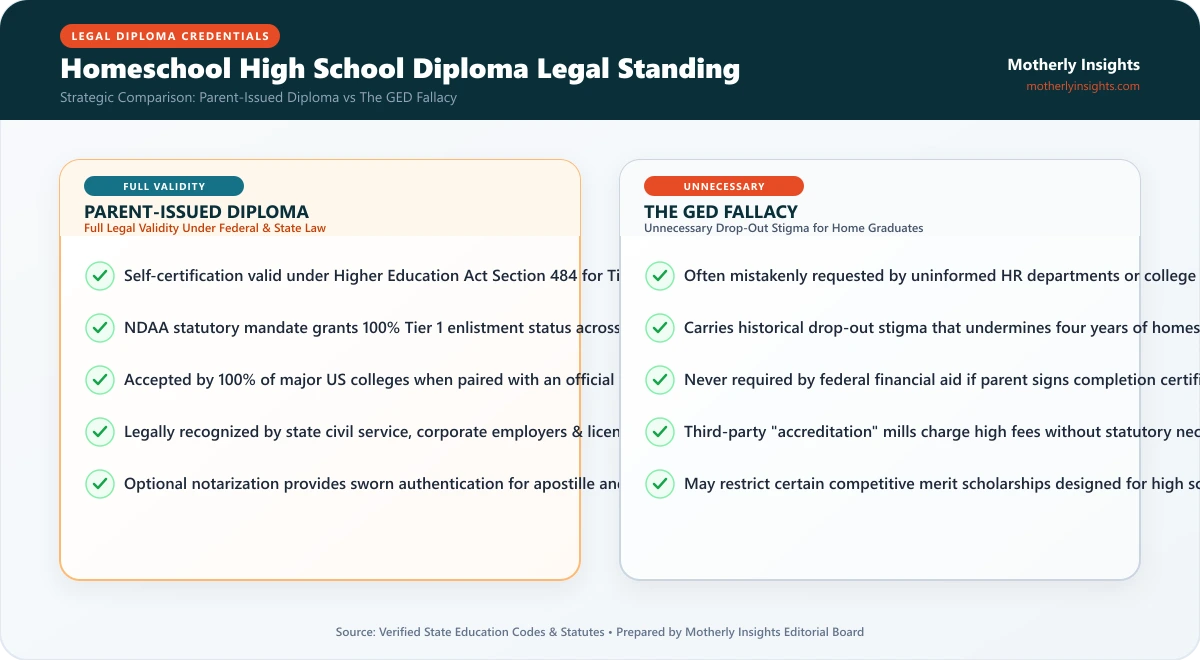
A parent-issued homeschool diploma, accompanied by a comprehensive official homeschool transcript, is a 100% legally recognized, valid secondary educational credential across all 50 states. This guide details the federal statutory protections, state-specific legal frameworks, military enlistment rights, and notarization protocols governing homeschool diplomas.
1. The Legal Authority: Why Parent-Issued Diplomas Are Valid
Under the United States Constitution and landmark Supreme Court jurisprudence (including Pierce v. Society of Sisters and Wisconsin v. Yoder), the fundamental right to direct the education of children resides with parents.
State legislatures regulate secondary education by defining compulsory school attendance ages and compliance pathways (e.g., home education exemptions, private tutor models, or non-accredited private schools). When a family operates within their state’s statutory homeschool framework and the student satisfies the parent’s secondary curriculum standards:
- The student has lawfully completed compulsory high school education.
- The homeschooling parent, serving as the chief administrative officer of the home school, holds the sole authority to confer graduation.
- The resulting diploma is an authentic, legally enforceable high school completion document.
No federal law, state education department, or municipal school district has the statutory power to invalidate a properly issued homeschool diploma that complied with state law.
2. Federal Statutory Protections
Homeschool graduates are protected by explicit federal statutes ensuring equal treatment across higher education and military service.
Higher Education Act (Title IV Federal Financial Aid / FAFSA)
For decades, universities occasionally claimed they could not disburse federal financial aid (Pell Grants, Stafford Loans, work-study) to homeschoolers without a traditional public school diploma or GED.
Congress permanently eradicated this barrier in the Higher Education Act of 1965 (20 U.S.C. § 1091(d)(3)):
- A student is legally eligible for Title IV federal student aid if they have completed a secondary school education in a home school setting that qualifies as an exemption from compulsory attendance requirements under state law.
- Self-Certification: The U.S. Department of Education’s Federal Student Aid Handbook explicitly confirms that a student self-certifies homeschool graduation on the FAFSA form. Colleges cannot condition federal aid on obtaining a GED or presenting a state-issued diploma.
National Defense Authorization Act (Military Enlistment Tier 1 Status)
Historically, the United States Armed Forces categorized recruits into tiers based on educational credentials. Public and private high school diploma holders were classified as Tier 1 (highest enlistment priority, eligible for all military occupational specialties and enlistment bonuses), while GED recipients were relegated to Tier 2 (strict quotas and limited bonuses).
Early military regulations mistakenly placed homeschool graduates into Tier 2. However, following aggressive legislative advocacy, the National Defense Authorization Act (NDAA) codified into law that homeschool graduates must be treated as Tier 1 recruits across all service branches (Army, Navy, Air Force, Marine Corps, Coast Guard, and Space Force), provided they obtain a qualifying score on the Armed Services Vocational Aptitude Battery (ASVAB).
3. The Accreditation Fallacy: Why You Don’t Need It
Perhaps the most profitable industry in homeschool marketing is the sale of “accredited” high school diplomas. Commercial umbrella schools and curriculum conglomerates routinely charge thousands of dollars under the pretense that unaccredited diplomas are worthless.
Understanding Regional Accreditation
Accreditation is an institutional evaluation process. Regional accrediting bodies (such as Cognia/SACS, Middle States Association, WASC, or New England Association) evaluate brick-and-mortar schools and universities: their physical facilities, teacher credential ratios, financial stability, and governance boards.
- Schools get accredited; students and diplomas do not.
- When an individual homeschool operates independently, there is no physical school to accredit.
- Admissions Reality: Over 99% of accredited four-year colleges and universities in the United States routinely admit independently homeschooled students with unaccredited, parent-issued diplomas.
Colleges do not evaluate applicants by the gold foil seal on their diploma; they evaluate the Official Homeschool Transcript, SAT/ACT/CLT scores, college dual enrollment grades, essays, and extracurricular portfolios.
4. State-Specific Diploma Nuances
While parents hold graduation authority in all 50 states, several jurisdictions provide explicit statutory frameworks:
Texas: Texas Education Code § 51.9241
Texas law contains the nation’s strongest homeschool non-discrimination statute. Under TEC § 51.9241:
- Texas public institutions of higher education and state agencies must treat graduates of non-traditional secondary education (homeschools) on an equal footing with graduates of public schools.
- Colleges are prohibited from requiring homeschool graduates to take additional examinations or present a GED.
Pennsylvania: Act 196 (Three Diploma Pathways)
Pennsylvania offers three distinct diploma options under PA Public School Code:
- Parent-Issued Diploma: Under Act 196 (effective since 2014), a parent-issued diploma signed by the homeschool supervisor and co-signed by the annual evaluator has full statutory standing identical to a public school diploma.
- Evaluator-Issued Diploma: Certified teachers or evaluators issue a completion certificate.
- PHEA/Accredited Organization Diploma: Issued through independent state homeschool organizations.
New York: Letter of Substantial Equivalency
In New York State, high school homeschoolers submit an Individualized Home Instruction Plan (IHIP) and quarterly reports under Section 100.10. Upon completion of 12th grade, parents request a Superintendent’s Letter of Substantial Equivalency confirming the student fulfilled all graduation requirements, which serves as official state verification alongside the parent diploma.
Florida: F.S. § 1002.41 & F.S. § 1003.4282
In Florida, homeschooling is codified under F.S. § 1002.41. The parent executes the high school graduation standards and confers the diploma. Florida colleges and the Bright Futures Scholarship Program accept parent-issued transcripts and diplomas without reservation.
5. Why You Should Never Take the GED
When encountering an ill-informed employer or community college clerk who asks, “Can you just take the GED?”, the answer should almost always be a polite but firm no.
The Drop-Out Stigma
The GED was created for individuals who abandoned high school before graduating. In corporate human resources applicant tracking systems (ATS), a GED flag can automatically lower candidate scoring compared to a standard high school diploma.
Undermining Four Years of High School Rigor
If your student completed four years of rigorous high school coursework—including Algebra II, Pre-Calculus, laboratory biology, world history, and foreign languages—taking a basic minimum-competency test reduces their multi-year academic achievement to a drop-out equivalency certificate.
What to Do Instead
Provide an education packet consisting of:
- The Parent-Issued High School Diploma.
- The Official High School Transcript signed by the parent with graduation date and cumulative GPA.
- A copy of your state’s homeschool statute or compulsory attendance exemption letter.
6. How and When to Notarize a Homeschool Diploma
Notarization is rarely required for domestic college admissions, but it is standard practice when preparing for international study, foreign work visas, or state apostille certification.
What Notarization Actually Does
A notary public does not certify that your child is smart, nor do they validate curriculum rigor. A notary public simply verifies the identity of the person signing the document and administers a sworn oath.
Step-by-Step Notarization Protocol
- Print the Diploma: Use high-quality 65 lb or 80 lb parchment paper. Include student name, school name, graduation date, and parental signature lines.
- Add a Notary Jurat: At the bottom or on an attached certificate, include standard notary language:
“State of [State], County of [County]. Subscribed and sworn to before me on this [Day] day of [Month], 20[Year], by [Parent Name], who proved to me on the basis of satisfactory evidence to be the person who appeared before me.”
- Sign in Presence of Notary: Do not sign the diploma in advance. Sign before the notary, present valid government photo identification, and have the notary apply their official inked stamp and embossed seal.
- Obtaining an Apostille: If your student plans to attend a university in Europe, Asia, or Latin America under the Hague Apostille Convention, submit the notarized diploma and transcript to your state’s Secretary of State office for an official Apostille Certificate.
Conferring a high school diploma is the crowning achievement of a homeschool journey. By standing confidently on federal and state law, you ensure your graduate’s hard-earned credentials open every door to higher education, military service, and career fulfillment.
*Disclaimer: This post is for informational and educational purposes only, accurate to the best of our knowledge at publication. It does not constitute advice. We do not guarantee accuracy or completeness and accept no liability for any decisions or losses resulting from reliance on this content.*