
The explosion of modern homeschooling has fueled an unprecedented demand for collaborative home education communities: homeschool co-ops, tutorial programs, and enrichment pods.
What frequently begins as three or four families gathering at a park to read Shakespeare or conduct chemistry experiments quickly evolves. Within a year or two, twenty, fifty, or one hundred families want to participate. Group organizers suddenly find themselves managing tens of thousands of dollars in class supply fees, negotiating facility leases with churches, paying specialized science teachers, and handling disciplinary disputes between children.
Without a sound legal and financial foundation, co-op organizers unwittingly expose their personal family assets (homes, savings accounts, and retirement funds) to catastrophic civil liability, property damage claims, and severe IRS tax penalties.
This comprehensive guide details the legal, financial, and operational architecture required to establish, incorporate, insure, and govern a resilient homeschool co-op.
1. Choosing the Proper Legal Entity
The first operational fork in the road is deciding how the co-op will exist in the eyes of state law and the Internal Revenue Service (IRS).
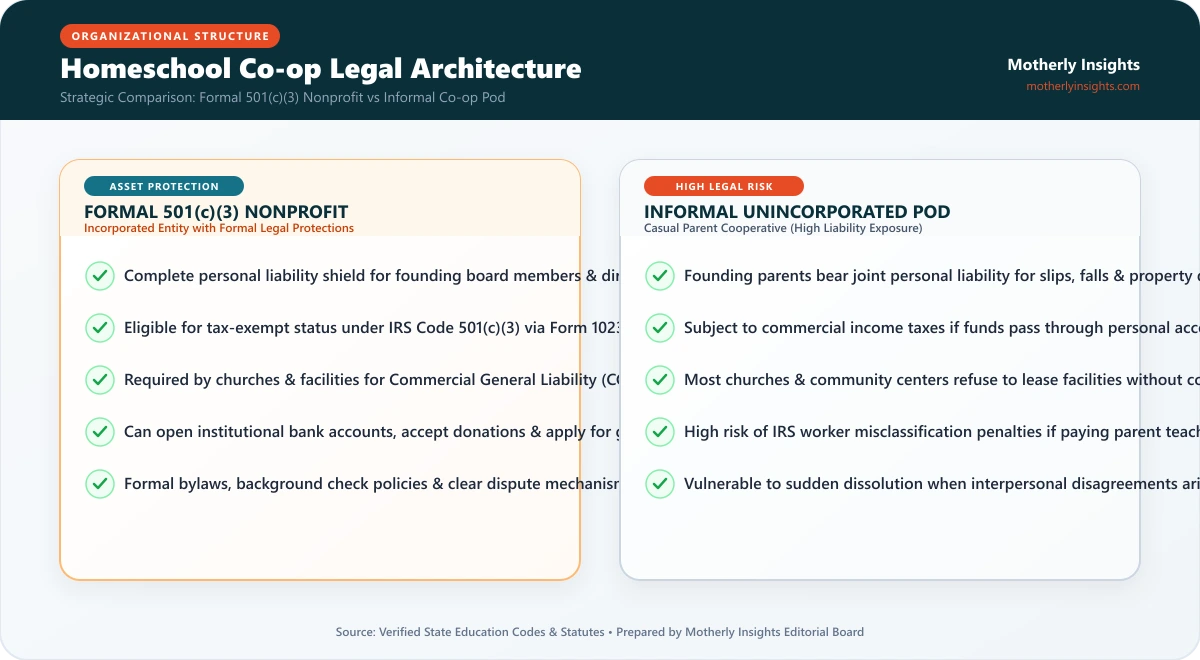
Option A: The Informal Unincorporated Association (High Risk)
Many grassroots groups operate informally without filing state incorporation papers.
- The Fatal Flaw: Under common law, an unincorporated nonprofit association (UNA) provides zero personal liability protection. If a child slips on spilled paint at the meeting hall or causes severe property damage, every parent organizer can be held personally, jointly, and severally liable. Furthermore, if membership fees pass through an individual parent’s personal Venmo or checking account, that parent can be audited and taxed on that money as personal commercial revenue.
Option B: State Nonprofit Corporation + IRS 501(c)(3) Status (The Gold Standard)
The overwhelming majority of established homeschool co-ops incorporate as a state non-profit corporation and obtain 501(c)(3) tax-exempt status from the IRS.
- Benefits:
- Personal Liability Shield: Protects directors, officers, and parents from personal financial ruin in lawsuits.
- Tax-Exempt Revenues: Membership fees, class dues, and fundraisers are exempt from federal and state corporate income taxes.
- Facility Access: Churches, YMCA centers, and municipal parks routinely lease space exclusively to registered 501(c)(3) entities.
- Tax-Deductible Donations: Allows families and businesses to donate books, computers, and funds with charitable tax deductions.
Option C: Limited Liability Company (LLC)
Commonly used for commercial “hybrid homeschool” models, for-profit micro-academies, or tutorial services where founders intend to draw commercial business profits rather than operating as a parent-volunteer charity.
2. Navigating IRS 501(c)(3) Tax Exemption: Form 1023-EZ
Historically, obtaining 501(c)(3) status required filing a daunting 30-page IRS Form 1023 and waiting up to a year for approval. Today, most homeschool co-ops qualify for the streamlined Form 1023-EZ.
Eligibility for Form 1023-EZ
A homeschool co-op can utilize the simplified Form 1023-EZ if:
- Annual gross receipts are projected to be under $50,000 for each of the next three years.
- Total assets are valued at under $250,000.
- The organization is organized and operated exclusively for educational purposes under Section 501(c)(3).
Step-by-Step Incorporation Sequence
- Appoint a Founding Board: Select 3 to 5 committed parents to serve as the initial Board of Directors (President, Treasurer, Secretary). Avoid having all board members related by blood or marriage to satisfy IRS governance independence criteria.
- File Articles of Incorporation: Submit non-profit articles with your state’s Secretary of State office. Ensure statutory IRS language is included verbatim: a statement that the entity is formed exclusively for charitable and educational purposes, and a dissolution clause directing assets to another 501(c)(3) upon termination.
- Obtain an EIN: Secure a federal Employer Identification Number from IRS.gov in five minutes online for free. Never use a personal Social Security Number.
- Draft Formal Bylaws: Adopt the internal governing rules of the organization (detailed in Section 5).
- Submit Form 1023-EZ Online: File via Pay.gov accompanied by the federal user fee ($275). Approval determination letters typically arrive within 4 to 8 weeks.
- Open an Institutional Bank Account: Take your state Articles of Incorporation, EIN letter, and IRS 501(c)(3) determination letter to a commercial bank or credit union to open a formal co-op checking account with dual-signatory controls.
3. Essential Insurance Coverage
You cannot run a safe homeschool co-op without commercial insurance. A single fractured wrist on a playground or an accidental chemical spill during high school biology can trigger tens of thousands of dollars in medical and legal expenses.
1. Commercial General Liability (CGL)
- Standard Policy Limits: $1,000,000 per occurrence / $2,000,000 aggregate.
- What It Covers: Bodily injury (slips, trips, falls), property damage to the leased church facility, and legal defense costs.
- Additional Insured Endorsement: Your host facility (e.g., church or community center) will demand a formal Certificate of Insurance (COI) naming them as an “Additional Insured” before handing over the keys.
2. Sexual Abuse & Molestation (SAM) Coverage
In the modern liability landscape, general liability policies specifically exclude claims related to child abuse or molestation. Co-ops must purchase an explicit SAM endorsement. Underwriters will mandate strict organizational protocols: two-adult rules in every classroom, open-door policies with viewable windows, and mandatory criminal background checks.
3. Directors & Officers (D&O) Liability
Protects the volunteer parent board members from personal lawsuits alleging mismanagement of funds, wrongful termination of an instructor, or arbitrary student expulsion.
4. The Teacher Compensation Trap: 1099 vs. W-2
As co-ops expand into middle and high school, parents often seek to hire specialized instructors (e.g., a retired chemist to teach AP Chemistry or a native speaker to teach Spanish). How you compensate these instructors is heavily scrutinized by the Department of Labor and the IRS.
The Myth of the Automatic 1099 Independent Contractor
Many co-ops mistakenly hand teachers a 1099-NEC at tax time, assuming that calling them “independent contractors” avoids payroll taxes.
- The Legal Reality: Under the IRS common-law rules and the Department of Labor’s “economic reality” test, worker classification depends on behavioral and financial control.
- If the co-op determines the class schedule, provides the classroom, sets tuition rates, mandates the syllabus, and evaluates teacher performance, the worker is an employee (W-2), NOT an independent contractor.
- Penalties for Misclassification: If audited, the co-op can be assessed back payroll taxes (FICA, Medicare, federal unemployment), state workers’ compensation fines, and substantial interest penalties that can bankrupt the organization.
Safe Harbor Approaches for Co-ops
- Pure Parent-Led Volunteer Model: All parents teach or volunteer on a rotating basis without cash remuneration. Parents receive tuition discounts or class fee waivers, which generally do not trigger taxable employment status if tied to mutual cooperative membership.
- True Independent Tutors: If hiring an outside tutor, the tutor must operate their own independent business entity (e.g., “Smith Tutoring LLC”), carry their own professional liability insurance, provide their own curriculum, and offer services to the general public outside your co-op.
- Payroll Services: If hiring statutory employees, utilize automated payroll platforms (such as Gusto or QuickBooks Payroll) to handle state withholdings, workers’ compensation insurance, and quarterly Form 941 filings seamlessly.
5. Drafting Resilient Co-op Bylaws & Policies
Interpersonal conflict—not finances or academics—is the leading cause of homeschool co-op collapse. Transparent, comprehensive bylaws provide the objective framework necessary to navigate disagreements.
Critical Bylaw Sections
- Mission & Statement of Faith (or Inclusivity Charter): Clearly define the cultural identity of the co-op. Is it explicitly Christian requiring a signed doctrinal statement, or is it an inclusive, secular community open to all worldviews? Ambiguity on this point breeds resentment.
- Membership Admission & Expulsion: Specify the application process, probation periods, and the explicit authority of the Board of Directors to terminate membership for disruptive behavior.
- Parent Participation Mandate: Clearly delineate volunteer expectations (e.g., “Every parent must teach one class and serve one cleaning shift per semester; drop-offs are strictly prohibited”).
- Mandatory Background Checks: Mandate annual nationwide criminal history and sex-offender registry screenings for all adult volunteers and instructors who interact with minors.
- Conflict Resolution Framework: Codify a structured grievance policy (e.g., following the Matthew 18 principle or formal administrative mediation) requiring parents to address issues privately before escalating to the board.
6. Negotiating Church and Facility Leases
Churches are the natural partners for homeschool co-ops, offering large educational wings, gyms, and parking lots that sit empty during Tuesday and Thursday mornings.
Best Practices for Church Facility Agreements
- Designate a Facility Liaison: Appoint a single co-op board member to communicate directly with the church facility manager or head trustee.
- Define Facility Boundaries: Explicitly list permitted rooms (e.g., Classrooms 101–108, Fellowship Hall for lunch, outdoor playground) and strictly off-limits areas (sanctuary, church staff offices).
- Custodial & Cleaning Checklists: Churches often terminate leases due to dirty bathrooms or glitter ground into carpets. Create a dedicated cleaning team that vacuums, sanitizes tables, and empties trash cans into commercial dumpsters at the conclusion of every co-op day.
- Fair Facility Donations: While many churches view co-ops as a community ministry, offer a fair monthly facility use fee ($500 to $1,500/month depending on size) to offset commercial heating, air conditioning, utility, and custodial wear-and-tear.
Building a homeschool co-op requires legal diligence, administrative discipline, and open communication. When properly incorporated, insured, and governed, your co-op becomes a vibrant, protective intellectual haven where children forge lifelong friendships and parents find mutual strength for the home education journey.
*Disclaimer: This post is for informational and educational purposes only, accurate to the best of our knowledge at publication. It does not constitute legal or financial advice. We do not guarantee accuracy or completeness and accept no liability for any decisions or losses resulting from reliance on this content.*