
Disclaimer: This post is for informational and educational purposes only, accurate to the best of our knowledge at publication. It does not constitute advice. We do not guarantee accuracy or completeness and accept no liability for any decisions or losses resulting from reliance on this content.
With average four-year college tuition and room and board soaring past $30,000 to $60,000 per year, homeschooling families have a powerful, nationally recognized alternative: Credit-by-Examination through the College Board’s College-Level Examination Program (CLEP).
Unlike Advanced Placement (AP) exams—which can only be administered once per year in early May through cooperative local public schools—CLEP exams are available 365 days a year. They can be taken on-demand at local community college testing centers or proctored remotely from your kitchen table on a home computer.
Even more extraordinarily, through the non-profit Modern States Education Alliance (“Freshman Year for Free”), homeschooled high schoolers can complete prep courses, secure exam vouchers, and obtain proctoring reimbursements, making their entire first year of college completely free of tuition, fees, and textbook costs.
This comprehensive collegiate acceleration guide walks homeschooling parents through the 34 available CLEP exams, pass-rate tiers, credit transfer policies, Modern States voucher mechanics, and how to format CLEP coursework on an official high school transcript.
1. What is CLEP? Mechanics & Scoring
Administered by the College Board (the same governing organization behind the SAT and AP exams), CLEP exams assess mastery of introductory undergraduate coursework. Over 2,900 accredited colleges and universities across the United States accept CLEP credits.
The Exam Format
- Duration: Most CLEP exams are approximately 90 minutes long (with the exception of College Composition with Essay, which is 120 minutes).
- Format: Computer-based, consisting of 75 to 120 multiple-choice questions. Spanish, French, and German include listening comprehension audio sections.
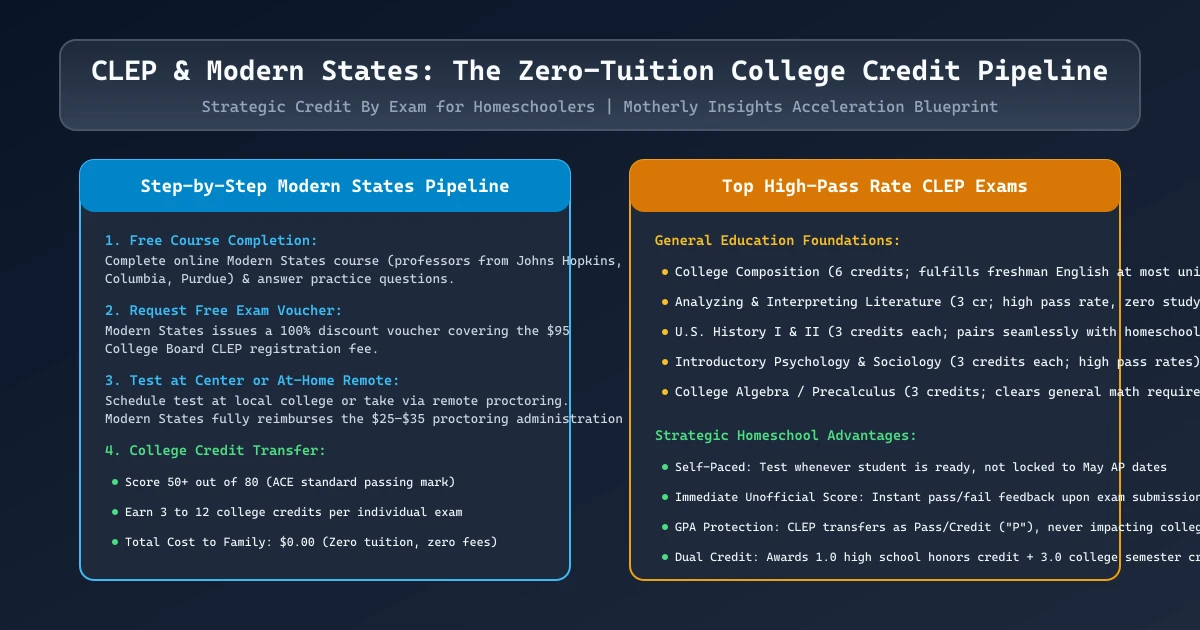
- Scoring: CLEP uses a scaled scoring system ranging from 20 to 80. The American Council on Education (ACE) recommends a scaled score of 50 (equivalent to a grade of ‘C’) for awarding college credit.
- Instant Results: For all multiple-choice exams, your student sees their unofficial scaled score pop up on the screen the very second they submit the test. College Composition (which requires human grading for two essays) returns scores in 2 to 3 weeks.
- Retake Policy: If a student fails to score 50+, the College Board enforces a mandatory 3-month waiting period before they can retake the exact same exam.
2. Modern States: “Freshman Year for Free”
The single greatest financial secret in homeschool high school education is Modern States (modernstates.org). Funded by the Klinsky Family Foundation, Modern States has a mission to make college accessible to every family at zero cost.
How the Modern States Pipeline Operates:
- Free High-Quality Lectures: The student signs up for a free Modern States course. The courses are taught by renowned university professors from institutions like Johns Hopkins, Columbia, Tufts, and Purdue. Courses include video lectures, free OpenStax digital textbooks, and practice quiz sets.
- Earn the Voucher: Upon completing the online course lessons and answering the practice questions (typically requiring an 80%+ quiz score), the student clicks “Request Voucher.” Within 2 to 5 business days, Modern States emails an individual voucher code.
- Waive the College Board Fee: The parent registers for the exam on the College Board portal. In the checkout window, entering the Modern States voucher reduces the $95 exam fee to $0.00.
- Reimburse Local Testing Center Fees: When scheduling the exam at a physical testing center, local colleges typically charge an administrative proctoring fee of $25 to $40. After testing, parents simply submit the receipt to Modern States, and Modern States issues a full check reimbursement.
By pairing Modern States with CLEP, a motivated homeschooler can earn 15 to 30 college credits—a full freshman year of university—for literally zero dollars.
3. Top Homeschool CLEP Exams by Difficulty & Pass Rate
Not all 34 CLEP exams are created equal. Some align effortlessly with standard homeschool high school curriculum, while others require specialized undergraduate depth.
| Exam Tier | Subject Area | Credits Awarded | Typical Homeschool Alignment | Study Timeline |
|---|---|---|---|---|
| Tier 1: High Pass / Accessible | • Analyzing & Interpreting Literature • Introductory Sociology • Introductory Psychology • US History I (Early Colonization to 1877) • College Composition |
3 to 6 credits | Pairs naturally with high school English, US History, and basic social studies electives. Literature requires zero reading list—strictly reading comprehension and poetry analysis. | 2 to 4 weeks of targeted review |
| Tier 2: Moderate Preparation | • US History II (1865 to Present) • American Government • Principles of Marketing • Principles of Management • College Algebra • Human Growth & Development |
3 credits | Requires structured textbook study and memorization of terminology, historical acts, or algebraic functions. Marketing and Management are highly intuitive for practical teens. | 4 to 8 weeks of study |
| Tier 3: Rigorous / Specialized | • Biology • Chemistry • Calculus • Financial Accounting • Macroeconomics & Microeconomics • Spanish / French / German Language |
3 to 12 credits | College science exams are broad and conceptual (equivalent to two semesters of pre-med biology). Foreign language exams award up to 6–12 credits for fluent or bilingual speakers. | 8 to 16 weeks of intensive study |
4. Institutional Credit Acceptance: ACE vs. University Policies
Before embarking on a CLEP acceleration track, parents must understand the fundamental difference between ACE recommendations and institutional transfer policies:
- State University Systems & Community Colleges: Public state universities (such as in Texas, Florida, Ohio, Arizona, and North Carolina) and community colleges have legislated, transparent CLEP transfer policies. Most state schools award credit for scores of 50 or higher and post exact course equivalency tables on their admissions websites.
- Private & Highly Selective Universities: Ivy League institutions and elite private colleges (e.g., Harvard, MIT, Stanford) rarely accept CLEP credits for degree acceleration, though some may use them for course placement.
- The “P” (Pass) Advantage: CLEP credits transfer to collegiate transcripts as transfer credits with a designation of “P” (Pass) or “CR” (Credit). They do not affect college GPA. If your student scores a 51 (equivalent to a C) or a 75 (equivalent to an A), the transcript records the exact same 3 credits without pulling down their college GPA.
Parent Tip: Always search “[University Name] CLEP Credit Policy” before finalizing your high school testing schedule. Verify how many maximum CLEP credits your target college accepts toward your student’s intended major (most institutions cap exam-based credits at 30 to 45 semester hours).
5. CLEP vs. AP vs. Dual Enrollment: The Strategic Comparison
Homeschoolers have three primary pathways to earn early college credits. Understanding their strategic trade-offs ensures you deploy the right tool for each subject:
| Feature | CLEP Exams | Advanced Placement (AP) | Community College Dual Enrollment |
|---|---|---|---|
| Testing Window | 365 days a year on-demand | Once a year (first two weeks of May) | End-of-semester collegiate exams |
| Administration | Computer testing center or home proctoring | Requires finding a host high school to order exam | On-campus or online community college class |
| Cost | $0 with Modern States ($95 standard) | ~$98 – $125 per exam | Free in some states; $300–$1,000 in others |
| Preparation Style | Self-paced; test when ready | Year-long college board audit syllabus | 15-week college semester schedule |
| College Acceptance | 2,900+ colleges (widely accepted at public univs) | Universally accepted across elite & private univs | Regional articulation agreements |
| Transcript GPA Impact | None (Recorded as Pass/Credit) | None on college GPA; boosts high school weighted GPA | Permanent letter grade on collegiate record |
6. How to Record CLEP on the Homeschool High School Transcript
A common question from parents is: How do I document CLEP credits on my student’s high school transcript without confusing college admissions officers?
The gold standard for homeschool high school transcripts is Dual Credit Recognition:
1. Course Title Formatting
When your student completes a rigorous high school course and validates mastery by passing the corresponding CLEP exam, designate the course title clearly with an honors or college-level label:
- English 11: Composition (with CLEP Exam Validation - 6 College Credits)
- U.S. History (with CLEP Exam Validation - 3 College Credits)
- College Algebra / Precalculus (with CLEP Exam)
2. High School Credit Awarding
- A standard 3-credit college course earned via CLEP corresponds to 1.0 Carnegie High School Unit (a full-year high school course).
- An exam awarding 6 college credits (like College Composition or Spanish Level 2) can be recorded as 1.5 to 2.0 High School Units.
3. Transcript Footnotes & Test Score Section
Include a dedicated “Standardized & College Credit Examinations” block at the bottom of the transcript detailing:
- Exam Name: CLEP College Composition | Date Taken: 10/2025 | Scaled Score: 62 | Status: Credit Awarded (6 sem hrs)
- Exam Name: CLEP Introductory Psychology | Date Taken: 02/2026 | Scaled Score: 58 | Status: Credit Awarded (3 sem hrs)
7. Recommended Test-Prep Resources & Study Stack
To guarantee a passing score of 50+ on the first attempt, combine the following resources:
- Modern States Course Modules: Complete all lectures, review question sets, and print out the course summary sheets.
- REA CLEP Prep Books (Research & Education Association): The gold standard in printed test prep. REA books include targeted content reviews and two full-length diagnostic practice exams with detailed answer rationales.
- Peterson’s Practice Tests: Peterson’s online practice exams are famously slightly harder than the actual College Board exams. If your student scores 55% to 60% on a Peterson’s practice test, they are virtually guaranteed to score 55+ on the official CLEP.
- OpenStax Free Textbooks: When Modern States videos introduce a concept that requires deeper reading, use the corresponding free, peer-reviewed OpenStax digital textbooks (e.g., OpenStax Psychology or OpenStax U.S. History).
- InstantCert Flashcards: An active online forum and flashcard community where students share recent exam impressions, key terms, and high-yield flashcard decks.
8. Summary: Launching Your Student’s College Career Debt-Free
The power of homeschooling lies in individualized pacing and sovereign academic control. By integrating CLEP exams and Modern States into your high school roadmap, you give your student more than just academic acceleration: you give them freedom from collegiate student debt, enhanced self-confidence, and a head start toward their career goals.
Sources & Reference Materials
- The College Board: CLEP Exam Descriptions, Scaled Scoring Guidelines, and Test Center Regulations.
- Modern States Education Alliance: Freshman Year for Free: Voucher Program and Course Catalogs.
- American Council on Education (ACE): Credit Recommendations for College-Level Examination Program (CLEP).
- Higher Education Policy Institute: Credit-by-Examination and Degree Completion Velocity Research.