In an increasingly interconnected global economy, multilingualism is no longer merely a decorative cultural asset; it is a profound cognitive superpower. Decades of neuroimaging and psycholinguistic research from Harvard, MIT, and Cambridge University demonstrate that children raised biliterate exhibit superior executive function, enhanced cognitive flexibility, greater divergent problem-solving ability, and delayed onset of cognitive decline in later adulthood.
Yet for homeschooling parents seeking to raise bilingual children in an overwhelmingly monolingual English-speaking society, the practical challenge can feel overwhelming. Conventional school-based language instruction is notorious for producing students who endure four years of secondary foreign language classes yet remain unable to order a meal or hold a five-minute conversational dialogue.
Home education provides an extraordinary advantage. Unlike a classroom teacher managing thirty pupils for forty-five minutes three times a week, homeschooling parents can structure the entire domestic ecosystem around authentic, contextual language acquisition.
Whether you are preserving a heritage language (Spanish, Mandarin, Arabic, Hindi, French, Russian) or imparting a second language as an intentional non-native parent, this guide provides a research-grounded roadmap for immersion modeling, phonemic awareness transfer, and high school biliteracy certification.
1. Choosing Your Immersion Model: OPOL vs. MLAH
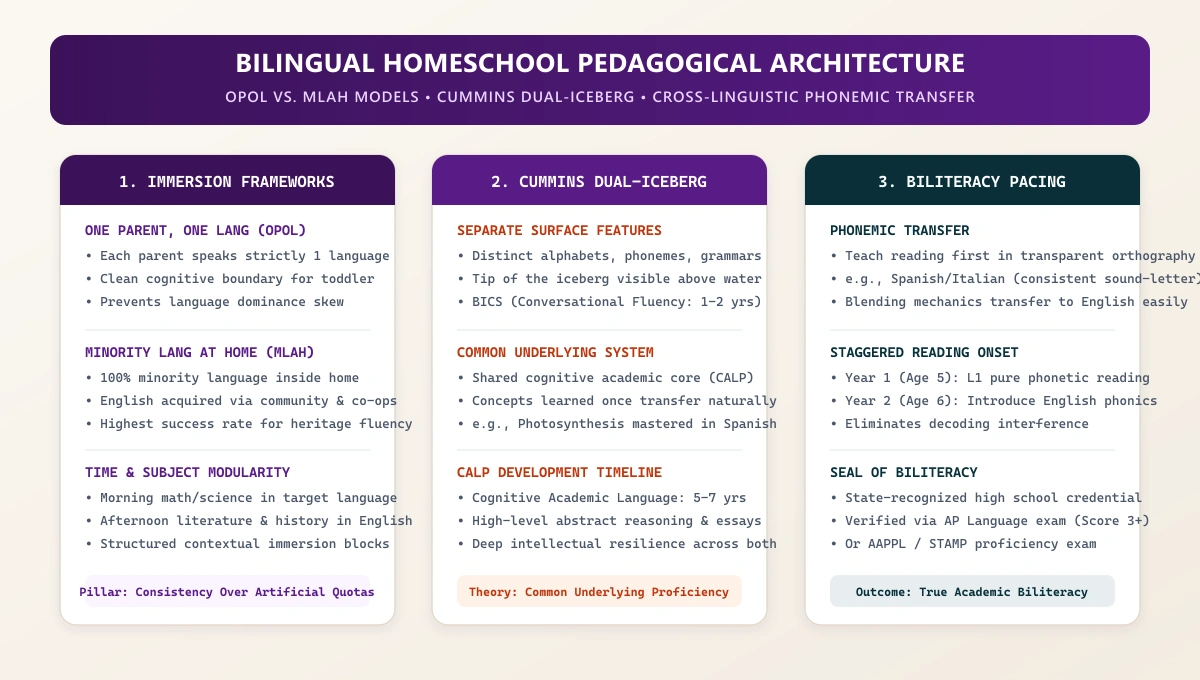
The foundation of successful bilingual home education is establishing clear, predictable linguistic boundaries. Children acquire language through context and necessity; if a child realizes they can simply speak English and still receive their desired response, the brain’s natural efficiency mechanism will cause them to default to the dominant community language.
Two primary pedagogical frameworks have emerged as gold standards:
The Two Core Dual-Language Immersion Frameworks
Option 1: One Parent, One Language (OPOL)
In an OPOL home, one parent speaks exclusively the minority language (e.g., Spanish or French), while the other parent speaks exclusively English. This creates a clean, person-specific linguistic association in the child's mind. OPOL is ideal for mixed-heritage couples where only one parent is fluent in the target language.
Option 2: Minority Language at Home (MLAH)
In an MLAH home, both parents speak 100% minority language inside the four walls of the house. English is acquired entirely outside the home—through neighborhood play, sports leagues, homeschool co-ops, libraries, and public interactions. Psycholinguistic research consistently shows that MLAH produces the highest long-term fluency and retention rates because it counterbalances the massive gravitational pull of dominant English media.
Alternative Framework: Time and Subject Modularity
For homes where neither parent is a native speaker or where parents are learning alongside their children:
- Morning Immersion Blocks: Conduct morning math, nature study, and physical movement entirely in the target language using scripted living curricula and audio resources.
- Afternoon English Blocks: Reserve afternoon hours for English literature read-alouds, phonics, and history discussions.
2. Jim Cummins’ Dual-Iceberg Model: Common Underlying Proficiency
A common fear among parents considering bilingual homeschooling is the myth of “cognitive overload”—the worry that teaching two languages simultaneously will delay reading, confuse grammar, or hinder intellectual development.
This misconception was dismantled by landmark Canadian linguist Dr. Jim Cummins through his Dual-Iceberg Hypothesis (Common Underlying Proficiency):
The Dual-Iceberg Architecture
Imagine two separate icebergs protruding from the ocean. Above the water surface, they look like two independent peaks (representing the visible surface features of Language 1 and Language 2: separate vocabulary, pronunciation, spelling rules, and grammatical syntax).
However, beneath the waterline, both peaks merge into a massive, unified submerged mountain: the Common Underlying Proficiency (CUP). Academic concepts, executive reasoning, logic, and cognitive operations belong to this central engine. When a child learns the concept of fractions, cause-and-effect, or historical chronology in Spanish, they do NOT need to re-learn that conceptual architecture in English. Only the surface vocabulary label changes.
Distinguishing BICS from CALP
Cummins further distinguished between two developmental tiers of language proficiency:
- BICS (Basic Interpersonal Communicative Skills): Conversational fluency used in daily social interactions (“Pass the butter,” “Let’s play ball”). BICS typically develops within 1 to 2 years of consistent immersion.
- CALP (Cognitive Academic Language Proficiency): The formal, abstract, text-dense literacy required to analyze historical documents, synthesize scientific hypotheses, and compose persuasive essays. CALP requires 5 to 7 years of systematic, intentional academic instruction.
Homeschoolers excel because they do not stop at casual kitchen conversational BICS; they systematically study academic literature, geography, and science in both languages, cultivating authentic CALP.
3. Pacing Biliteracy: The Phonics & Reading Roadmap
Achieving spoken fluency is only half the battle; true biliteracy requires reading and writing competence in both languages.
Teaching initial reading simultaneously in two languages with vastly different orthographic depths can occasionally lead to decoding friction. Follow this phased pacing model:
The Staggered Biliteracy Pacing Schedule
Phase 1 (Ages 4–5): Phonemic Awareness & Nursery Verse
Focus exclusively on auditory rhyme, alliteration, syllable clapping, and rich oral storytelling in both languages. Zero formal reading pressure. Fill the home with poetry, folk songs, and fingerplays.
Phase 2 (Ages 5–6): Primary Reading in Transparent Orthography
Begin systematic synthetic phonics in the language with the most transparent (regular) spelling system. For example, Spanish, Italian, and Finnish have nearly 1:1 sound-to-letter correspondence, making initial blending intuitive. Once a child grasps the universal mechanics of phonemic blending ('m' + 'a' = 'ma'), that decoding skill is unlocked forever.
Phase 3 (Ages 6–7): Introducing English Reading
Introduce English reading instruction. Because the child already understands how letters represent sounds, they can focus their mental energy on mastering English's complex, opaque vowel digraphs (e.g., -ough, -eigh) without cognitive frustration.
Phase 4 (Ages 8+): Parallel Literature & Dual Written Composition
Assign independent reading in both languages. Alternate weekly written narrations: one week in English, the following week in the target language.
4. High School Credentials: The State Seal of Biliteracy
When your bilingual homeschooler enters high school, their dual-language competence should be formally documented for university admissions:
The State Seal of Biliteracy
Over 49 U.S. states have established the State Seal of Biliteracy, an official certification awarded to high school graduates who demonstrate functional proficiency in English and at least one other world language.
Homeschoolers can earn this distinction by submitting third-party exam scores meeting state criteria:
- College Board AP Language and Culture Exam: Achieving a score of 3, 4, or 5 on the AP Spanish, French, German, Chinese, Italian, or Japanese exam.
- STAMP 4S Exam (Standards-based Measurement of Proficiency): Administered online by Avant Assessment, evaluating reading, writing, listening, and speaking benchmarks against ACTFL standards.
- AAPPL (ACTFL Assessment of Performance toward Proficiency in Languages): Video-proctored standardized assessment evaluating real-world interpersonal listening and speaking.
Documenting the Seal of Biliteracy on your student’s official homeschool transcript alongside their exam score report validates their academic dedication and opens doors to competitive international study scholarships.
Practical Daily Strategies for Parents
- Purge English Subtitles: When streaming cartoons, nature documentaries, or audiobooks, enforce a strict rule: foreign audio must be accompanied by foreign subtitles (or zero subtitles). English subtitles cause the brain to bypass audio processing entirely.
- Cultivate Minority Language Community: Connect with local heritage cultural associations, bilingual church congregations, playgroups, or international pen pals. Language thrives when it serves real social relationships.
- Embrace Code-Switching with Grace: When young children insert an English word into a Spanish sentence (“Quiero ir al playground”), do not reprimand them. This is normal cognitive borrowing. Simply reflect the correct vocabulary back naturally: “Ah, ¿quieres ir al parque de juegos? ¡Vamos!”
Pedagogical References and Linguistic Citations
- Grosjean, F. (2010). Bilingual: Life and Reality. Harvard University Press.
- Cummins, J. (2001). Bilingual Children’s Mother Tongue: Why Is It Important for Education? Sprogforum, 7(19), 15–20.
- Bialystok, E. (2007). Bilingualism in Development: Language, Literacy, and Cognition. Cambridge University Press.
- Center for Applied Linguistics (CAL). Guiding Principles for Dual Language Education (3rd ed.). Washington, DC.
- American Council on the Teaching of Foreign Languages (ACTFL). Proficiency Guidelines for Global Language Acquisition. Alexandria, VA.
Disclaimer: This post is for informational and educational purposes only, accurate to the best of our knowledge at publication. It does not constitute advice. We do not guarantee accuracy or completeness and accept no liability for any decisions or losses resulting from reliance on this content.