At the close of the nineteenth century, British educational reformer Charlotte Maria Mason (1842–1923) revolutionized home and primary education by challenging the dominant Victorian assumption that children were either defective adults requiring moral subjugation, blank slates awaiting teacher scribbling, or mechanical vessels to be crammed with industrial facts. Writing in an era obsessed with rote recitation, utilitarian job training, and external examination pressures, Mason articulated a profound, cohesive philosophy of education grounded in Christian humanism, physiological neurology, and psychological respect.
Her complete philosophy is distilled into Twenty Principles, first published systematically in the preface to her crowning treatise, Towards a Philosophy of Education (Volume 6 of her Home Education Series). These twenty axioms are not mere classroom techniques or disjointed curriculum recommendations; they constitute an indivisible pedagogical ecosystem. When embraced in its entirety, Mason’s philosophy frees families from the exhausting treadmill of textbook drill, busywork worksheets, and artificial reward systems, replacing them with a generous feast of living ideas, joyful outdoor exploration, and intellectual self-discipline.
As a fourteen-year Ambleside Online mentor and curriculum specialist at Motherly Insights, I have guided thousands of families through the practical realization of Mason’s work. In this comprehensive 2026 blueprint, we analyze each of the Twenty Principles in rigorous detail, exploring their cognitive rationale and demonstrating exactly how to apply them inside a modern home education routine.
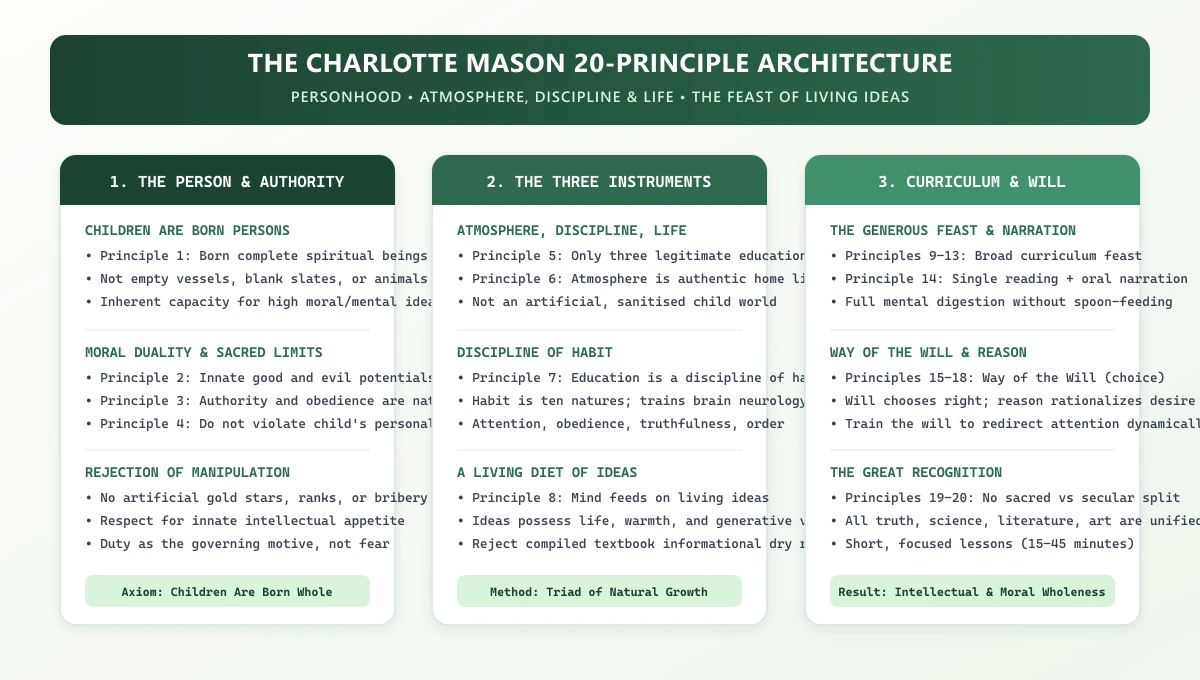
The Complete Architecture of Mason’s 20 Principles
To navigate Mason’s framework, it is vital to recognize how the twenty principles naturally coalesce into six foundational pedagogical domains:
- The Nature of the Child & Sacred Limits of Authority (Principles 1–4)
- The Three Instruments of Education (Principles 5–8)
- The Mind as a Living Organism (Principles 9–12)
- The Generous Feast & The Practice of Narration (Principles 13–14)
- The Moral Will & The Reasoning Faculty (Principles 15–18)
- The Great Recognition & The Unity of Truth (Principles 19–20)
Domain I: The Nature of the Child & Sacred Limits of Authority
Principle 1: Children Are Born Persons
“Children are born persons.”
This first and most famous principle is the cornerstone of Mason’s entire philosophy. To proclaim that children are born persons is to affirm that an infant does not gradually become a human being through schooling, socialization, or intellectual attainment; they arrive in this world as whole, complete spiritual and intellectual entities endowed with an innate capacity to perceive beauty, comprehend truth, and express moral conscience.
In practice, Principle 1 demands that parents discard infantalizing condescension. A child does not require artificial “twaddle”—watered-down, patronizing literature stripped of sophisticated vocabulary and moral tension. Because children are born persons, they are worthy of profound intellectual respect, noble literature, and authentic artistic expression from their earliest years.
Principle 2: The Moral Duality of Childhood
“They are not born either good or bad, but with possibilities for good and for evil.”
Mason explicitly rejected two popular educational dogmas of her time: the Rousseauian romantic myth that children are inherently pure angels corrupted only by adult society, and the extreme Calvinistic view that children are totally depraved vessels devoid of any natural inclination toward virtue. By recognizing that children possess innate capacities for both selfishness and altruism, curiosity and apathy, courage and deceit, parents are relieved of either naive permissiveness or tyrannical cynicism. Education becomes the deliberate cultivation of noble tendencies and the steady starving of ignoble impulses.
Principle 3: Natural Authority and Obedience
“The principles of authority on the one hand, and of obedience on the other, are natural, necessary and fundamental; but—”
Mason viewed authority not as an arbitrary power wielded by tyrannical adults, but as a universal natural law woven into the fabric of the cosmos. Just as celestial bodies obey gravitational laws, children have an innate psychological need for wise, loving parental guidance. Obedience is not servitude; it is the child’s natural response to legitimate, humble authority. Parents do not own their children; they are stewards appointed by God to administer authority with justice, calm consistency, and self-restraint.
Principle 4: The Sacred Limits of Authority
“These principles are limited by the respect due to the personality of the children, which must not be encroached upon whether by the direct use of fear or love, suggestion or play upon any other natural desire.”
While affirming parental authority, Principle 4 establishes its inviolable boundaries. A parent or teacher must never manipulate a child’s personality through fear (threats, humiliation, harsh punishment) or through the emotional blackmail of love (“Do this because Mommy loves you”). Nor should educators use hypnotic suggestion, competitive vanity, or bribery (gold stars, ranks, cash rewards). Such coercive methods bypass the child’s conscious will, crippling their capacity for autonomous moral judgment.
Domain II: The Three Legitimate Instruments of Education
Principle 5: The Only Three Legitimate Tools
“Therefore, we are limited to three educational instruments—the atmosphere of environment, the discipline of habit and the presentation of living ideas. The P.N.E.U. Motto is: ‘Education is an atmosphere, a discipline, a life.’”
Having eliminated manipulation, fear, and bribery, Mason asserts that educators have only three legitimate levers to shape a child’s development. These three instruments form the famous motto of the Parents’ National Educational Union (P.N.E.U.): Atmosphere, Discipline, and Life.
Principle 6: Education Is an Atmosphere
“When we say that ‘education is an atmosphere,’ we do not mean that a child should be isolated in what may be called a ‘child-environment’ especially adapted and prepared, but that we should take into account the educational value of his natural home atmosphere, both as regards persons and things, and should allow him to live freely among his proper conditions. It stultifies a child to bring down his world to the ‘child’s’ level.”
Education is not confined to scheduled school hours; it is breathed in from the cultural, spiritual, and emotional reality of the home. Mason cautioned against artificial, hyper-curated “kiddie worlds” filled with plastic toys and sanitized chatter. The true educational atmosphere is the authentic life of the family: the parents’ real intellectual interests, conversational honesty, hospitality toward neighbors, reverence for work, and emotional stability. Children absorb more from who their parents genuinely are than from what their parents formally preach.
Principle 7: Education Is a Discipline
“By ‘education is a discipline,’ we mean the discipline of habits, formed definitely and thoughtfully, whether habits of mind or of body. Physiologists tell us of the adaptation of brain structures to habitual lines of thought, i.e., to our habits.”
Writing decades before modern neuroscientists mapped neuroplasticity and synaptic pruning, Mason recognized that physical brain tissue adapts to habitual lines of thought and action. A habit is like a deep railway track laid down across the mind; once formed, thoughts and actions glide effortlessly along that groove.
Mason famously observed that “Habit is ten natures”—good habits make living a noble, disciplined life nearly automatic. In a Mason homeschool, parents prioritize the deliberate, one-at-a-time formation of physical, intellectual, and moral habits:
- The Habit of Full Attention: The foundational intellectual habit. Lessons are kept short so the child gives 100% focused attention without mind-wandering.
- The Habit of Obedience: Prompt, cheerful compliance on the first command, eliminating nagging and parental weariness.
- The Habit of Truthfulness: Exact precision in reporting facts without exaggeration or deceit.
- The Habit of Order & Neatness: Respect for materials, books, and living spaces.
Principle 8: Education Is a Life
“In saying that ‘education is a life,’ the need of intellectual and moral sustenance is implied. The mind needs ideas to feed upon, and needs them continually. We must sustain the mind with ideas as we sustain the body with food.”
The mind is not an empty storage warehouse to be packed with dry information, nor is it a muscle to be mechanically exercised with abstract drills. The mind is a living spiritual organism that hungers for living ideas. Just as a physical body starves on a diet of plastic sawdust, the child’s mind languishes into apathy when fed compiled textbook summaries, bulleted study guides, and comprehension worksheets. The mind requires living thoughts, noble narratives, and generative concepts from great minds.
Domain III: The Mind as a Living Organism & The Rejection of Twaddle
Principle 9: The Mind as a Living Organism
“We hold that the child’s mind is no mere sac to hold ideas; but is rather, if the metaphor may allowed, a spiritual organism, with an appetite for all knowledge. This is its proper diet, with which it is prepared to deal; and which it can digest and assimilate as the body does foodstuffs.”
Mason insists that knowledge cannot be transferred mechanically from teacher to student. The child’s mind must actively take in, digest, and assimilate ideas through its own spiritual and mental metabolism. Just as a mother cannot digest an apple for her child, a teacher cannot perform the act of learning on the student’s behalf. The teacher’s humble role is to set a feast of noble books before the child and step out of the way.
Principle 10: The Fallacy of Herbartian Apperception
“Such a doctrine as Herbart’s, that the mind is a stage upon which ideas play their parts… relegates personality to the background and leaves the work of education to be done from without.”
Mason directly critiqued the educational theory of Johann Friedrich Herbart, whose five-step formal lesson plan dominated 19th-century teacher training. Herbart viewed the teacher as a master architect who constructed a child’s knowledge from the outside by linking new concepts to existing “apperceptive masses.” Mason warned that this system inflated the teacher’s ego, reduced the child to a passive recipient, and replaced living literature with tedious teacher lectures.
Principle 11: The Natural Affinity for Knowledge
“A child requires much knowledge, for the mind needs food as truly as the body. Knowledge should be various, for diversity in food stimulates appetite; and it should be addressed to the child’s imagination, not merely to his intellect.”
Children possess an insatiable, natural appetite for knowledge across every domain: astronomy, poetry, history, geology, architecture, philosophy, botany, and art. When a child appears bored or resistant to school, the fault rarely lies with the child; it lies with a monotonous, repetitive curriculum that serves stale educational gruel instead of a varied, nutrient-dense banquet.
Principle 12: Living Ideas vs. Compiled Information
“The ‘twaddle’ of easy reading, the ‘didactic’ moral tale, the ‘useful knowledge’ primer, are not food for the mind. The mind requires living ideas, expressed in literary language, to feed upon.”
Mason coined the educational term “twaddle” to describe books that underestimate a child’s intellect. Twaddle consists of talking down to children, using simplistic sentence structures, forced moralizing, or dry recitations of isolated facts. Instead, Mason championed Living Books: works authored by a single writer with passionate expertise in their subject, penned in rich, literary prose, and infused with living, generative ideas that ignite the imagination.
Domain IV: The Generous Feast & The Art of Narration
Principle 13: The Generous Curriculum Feast
“The child’s curriculum should be generous and wide; he should not be restricted to the ‘three R’s,’ but should have continuous relations with a large number of things and thoughts.”
A Mason education introduces children to an expansive curriculum: world history taught chronologically through primary sources and biographies, literature, geography, natural history, foreign languages, fine arts (picture study and composer appreciation), handicrafts, poetry, and citizenship. Mason insisted that children are born to establish living relations with the universe—with nature, with great thinkers, with historical epochs, and with God. Narrowing the curriculum to basic reading, writing, and arithmetic starves the human soul.
Principle 14: Single-Reading Narration as the Act of Knowing
“As a knowledge is not assimilated until it is reproduced, children should ‘tell back’ after a single reading or hearing: or write on some part of what they have read. This method of ‘narration’ is the natural way for the mind to work.”
Here lies Mason’s primary instructional mechanism: Narration. After a child listens to or reads a passage of living literature a single time, they are asked to “tell it back” in their own words.
Narration is vastly superior to standardized comprehension worksheets because:
- Enforces Absolute Concentration: Knowing they will hear the text only once, the child marshals the full power of their attention without daydreaming.
- Requires Active Mental Digestion: To narrate, the student must visualize the narrative, sequence the chronology, select key details, synthesize the moral implications, and formulate expressive oral sentences.
- Eliminates Cheating and Guesswork: Worksheets allow students to skim for superficial keywords. Narration reveals instantly whether the student has truly understood and assimilated the text.
- Scaffolds into Masterful Composition: Daily oral narration from ages six to nine builds immense linguistic fluency. When formal written narration begins around age ten, students write eloquently because they have spent years organizing complex thoughts aloud.
Domain V: The Way of the Will & The Way of the Reason
Principle 15: The Way of the Will (The Governing Executive)
“There are two guides to moral and intellectual conduct which we cannot offer to children too early: ‘The Way of the Will’ and ‘The Way of the Reason.’”
Mason recognized that human maturity depends upon understanding how our inner faculties operate. Principles 15 through 18 outline the psychological machinery of character formation.
Principle 16: The Function and Weakness of the Will
“The way of the will: Children should be taught that the will is the sole governing power of the person; that it is not the same thing as the passions or desires; that the will is free; but that it is weak and cannot maintain its stand alone without divine help.”
Willpower is the conscious decision-making faculty that chooses what is right in opposition to fleeting desires, appetites, or emotional impulses. A child who throws a tantrum is not displaying “strong will”; they are displaying utter will-weakness, completely conquered by animal passion. Parents must teach children to distinguish between what they want to do (desire) and what they choose to do (will).
Principle 17: The Technique of Redirection
“The will is strengthened by exercise, but when its power flags, the best way to help it is to change the direction of thought; to divert the mind to something else, pleasant and interesting, until the will has recovered its tone.”
When a child is locked in moral struggle, fatigue, or temptation, directly fighting the obsession often exhausts their resolve. Mason introduced the practical psychological technique of diversion: consciously turning the mind’s attention to an entirely different, wholesome subject—stepping outside into the garden, reading a poem, or engaging in a physical craft—allowing the will to recover its executive strength.
Principle 18: The Way of the Reason & The Danger of Rationalization
“The way of the reason: We should teach children, too, not to ‘lean (too much) unto their own understanding’; because the function of reason is to demonstrate mathematically, so to speak, any idea, good or bad, which the will has accepted.”
Mason issued a brilliant psychological warning against blind intellectualism. Human reason is not an infallible judge; it is a loyal servant that invents logical justifications for whatever premise the will has already embraced. If a person secretly desires to steal or shirk duty, their reasoning faculty will construct elaborate rationalizations to justify that dishonesty. Therefore, children must be taught that a logically sound argument is not necessarily true or virtuous; all intellectual premises must be examined against immutable moral standards.
Domain VI: The Great Recognition & Pedagogical Timetable
Principle 19: The Fallacy of Intellectual Self-Sufficiency
“Children must be taught to look out into the world with reverence and open eyes; that life is a unity, and that secular and religious knowledge are not separated into distinct compartments.”
Mason vehemently rejected the artificial dichotomy between “sacred” and “secular” knowledge. All truth is God’s truth. A lesson in botanical cell division or quadratic equations is just as sacred as a lesson in Scripture. When children perceive that science, literature, history, and art are harmoniously unified, their learning is infused with wonder, humility, and reverence.
Principle 20: The Great Recognition
“We allow no separation between the intellectual and ‘spiritual’ life of children, but teach them that the Divine Spirit has constant access to their spirits, and is their continual Helper in all the interests, duties and joys of life.”
The twentieth principle is the spiritual culmination of Mason’s philosophy, inspired by the 14th-century fresco in the Spanish Chapel of Santa Maria Novella in Florence. This painting depicts the Holy Spirit pouring light directly upon the heads of scientists, grammarians, musicians, and civic leaders. Mason reminded parents that they are never alone in the homeschool room; the supreme Educator of mankind is constantly illuminating the child’s intellect, guiding their conscience, and quickening their understanding.
Translating the 20 Principles into a Modern 2026 Homeschool Routine
To implement these timeless axioms amidst the digital distractions and busy schedules of 2026, adhere to these battle-tested scheduling and instructional protocols:
| Mason Principle & Domain | Traditional School Failure Mode | 2026 Charlotte Mason Home Implementation |
|---|---|---|
| Short Lessons & Full Attention (Principle 7 & 13) | 60-minute monotonous textbook lectures causing mental fatigue and wandering focus. | Form I (Grades 1–3): 15–20 minutes max per subject. Form II (Grades 4–6): 25–30 minutes max. Forms III–VI (Grades 7–12): 40–45 minutes max. |
| The Generous Feast (Principle 11 & 13) | Narrow curriculum restricted to reading, math, and standardized test prep. | A wide banquet: 16–20 distinct subjects scheduled weekly in short, rotating blocks (Composer Study, Picture Study, Shakespeare, Plutarch, Swedish Drill, Handicrafts). |
| Living Books vs. Twaddle (Principle 12) | Abridged, patronizing anthologies and sterile encyclopedic textbooks. | Unabridged, literary works written with passion (e.g., Fabre for science, Holling C. Holling for geography, primary source letters for history). |
| Single-Reading Narration (Principle 14) | Multiple-choice comprehension worksheets and repetitive textbook quizzing. | Read once with full attention, followed by immediate oral or written narration without leading questions or parental interruptions. |
| Nature Lore & Outdoor Life (Principles 6 & 19) | Confinement indoors with digital screens and virtual laboratory simulations. | A minimum of 2 to 4 hours outdoors daily for young children, plus dedicated weekly Nature Journaling with watercolor brush-drawings and field identification. |
| The Discipline of Habit (Principle 7) | Reacting to misbehavior with emotional anger, bribery, or arbitrary punishment. | Deliberate, proactive habit cultivation: focusing on one habit for 6 to 8 weeks until neurological permanence is established. |
The Enduring Legacy of Mason’s Vision
Charlotte Mason’s 20 Principles remind us that the ultimate aim of education is not the competitive accumulation of grade-point averages, elite college admissions, or industrial economic utility. Education is the formation of a whole, magnanimous person who loves truth, perceives beauty, exercises self-governing moral will, and establishes life-giving relations with the created universe.
When you open a living book tomorrow morning, step outdoors to sketch autumn foliage in a nature diary, and listen patiently as your child narrates a historical chapter with sparkling eyes, you are not merely doing school at home. You are honoring their divine personhood, nourishing their spiritual intellect, and building a foundation that will sustain their curiosity, character, and joy for a lifetime.
Disclaimer: This post is for informational and educational purposes only, accurate to the best of our knowledge at publication. It does not constitute advice. We do not guarantee accuracy or completeness and accept no liability for any decisions or losses resulting from reliance on this content.