In conventional early childhood and elementary classrooms, “arts and crafts” typically means a flurry of paper plates, dried macaroni glued to construction paper, plastic googly eyes, and cotton balls drenched in school glue. While well-intentioned, these disposable craft projects—which almost invariably find their way into the kitchen trash bin within forty-eight hours—fail to cultivate genuine manual dexterity, patience, or aesthetic discernment.
British educational reformer Charlotte Mason (1842–1923) took a radically different view of manual training. Influenced by John Ruskin and the European Arts and Crafts movement, Mason insisted that a child’s creative energy should never be squandered on frivolous busywork. Instead, she introduced two intertwined disciplines that nourish a child’s soul and train their hands: Utilitarian Handicrafts and Picture Study.
When practiced consistently, these practices train children to appreciate sublime beauty, respect the integrity of physical materials, and develop the lifelong habit of completing thorough, careful work.
The Philosophy of Handicrafts: Banishing “Futilities”
In Volume 1 of her home education series, Charlotte Mason articulated four unbending principles for children’s manual work:
- No Futilities: Children must not be employed in making useless trinkets that serve no practical or aesthetic function. Every handicraft should produce an object of genuine utility or lasting beauty—a warm wool scarf, a woven market basket, a carved wooden butter spreader, or a hand-stitched leather bookmark.
- Slow, Careful Instruction: Skills must be demonstrated methodically. A child should not be left to flounder through an ambitious project unassisted.
- Zero Slipshod Work Allowed: Quality always supersedes quantity. It is infinitely better for an eight-year-old to complete three perfect, neat cross-stitches on linen than fifty uneven, messy stitches.
- The Child’s Best Effort: The work should command the student’s full concentration and pride. Sloppy execution is never praised as “cute.”
By adhering to these principles, handicrafts cease to be messy diversions. They become moral training in patience, fine-motor coordination, and stewardship.
Developmental Progression of Authentic Handicrafts (Grades 1–12)
A successful handicraft program introduces one new craft per school term or year, giving the child sufficient time to achieve true competence before moving on to another medium.
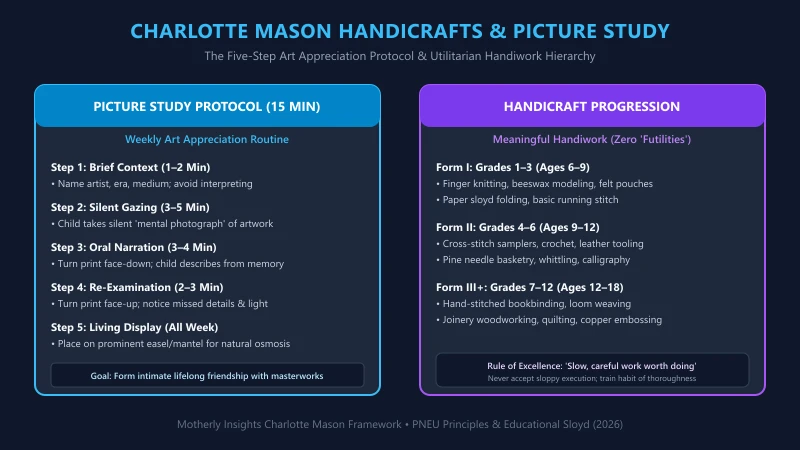
Form I: Early Elementary (Grades 1–3 • Ages 6–9)
At this stage, hand muscles and spatial reasoning are developing. Choose crafts that offer immediate tactile feedback without requiring dangerous sharp blades:
- Finger Knitting & French Knitting: Teaches tension control and rhythm without the complication of needles, producing thick yarn ropes that can be coiled and stitched into hot pads or round rugs.
- Beeswax Modeling: Unlike synthetic petroleum play-dough, natural beeswax is firm and fragrant. It requires the gentle, sustained warmth of the child’s hands to soften, developing finger strength and deliberate modeling control.
- Paper Sloyd: Rooted in the 19th-century Swedish manual training system, paper sloyd teaches exact mathematical measurement, scoring, cutting, and geometric folding to create functional desk boxes, seed packets, and envelopes.
- Basic Hand Sewing on Felt: Thick wool felt does not fray. Using a blunt tapestry needle and embroidery floss, children learn the running stitch and whipstitch to craft simple coin pouches and needle cases.
Form II: Upper Elementary (Grades 4–6 • Ages 9–12)
As fine-motor precision matures, introduce formal tools and durable natural materials:
- Cross-Stitch Samplers: Working on evenweave Aida cloth or linen, children execute counted cross-stitch letters, geometric borders, and botanical motifs, reinforcing spatial symmetry and neatness.
- Pine Needle & Reed Basketry: Soaking reeds or coiling longleaf pine needles with waxed linen thread teaches structural tension, 3D spatial thinking, and craftsmanship.
- Crochet & Two-Needle Knitting: Reading basic patterns, casting on, purling, and decreasing to knit winter beanies, washcloths, or baby blankets.
- Wood Whittling & Carving: Equipped with a thumb guard and a small fixed-blade whittling knife, students carve soft basswood into tent pegs, spatulas, and animal figurines.
Form III & Beyond: Middle & High School (Grades 7–12 • Ages 12–18)
High school handicrafts transition into mature artisan trades that can blossom into lifelong hobbies or entrepreneurial pursuits:
- Traditional Bookbinding: Folding paper signatures, sewing text blocks with linen tape, gluing mull, and binding hardcover books wrapped in marbled paper or bookcloth.
- Wood Joinery & Carpentry: Measuring with precision squares, sawing tenons, chiseling mortises, and building dovetailed step-stools, birdhouses, and storage chests.
- Loom Weaving: Warping a rigid heddle loom and weaving complex twill or plaid patterns into table runners and woven wall hangings.
- Copper & Leather Tooling: Embossing sheet copper with burnishers or hand-stamping vegetable-tanned leather to produce belts, journal covers, and sheaths.
The 15-Minute Picture Study Protocol
Alongside training the hands, Charlotte Mason prioritized training the eye to perceive visual truth and beauty. Modern society bombards children with rapid, hyper-stimulating video cuts and algorithmic digital imagery. Picture Study is the powerful cultural antidote: a quiet, contemplative discipline that trains children to slow down, observe deeply, and commune with the greatest artistic minds in human history.
The Golden Rule of Picture Study
One artist per term (6 to 12 weeks). One painting per week.
Over a two-year period, your student will live intimately with twelve master artists across diverse historical movements (e.g., Giotto, Leonardo da Vinci, Rembrandt, Vermeer, John Constable, Claude Monet, Mary Cassatt, Albrecht Durer).
Step-by-Step Weekly Lesson Walkthrough (15 Minutes Max)
- Step 1: Brief Context (1–2 Minutes): Display the high-resolution art reproduction. The parent briefly states the painting’s title, the artist’s name, the year of completion, and the medium (e.g., “This is ‘The Milkmaid’ painted in 1658 by Johannes Vermeer in oil on canvas”). Crucially, the parent does not lecture on the painting’s symbolic meaning or explain what the child is supposed to feel.
- Step 2: Silent Gazing (3–5 Minutes): The child holds the reproduction or looks at the print on an easel in total silence. They are instructed to look closely at every corner—the light, shadows, textures, facial expressions, background architecture, and brushstrokes—until they can close their eyes and see the entire picture clearly in their imagination.
- Step 3: Oral Narration (3–4 Minutes): The parent turns the picture face down so the child cannot see it. The child now narrates the painting from memory in rich detail: “There is a woman wearing a blue apron and a yellow bodice standing by a window on the left. Stream of sunlight pours in, illuminating tiny droplets of bread crusts on the table. She is pouring milk from an earthenware jug into a bowl, and on the floor in the bottom right corner is a small wooden foot warmer…”
- Step 4: Re-Examination (2–3 Minutes): Turn the picture face up again. The child eagerly inspects the print to see what subtle details they remembered accurately and what nuances they overlooked.
- Step 5: Living Display (All Week): Place the art print on a prominent display easel on your dining table, schoolroom shelf, or fireplace mantel. Throughout the week, the child glances at the painting naturally during breakfast and family conversations, allowing its aesthetic composition to settle deep into their visual subconscious.
Curricula, Art Portfolios & Free Public Domain Sourcing
Parents do not need an art history degree or expensive museum memberships to conduct world-class Picture Study:
1. High-Quality Print Portfolios
- Simply Charlotte Mason Picture Study Portfolios: Beautifully curated cardstock folders featuring a short artist biography, six large glossy 8x10 art prints, and gentle discussion prompts.
- AmblesideOnline Artist Rotations: Free online schedules coordinating artists chronologically with your historical time period, complete with links to high-resolution museum files.
- A Charlotte Mason Plenary: Complete term-by-term art packages formatted for easy home printing.
2. Free High-Resolution Museum Digital Repositories
Thanks to open-access digital initiatives, thousands of masterworks are available in ultra-high resolution for free personal printing:
- The Metropolitan Museum of Art (The Met Open Access): Over 400,000 public domain images available in lossless resolution.
- The National Gallery of Art (NGA Images): Free, high-fidelity downloads of European and American masterpieces.
- Rijksmuseum Open Data (Amsterdam): Exceptional high-res scans of Dutch masters including Vermeer, Rembrandt, and Frans Hals.
Weekly Pacing: Integrating Beauty Without Overwhelm
Handicrafts and Picture Study require very little time, making them effortless to integrate into any homeschooling schedule:
- Friday Afternoon Handicraft Hour (60 Minutes): Reserve the final hour of your homeschool week for manual handiwork. Clear the table, put on classical music or an audiobook, and let everyone—parent included—work quietly on their ongoing leatherwork, knitting, or wood carving.
- Wednesday Morning Picture Study (15 Minutes): Conduct your weekly 15-minute Picture Study immediately after morning poetry or scripture reading while minds are fresh and calm.
When education honors both the head, the heart, and the hands, children develop an inner reservoir of calm competence. They learn that they are capable of creating things of enduring value and that true beauty is not a luxury, but essential spiritual food for a flourishing human life.
Disclaimer: This post is for informational and educational purposes only, accurate to the best of our knowledge at publication. It does not constitute advice. We do not guarantee accuracy or completeness and accept no liability for any decisions or losses resulting from reliance on this content.