
In an era dominated by high-resolution screens, climate-controlled interiors, and digitized learning modules, children are spending an average of four to seven minutes in unstructured outdoor play each day, compared to over seven hours consuming digital entertainment[1].
Author Richard Louv coined the term “Nature-Deficit Disorder” to describe the cognitive, emotional, and physical consequences of this profound estrangement from the living world: diminished executive functioning, rising childhood anxiety, sensory dullness, and a fragmented capacity for sustained attention.
Long before modern neuroscientists documented the neurological benefits of outdoor immersion, nineteenth-century British educational pioneer Charlotte Mason identified the natural world as the indispensable crucible of human education[2].
In Mason’s philosophy, Nature Study is not an auxiliary craft project or an optional Friday elective. It is the foundational training ground for all scientific inquiry, geographical intuition, artistic expression, and moral character. Through weekly nature walks, unhurried observation, and dedicated watercolor field journaling, children develop the foundational habits of mind that underpin true intellectual genius: razor-sharp attention, patient discrimination, accurate verbal expression, and reverence for creation[3].
In this practical, comprehensive field guide, we examine how to implement an authentic Charlotte Mason nature study rhythm in your homeschool, master botanical watercolor field journaling, equip your family with durable gear, and cultivate a living science atmosphere that endures through graduation.
1. The Charlotte Mason Philosophy: Why Nature Study Precedes Textbooks
In Volume 1 of her landmark educational series, Home Education, Charlotte Mason issued a revolutionary challenge to parents:
“Never be within doors when you can rightly be without… Let them once get into the habit of looking with the eye of the naturalist, and they have found a resource for life.”
Mason observed that conventional schooling commits a catastrophic pedagogical error: it introduces children to science through abstract generalizations, second-hand textbook summaries, and sterile diagrams before the child has formed an intimate, emotional relationship with the living organisms themselves.
The Organic Science Progression
- Intimate First-Hand Acquaintance: Before a child learns the technical cellular biology of photosynthesis or the binomial Latin terminology of angiosperms, they must know the buttercup intimately. They must know where it grows, what soil it prefers, when its petals unfurl in the morning light, what insects visit its nectar, and how its seed pods scatter in late summer.
- The Habit of Attention: Institutional classrooms struggle to teach focus because they force children to attend to dry, disembodied worksheets. In the woods, attention is captured naturally by wonder: the rhythmic tapping of a downy woodpecker, the translucent green veins of a fiddlehead fern, or the glistening trail of a garden snail.
- Painless Science Foundations: A child who has kept a Charlotte Mason nature journal for six years has already studied botany, entomology, meteorology, geology, ornithology, and ecology through direct personal field research. When they encounter formal high school biology and chemistry, they are not memorizing dry abstractions; they are organizing memories of friends they have known for years.
2. The Anatomy of a Nature Journal Page
A Charlotte Mason nature journal is a scientific field notebook, a personal artistic portfolio, and a living family heirloom all at once. It is distinctly different from a school art class or a freeform doodle pad.
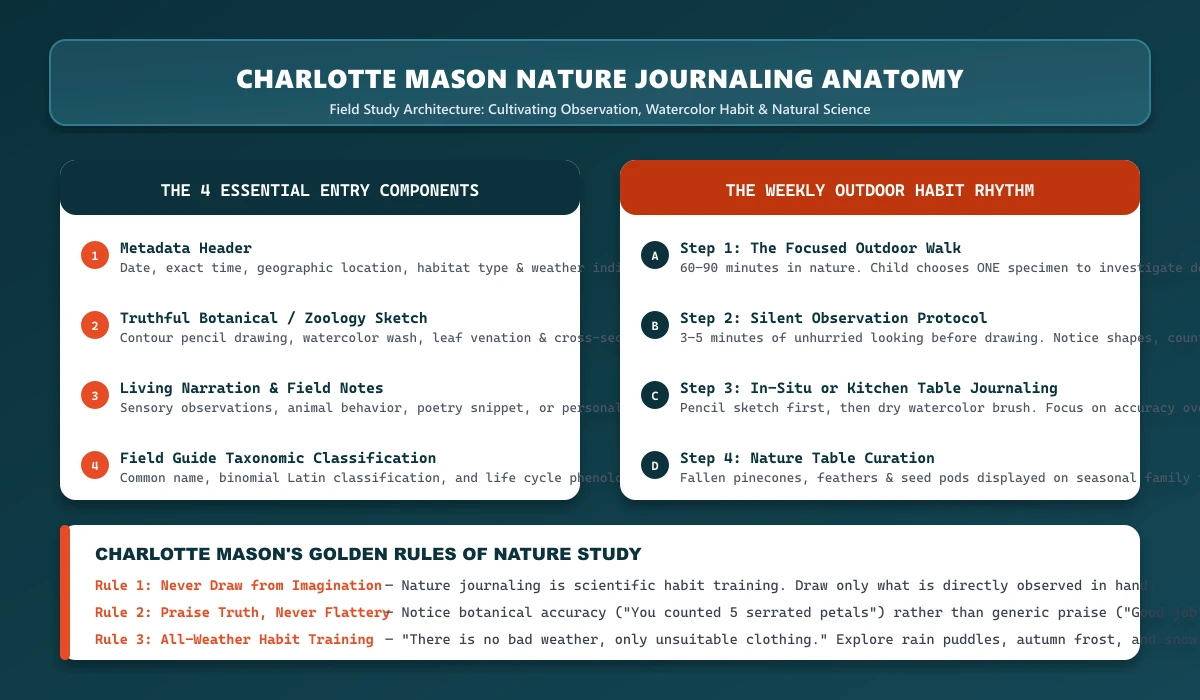
To build rigorous scientific habits, train your children to include four essential components on every single journal page:
1. Environmental Metadata (The Header)
Every entry must be anchored in space and time. At the top of the page, write:
- Date & Exact Time: e.g., October 14, 2026 — 2:15 PM.
- Geographic Location & Habitat: e.g., Hemlock Ravine Trail, Western Slope, Mixed Deciduous Woods.
- Weather Indicators: Temperature, barometric trend, wind direction (e.g., Breezy NW, 54°F, high cirrus clouds, dry soil).
Recording weather parameters trains children to observe micro-climates and understand how temperature and humidity dictate animal behavior and plant blooming cycles.
2. Truthful Botanical or Zoological Sketch
The central visual element is a careful observational drawing of the chosen specimen:
- Draw What You See, Never What You Imagine: If a daisy petal has been chewed in half by a grasshopper, the child must draw a ragged, half-eaten petal—not a symmetrical cartoon daisy. Precision and truthfulness are the goals.
- Contour Pencil Lines First: Use a light 2B graphite pencil to capture outer silhouettes and proportion before adding color.
- Dry-Brush Watercolor Wash: Add transparent, luminous watercolor washes to capture authentic hues (mixing sap green, burnt umber, and ochre rather than using flat synthetic greens).
3. Living Field Notes & Personal Narration
Surrounding the sketch, the child records written observations using John Muir Laws’ three foundational prompts:
- “I Notice…”: Objective sensory facts (“The underside of the oak leaf is covered in pale, downy fuzz. The bark has deep vertical furrows that smell like damp earth.”).
- “I Wonder…”: Scientific curiosity (“I wonder why the leaves at the top of the sapling have turned crimson while the lower leaves remain dark green?”).
- “It Reminds Me Of…”: Metaphorical connections (“The seed pod rattles like dry parchment in the autumn wind.”).
- Poetry Snippets: A short stanza from Wordsworth, Robert Frost, or Christina Rossetti reflecting the seasonal mood.
4. Field Guide Identification & Taxonomic Classification
At the base of the entry, look up the specimen using local regional field guides:
- Common Name: Sugar Maple
- Binomial Latin Name: Acer saccharum
- Phenology Stage: Senescence / Autumn seed drop (winged samaras)
3. The Weekly Outdoor Habit Rhythm
Many homeschooling parents fail at nature study because they attempt to do it sporadically or turn it into an overwhelming four-hour wilderness expedition. Nature study thrives on steady, dependable, weekly rhythm.
The 90-Minute Weekly Rhythm (Tuesday or Thursday Afternoon)
- 1:30 PM – 1:45 PM: Departure & Gear Check: Pack nature backpacks with journals, watercolor tins, water brushes, and hand lenses. Step out into the backyard or drive to a local nature preserve, state park, or conservation trail.
- 1:45 PM – 2:15 PM: The Silent Looking Walk: Walk along the path at an unhurried, meandering pace. Encourage quiet senses. Stop when something catches the eye: a patch of luminous lichen, a vibrant cluster of wild chanterelles, an owl pellet, or a garter snake sunning on a granite boulder.
- 2:15 PM – 2:30 PM: Specimen Focus: Each child selects one discrete subject to investigate deeply. Trying to draw an entire landscape overwhelms young children. Direct them to focus on a single acorn cap, a single dragonfly wing, or a six-inch patch of moss.
- 2:30 PM – 2:50 PM: In-Situ Sketching: Sit on a waterproof pad. Spend 3 to 5 minutes looking silently before a pencil touches paper. Sketch the contours and capture color notes.
- 2:50 PM – 3:00 PM: Group Sharing: Gather in a circle. Each family member shows their page and shares one fascinating detail they discovered. No criticism, no grading—only shared delight.
💡 “There Is No Bad Weather, Only Unsuitable Clothing”: Do not cancel nature study because of rain, cold, or wind. Children learn distinct ecological lessons during rainy walks (watching earthworms surface, smelling petrichor, observing rain droplets bead on waxy leaves) and winter frost walks (tracking rabbit prints in fresh snow, studying dormant bud scales).
4. Essential Field Gear: Tools for the Young Naturalist
Equipping your children with quality, durable tools eliminates frustration and signals that their scientific work is valued:
| Gear Item | Recommended Specifications | Why It Matters in the Field |
|---|---|---|
| Nature Journal | Hardbound mixed-media or watercolor sketchbook (140 lb / 300 gsm paper) | Prevents watercolor buckling; durable hardback acts as a firm drawing lap desk. |
| Field Watercolor Tin | Winsor & Newton Cotman Field Pocket Set (12 half-pans) or Prang Oval-8 | Compact, pocket-sized, rich pigments that mix clean, authentic earthy tones. |
| Water Brushes | Pentel Arts Aquash Water Brushes (Medium & Fine tip) | Holds water inside barrel; eliminates the need for open water cups in the mud. |
| Jeweler's Loupe / Hand Lens | 10x to 20x triplet optical glass loupe with LED light | Reveals hidden micro-architecture: moss spore capsules, insect compound eyes, stoma. |
| Waterproof Sit Pad | Closed-cell folding foam sit mat (Therm-a-Rest Z-Seat) | Keeps clothes warm and dry when sitting on wet logs, snowy boulders, or damp moss. |
| Regional Field Guides | Peterson Field Guides, Audubon Society Pocket Guides, or Sibley Birds | Enables rapid, authoritative species identification directly on the trail. |
5. Curating the Seasonal Family Nature Table
Nature study should not vanish the moment you step through your front door. Charlotte Mason advocated maintaining an indoor Nature Table (or Nature Shelf) as a living, tactile exhibit of seasonal change.
How to Operate a Living Nature Table
- A Dedicated Surface: Use a low bookshelf, credenza, or small entryway table accessible to children of all heights.
- Curated Seasonal Specimens: Display treasures collected during your walks:
- Spring: Delicate bird feathers found on trails, sprouted acorns, budding willow twigs in jars of water, snail shells.
- Summer: Pressed wildflowers, polished river stones, dried cicada husks, coastal driftwood.
- Autumn: Vibrant red maple leaves, varied pinecones, sweetgum seed pods, milkweed pods bursting with silk.
- Winter: Evergreen boughs, bare deciduous branch segments showing terminal bud rings, shed deer antlers, quartz crystals.
- Essential Table Tools: Keep a high-powered stereo dissecting microscope or a 10x magnifying glass, a brass specimen tray, botanical tweezers, and regional field guides sitting permanently on the table.
- The Living Science Spine: Keep Anna Botsford Comstock’s legendary 1911 classic, Handbook of Nature Study, on the table. When a child brings home a praying mantis egg case or an oak gall, look up Comstock’s detailed teacher questions together.
6. Phenology Wheels: Tracking Year-Round Ecology
One of the most rewarding long-term projects in Charlotte Mason homeschooling is the creation of a Phenology Wheel.
Phenology is the study of cyclical biological events and their relationship to weather and seasons—bird migrations, leaf senescence, insect emergence, and flower blooming dates.
Constructing a 12-Month Phenology Wheel
- The Canvas: Draw a large circle (12 to 16 inches in diameter) on heavyweight watercolor paper.
- Divide into 12 Wedges: Create twelve radiating pie segments, one for each month of the calendar year.
- Select a Focal Study: Choose one permanent natural entity in your neighborhood:
- Option A: A Specific Tree (e.g., the large white oak in your front yard).
- Option B: A Nearby Creek or Pond.
- Option C: Your Vegetable Garden or Local Park.
- Monthly Field Entry: On the 15th of each month, visit your focal specimen. In that month’s wedge, paint its current state: bare snowy branches in January, swelling green catkins in April, lush green leaves in July, golden foliage in October.
At the conclusion of the year, your student possesses a stunning, circular visual chronology of the Earth’s orbit around the sun, reinforcing cyclical time and seasonal rhythm far deeper than any static textbook diagram could ever convey.
Final Encouragement: Cultivating Wonder Over Perfection
If your child’s first nature journal sketches look messy, uneven, or smudged, rejoice.
The goal of a Charlotte Mason nature journal is not to produce museum-ready botanical lithographs; it is to forge an unbreakable bond between a child’s soul and the living wonders of the earth. When you model curiosity, lace up your hiking boots in the rain, and stoop down to inspect a fuzzy caterpillar with genuine reverence, you impart an educational legacy that textbooks cannot match: a lifelong reverence for the beauty, complexity, and truth of the natural world.
Frequently Asked Questions
What if I cannot draw or know nothing about nature?
You do not need to be an expert botanist or an accomplished watercolor artist. The best homeschool nature study occurs when parents learn alongside their children. Say openly: “I don’t know what kind of fern this is—let’s look at its spore pattern together in our field guide.” Seeing a parent ask genuine questions and practice watercolor sketching models intellectual humility and lifelong curiosity.
How do we do nature study if we live in an urban apartment?
Nature is remarkably resilient in cities. Urban nature study is rich and vibrant: observe dandelions pushing through sidewalk concrete, study pigeons and peregrine falcons roosting on masonry cornices, observe squirrel foraging behaviors in city parks, track the phases of the moon from your balcony, and watch moss colonize brick walls. City trees (Ginkgo biloba, London plane trees) have fascinating evolutionary histories.
What is the specimen collection etiquette for homeschoolers?
Follow the strict outdoor ethic: “Take only pictures and sketches, leave only footprints.” Never pick wild orchids, rare wildflowers, or live sea life. Collect only abundant, fallen treasures (fallen leaves, dropped pinecones, empty shells, shed feathers). If a specimen is attached to a living plant or tree, teach your child to sit quietly and draw it in-situ without tearing it away from its life source.
Disclaimer: This post is for informational and educational purposes only, accurate to the best of our knowledge at publication. It does not constitute advice. We do not guarantee accuracy or completeness and accept no liability for any decisions or losses resulting from reliance on this content.