In conventional public school social studies curricula, historical education is notorious for its disjointed, fragmented presentation. A student might study state history in third grade, jump erratically to American colonial settlements in fourth grade, explore ancient Egypt for two weeks in sixth grade, and skip straight to twentieth-century American government in eleventh grade. The inevitable consequence is that students graduate viewing human history not as a grand, interconnected narrative of cause and effect, but as a random collection of isolated dates, wars, and memorized trivia questions.
Classical home educators approach historical inquiry from an entirely different pedagogical foundation: the four-year chronological history cycle. Popularized by Susan Wise Bauer and Jessie Wise in The Well-Trained Mind, this time-tested framework teaches the story of humanity sequentially from the dawn of recorded civilization to the modern era.
By organizing your homeschool around a repeating four-year cycle, history becomes the vibrant narrative backbone of your entire curriculum—seamlessly anchoring literature, geography, science discoveries, theology, art history, and philosophical debate.
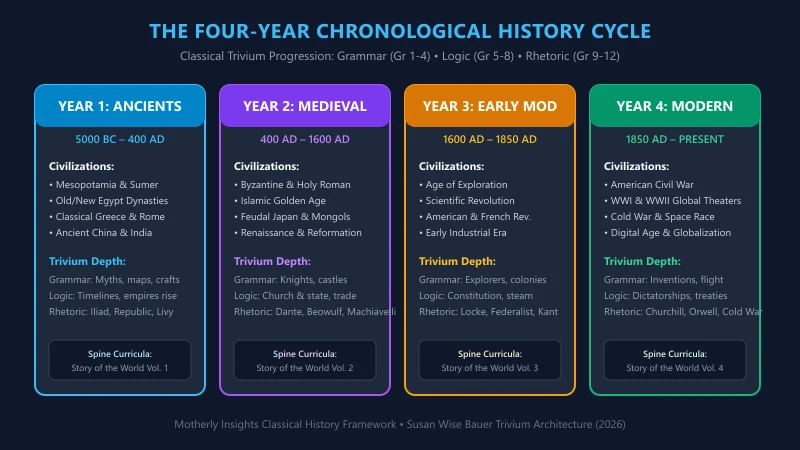
The Four Epochs of Classical History
The classical model divides world history into four distinct, sequential epochs. Each school year is dedicated entirely to exploring one epoch in exhaustive global context:
Year 1: The Ancients (approx. 5000 BC – 400 AD)
- Scope: The cradles of civilization in Mesopotamia and Sumer, the dynastic kingdoms of Old and New Kingdom Egypt, the Indus Valley, ancient China (Shang and Zhou dynasties), Phoenician seafaring, classical Greek city-states, the Persian Empire, the Hellenistic world of Alexander the Great, and the rise and fall of the Roman Republic and Empire.
- Core Themes: The transition from nomadic hunter-gatherers to agrarian city-states, the invention of writing (cuneiform and hieroglyphics), early legal codes (Code of Hammurabi), polytheistic mythologies, monotheism in ancient Israel, classical philosophy (Socrates, Plato, Aristotle), and the emergence of early Christianity.
Year 2: The Middle Ages (approx. 400 AD – 1600 AD)
- Scope: The collapse of the Western Roman Empire, the Byzantine Empire under Justinian, the rise of Islam and the Islamic Golden Age in Baghdad, the European Dark Ages and feudalism, the Viking invasions, the Crusades, Imperial China (Tang and Song dynasties), the Mongol Empire, sub-Saharan African kingdoms (Mali, Ghana, Great Zimbabwe), pre-Columbian Mesoamerica (Maya, Aztec, Inca), the Black Death, the Italian Renaissance, and the Protestant Reformation.
- Core Themes: Feudal social structures, church and state tensions, monastic preservation of classical texts, transcontinental trade routes (Silk Road and Trans-Saharan), technological leaps (printing press, gunpowder), and the birth of humanism and maritime exploration.
Year 3: Early Modern Times (approx. 1600 AD – 1850 AD)
- Scope: The Scientific Revolution (Galileo, Newton, Kepler), the Age of Discovery and European colonization of the Americas, the transatlantic slave trade, the rise of constitutional monarchy and absolute autocracy, the Enlightenment (Locke, Voltaire, Rousseau), the French and Indian War, the American Revolution and Constitutional Convention, the French Revolution and Napoleonic Wars, Latin American independence movements (Simón Bolívar), and the early Industrial Revolution.
- Core Themes: The democratization of knowledge, social contract philosophy, the transition from agrarian economies to steam-powered industrialization, global imperial conflicts, and the abolition of the British and transatlantic slave trade.
Year 4: The Modern Era (approx. 1850 AD – Present Day)
- Scope: The Victorian era, the American Civil War and Reconstruction, the Scramble for Africa, the Meiji Restoration in Japan, World War I and the collapse of empires (Ottoman, Russian, Austro-Hungarian), the Russian Revolution and rise of totalitarianism, the Great Depression, World War II and the Holocaust, the nuclear age, the Cold War, decolonization across Africa and Asia, the Civil Rights Movement, the collapse of the Soviet Union, the digital revolution, and modern globalization.
- Core Themes: Total warfare, technological acceleration, ideological clashes (liberal democracy, communism, fascism), globalization, civil liberties, and human rights.
The Three-Tier Trivium Repeat: Deepening Across Grades 1–12
A common question among new homeschooling parents is: “If history takes four years to cover, what happens in year five?”
The brilliance of the classical model is that your student travels through the four-year cycle three complete times during their twelve years of schooling. Each time the student returns to an epoch, they engage with it at a qualitatively higher developmental stage of the classical Trivium:
| Trivium Stage | School Grades | Cognitive Focus | Historical Output & Expectations |
|---|---|---|---|
| Grammar Stage | Grades 1–4 (Ages 6–10) | Facts, Stories, Chronology | Oral narration, coloring maps, reading myths, hands-on archaeology crafts |
| Logic (Dialectic) Stage | Grades 5–8 (Ages 10–14) | Cause & Effect, Why Events Occurred | Centuried timelines, outlining text, primary source excerpts, geography analysis |
| Rhetoric Stage | Grades 9–12 (Ages 14–18) | Synthesis, Original Sources, Worldviews | Great Books readings (Iliad, Aeneid, Republic), historiographical essays, debate |
Grammar Stage (Grades 1–4): Cultivating the Imagination
In elementary school, children are fascinated by stories, colorful personalities, and memorable narratives. They do not need to analyze the socio-economic causes of the Peloponnesian War; they need to hear the thrilling tale of the 300 Spartans at Thermopylae, the courage of Horatius at the bridge, and the cleverness of Odysseus.
The goal of the Grammar Stage is to build a mental framework of historical pegs—names, places, and broad timelines—so that later analytical study has a rich foundation to build upon.
Logic Stage (Grades 5–8): Uncovering Cause and Effect
During middle school, the child’s natural intellectual skepticism awakens. As they re-enter Year 1 (The Ancients in 5th grade), they no longer simply want to hear the story of Julius Caesar; they want to analyze why the Roman Republic fell, how crossing the Rubicon violated constitutional law, and what consequences followed.
Logic stage students maintain a comprehensive Book of Centuries (a personal historical timeline), outline historical chapters, and compare conflicting primary accounts of historical events.
Rhetoric Stage (Grades 9–12): Wrestling with the Great Books
In high school, students revisit the cycle for the final time as young scholars. Rather than relying on a secondary textbook to summarize ancient philosophy, they read Homer, Thucydides, Plato, Virgil, and Augustine directly.
They write thesis-driven analytical essays, participate in collegiate-level Socratic discussions, and evaluate how ancient and medieval worldviews shaped modern Western civilization.
Top History Spines & Curricula for Classical Homeschoolers
To execute a successful four-year cycle, you need a dependable narrative “spine” book that guides your weekly reading, supplemented by living library books, historical fiction, and atlas maps.
1. The Story of the World (Susan Wise Bauer, Peace Hill Press)
- Format: Four volumes corresponding exactly to the four classical epochs.
- Pedagogy: Masterful, engaging narrative storytelling written directly to elementary and middle school children. Accompanied by comprehensive Activity Books featuring map work, coloring pages, reading comprehension questions, and cross-curricular literature suggestions.
- Best For: Multi-age elementary instruction (Grades 1–6). Widely considered the gold standard narrative spine in the homeschooling community.
2. History Quest (Pandia Press)
- Format: Four volumes covering Early Times, Middle Times, Early Modern, and Modern.
- Pedagogy: A secular alternative to Story of the World. Features rich narrative chapters (“History Hops”) written from the perspective of ordinary citizens living during historical eras. Includes robust study guides and hands-on STEM and art projects.
- Best For: Secular classical and Charlotte Mason homeschoolers seeking high literary quality.
3. Biblioplan for Families
- Format: A multi-age classical curriculum that integrates biblical, church, and world history into a unified four-year cycle.
- Pedagogy: Exceptional for families teaching multiple grade bands simultaneously. A single family guide schedules readings across four distinct grade-level readers (K–2, 3–5, 6–8, 9–12), allowing the whole family to discuss the same era around the dinner table.
- Best For: Large Christian homeschooling families seeking comprehensive literature scheduling and parent-guided discussions.
4. Tapestry of Grace (TOG)
- Format: A rigorous, deeply comprehensive classical Christian humanities curriculum divided into four year-plans.
- Pedagogy: Integrates history, literature, geography, church history, fine arts, and government into a cohesive weekly grid. Features extensive teacher background notes and dialectic/rhetoric Socratic discussion scripts.
- Best For: Ambitious classical home educators willing to invest significant planning time in exchange for elite collegiate-prep humanities training.
How to Teach the Four-Year Cycle with Multiple Children
The greatest logistical fear of homeschooling parents is running multiple history curriculums simultaneously. If you have an eighth-grader, a fifth-grader, and a second-grader, attempting to teach three different historical periods will lead directly to parental exhaustion.
The Golden Rule of Classical Family Scheduling: Keep the entire household on the exact same historical epoch.
Here is how a multi-age family studies the Middle Ages (Year 2) together:
- Family Spine Time (Morning): Read aloud a chapter of The Story of the World or History Quest together in the living room. All children listen to the narrative.
- Differentiated Activity Time:
- 2nd Grader: Colors an illuminated manuscript coloring sheet, traces a map of feudal Europe, and reads a picture book biography of Joan of Arc.
- 5th Grader: Adds dates of the Magna Carta to their Book of Centuries, writes a three-point outline of the chapter, and reads The Door in the Wall independently.
- 8th Grader: Reads primary source excerpts from the Magna Carta, compares feudal chivalry with samurai Bushido codes, and drafts a five-paragraph comparison essay.
By keeping the historical era unified across the household, family field trips, documentary nights, library hauls, and dinner table conversations remain cohesive, inspiring, and manageable.
Connecting History to Literature, Science & Art
Chronological history should never exist in an academic vacuum. When you align your other subjects with the current historical cycle, your homeschool achieves breathtaking multidisciplinary synergy:
- Historical Literature: When studying Year 1 Ancients, select literature set in the ancient world (The Golden Goblet, Black Ships Before Troy, Eagle of the Ninth).
- History of Science: Align scientific discovery with human history. Study Archimedes and simple machines during Year 1; astronomy and Galileo during Year 2 and 3; atomic theory and genetics during Year 4.
- Fine Arts & Music: Listen to Gregorian chants during Year 2 Medieval studies; study Baroque and Classical composers (Bach, Mozart, Beethoven) during Year 3 Early Modern; explore Impressionism and jazz during Year 4 Modern.
When children perceive that human mathematics, science, literature, and art all emerged out of real historical pressures, triumphs, and dilemmas, education ceases to be a chore—it becomes an epic journey through human civilization.
Disclaimer: This post is for informational and educational purposes only, accurate to the best of our knowledge at publication. It does not constitute advice. We do not guarantee accuracy or completeness and accept no liability for any decisions or losses resulting from reliance on this content.