
In his landmark defense of liberal arts education, Dorothy Sayers remarked that the greatest advantage of teaching Latin to children is that “even a rudimentary knowledge of Latin cuts the time needed to learn another language by half.”[1] Far from being a dead language, Latin remains the living skeleton of Western civilization, jurisprudence, scientific nomenclature, and English syntax.
When modern homeschool parents embark on classical education, Latin frequently sparks equal parts excitement and apprehension. Parents who never studied declensions or conjugations themselves worry about whether they can teach an inflected tongue.
This comprehensive guide clarifies the pedagogical methods, compares top curricula, outlines a developmentally paced K–12 roadmap, and explains how to translate Latin mastery into validated high school transcript credits.
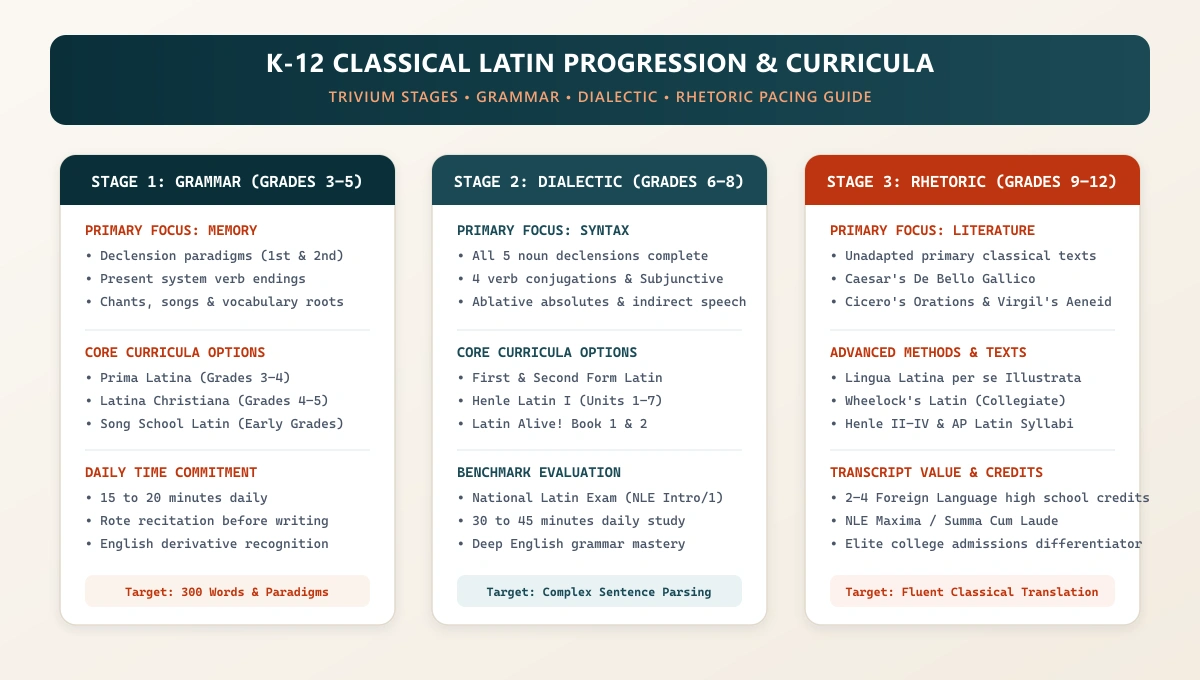
K-12 Classical Latin Educational Architecture
1. Why Study Latin? The Three Enduring Benefits
Before examining specific curricula, it is crucial to recognize why Latin occupies the undisputed central position in classical and Trivium-based education:
- Analytical Mastery of English Grammar: English is only lightly inflected, allowing students to speak and write colloquially without grasping the underlying mechanics of parts of speech. Latin, by contrast, is highly inflected—the function of a word (subject, direct object, possessive, indirect object) is governed entirely by its case ending (nominative, genitive, dative, accusative, ablative). A child who parses Latin nouns and verbs acquires an instinctive, master-level comprehension of English structure.
- Vocabulary and Etymological Dominance: Over 60% of common English words and up to 90% of polysyllabic academic, botanical, anatomical, and legal vocabulary derive from Latin roots[2]. Students with multi-year Latin training consistently score in the 90th percentile and above on verbal SAT and ACT sections.
- Cognitive Discipline and Logic: Translating an inflected classical sentence requires the same deductive reasoning, pattern recognition, and working memory manipulation as solving a multi-step algebraic equation. Latin trains the brain to suspend snap judgments, examine relational suffixes, and verify syntactic agreement before reaching a conclusion.
2. Choosing Your Method: Grammar-Translation vs. Natural Reading
Homeschool Latin curricula fall broadly into two competing instructional philosophies:
The Grammar-Translation Method (Traditional/Deductive)
The grammar-translation approach is the historic gold standard of classical schooling. Students learn grammatical rules, declension paradigms, and vocabulary lists systematically through rote recitation and chant, and then apply those rules to parse and translate sentences from Latin into English and English into Latin.
- Top Curricula: Memoria Press (Prima Latina, Latina Christiana, Forms Series), Henle Latin, Wheelock’s Latin.
- Strengths: Unrivaled clarity, predictable structure, easy for non-Latin-speaking parents to facilitate, directly enhances English analytical grammar.
- Drawbacks: Can feel dry if pacing is bogged down; students read slowly rather than fluidly.
The Natural/Direct Reading Method (Inductive)
Pioneered in modern times by Danish classicist Hans Henning Ørberg with his celebrated text Lingua Latina per se Illustrata (LLPSI), this method immerses the student in continuous Latin prose from page one. Context clues, marginal illustrations, and grammatical morphology are absorbed intuitively through graded story immersion.
- Top Curricula: Lingua Latina per se Illustrata (Familia Romana), Cambridge Latin Course.
- Strengths: Develops authentic reading speed, fosters thinking directly in Latin, highly engaging narrative format.
- Drawbacks: Requires significant deductive intuition; students can gloss over precise grammatical mechanics without realizing it.
💡 The Hybrid Recommendation: Many veteran homeschool classicists employ a hybrid approach: building an ironclad grammatical foundation through Memoria Press or Henle in elementary and middle school, and introducing Lingua Latina per se Illustrata as supplementary reading in high school.
3. Pronunciation: Ecclesiastical vs. Classical
One of the first decisions a family faces is choosing between two pronunciation standards:
- Ecclesiastical Latin: The traditional pronunciation of the Western Christian Church and medieval Europe. It mirrors modern Italian phonetics: ‘c’ before ‘e’ or ‘i’ sounds like ‘ch’ (civitas = chee-vee-tahs), ‘g’ before ‘e’ or ‘i’ is soft like ‘gem’, and ‘v’ is pronounced as an English ‘v’. Recommended for Christian homeschoolers, choir singers, and families focusing on historic liturgy.
- Classical Latin: The reconstructed pronunciation of Cicero, Julius Caesar, and Augustan Rome. The letter ‘c’ is always hard like ‘cat’ (civitas = kih-wih-tahs), ‘v’ sounds like an English ‘w’ (veni, vidi, vici = weh-nee, wee-dee, wee-kee), and diphthongs carry distinctive vowel combinations. Recommended for secular homeschoolers and competitive students preparing for secular university classics departments.
Both pronunciations use identical vocabulary, syntax, and case endings. Choose the pronunciation used by your chosen curriculum and maintain consistency throughout your studies.
4. K–12 Curriculum Roadmap: Stage by Stage
The Grammar Stage (Grades 3–5): Chants, Paradigms & Vocabulary
In early elementary, children possess an extraordinary natural capacity for rote memorization. Do not bog young students down in dense syntactic analysis; focus on joyful chants, songs, and primary vocabulary roots.
- Grades 3–4: Prima Latina (Memoria Press): Gentle, slow introduction covering basic Latin prayers, 125 vocabulary words, 1st and 2nd declension noun endings, and English derivatives. Designed specifically for teachers with zero Latin background.
- Grades 4–5: Latina Christiana (Memoria Press): Expands vocabulary to 250 words, covers 1st and 2nd verb conjugations in the present tense, and introduces basic grammatical parsing.
The Dialectic Stage (Grades 6–8): Systematic Syntax & Parsing
As students enter middle school, their brains transition toward questioning, logical categorization, and systematic cause-and-effect thinking. Here, Latin grammar is mastered in its entirety.
- Grades 6–8: First Form through Fourth Form Latin (Memoria Press): A comprehensive 4-year grammatical progression that systematically covers all five noun declensions, four verb conjugations, personal pronouns, adjectives, adverbs, and complex syntax including indirect discourse and the subjunctive mood.
- Alternative: Henle Latin First Year (Loyola Press): A timeless classic written by Father Robert Henle. Features rigorous grammatical exercises set against the historical backdrop of Caesar’s Gallic Wars and Christian antiquity.
The Rhetoric Stage (Grades 9–12): Authentic Classical Literature
By high school, students move beyond textbook exercises to translate authentic classical authors in their original meter and style:
- Latin I & II (Grades 9–10): Completion of fundamental Latin grammar and syntax through Henle I, Wheelock’s Latin, or Latin Alive! Book 3.
- Latin III (Grade 11): Julius Caesar’s De Bello Gallico and Cicero’s In Catilinam oration. Focus shifts toward historical context, rhetorical figures of speech, and political philosophy.
- Latin IV / AP Latin (Grade 12): Virgil’s epic masterpiece The Aeneid. Students analyze dactylic hexameter meter, Augustan poetic themes, and mythological subtext.
5. High School Credits and the National Latin Exam (NLE)
Homeschoolers can readily validate their high school Latin coursework on college transcripts through external, standardized milestones:
High School Transcript Documentation
One full academic year of daily study (approximately 120–150 instructional and study hours) covering a standard high school textbook (such as Henle I or the first half of Wheelock’s) equals 1.0 High School Foreign Language Credit. Most selective universities recommend or require 2 to 4 consecutive credits of the same foreign language.
The National Latin Exam (NLE)
Sponsored by the American Classical League (ACL), the National Latin Exam is a premier 40-question multiple-choice exam administered annually in March to over 100,000 students worldwide[3].
Homeschool students can register through a local homeschool cooperative or approved proctor. Earning a Maxima Cum Laude (Silver Medal) or Summa Cum Laude (Gold Medal) on the NLE provides objective, third-party validation that admissions officers at Ivy League and top-tier institutions recognize instantly.
Curriculum Comparison Matrix for Homeschool Latin
| Curriculum | Approach | Target Grades | Pronunciation | Parent Effort Required | Best Suited For |
|---|---|---|---|---|---|
| Prima Latina | Grammar-Translation | 3rd–4th | Ecclesiastical | Minimal (DVD/Audio included) | Gentle elementary launch for beginners |
| First Form Latin | Grammar-Translation | 5th–8th | Ecclesiastical | Low to Moderate | Comprehensive, mastery-based middle school |
| Henle Latin I | Grammar-Translation | 8th–11th | Ecclesiastical / Classical | Moderate to High | Rigorous, logic-stage classical students |
| Lingua Latina (LLPSI) | Natural / Direct Reading | 8th–12th | Classical | High (Requires guidance) | Visual, immersion-oriented readers |
| Wheelock’s Latin | Intensive Grammar | 9th–12th+ | Classical | High (College level) | Advanced high schoolers aiming for AP Latin |
Frequently Asked Questions About Homeschool Latin
Do colleges accept Latin as a high school foreign language requirement? ↓
Can a parent who never studied Latin teach it successfully? ↓
Should we study Latin or a modern spoken language first? ↓
What grade is best to begin formal Latin instruction? ↓
Disclaimer: This post is for informational and educational purposes only, accurate to the best of our knowledge at publication. It does not constitute advice. We do not guarantee accuracy or completeness and accept no liability for any decisions or losses resulting from reliance on this content.