
In conventional schooling, mathematics is almost universally regarded as the single greatest source of childhood academic trauma. From first-grade timed arithmetic drills to high school polynomial factorization worksheets, millions of students endure a daily ritual of memorizing arbitrary algorithms without context, purpose, or intrinsic joy. By age twelve, the overwhelming majority of American students conclude that they are simply “not a math person”—internalizing a debilitating psychological block known clinically as math anxiety.
Yet, when we examine how human beings actually interact with numerical reality outside the confines of a schoolroom, a startling truth emerges: the universe is inherently mathematical, and human children are natural mathematical pattern-seekers. Long before the invention of school desks and standardized testing, children mastered intricate spatial ratios, trade valuations, physical trajectories, and quantitative estimations through play, survival, and practical craftsmanship.
In an unschooling or self-directed home education environment, mathematics is liberated from the sterile confines of 45-minute textbook lessons. Instead of forcing an eight-year-old through thirty repetitive workbook problems on two-digit subtraction, unschooling families embed numeracy within the fabric of daily life: running youth micro-businesses, managing real cash budgets, calculating recipe fractions, measuring lumber for treehouses, tracking high-yield savings accounts, and analyzing probability during family board game nights.
As Unschooling Director at Motherly Insights and a veteran unschooling parent of eleven years, I have mentored hundreds of families through the deschooling of mathematics. In this 2026 comprehensive guide, we unpack the cognitive science of natural numeracy, outline practical immersion pathways across financial and spatial domains, and demonstrate how self-directed teens seamlessly conquer formal high school mathematics and college entrance exams when they are truly ready.
The Cognitive Science of Natural Numeracy & Deschooling Math
To understand why natural mathematics produces such profound numerical intuition, we must examine developmental cognitive psychology. Educational pioneer John Holt famously argued in How Children Learn that children possess an innate drive to understand the world through direct sensory feedback. When a child learns math through an abstract textbook, they are manipulating arbitrary symbols on paper; when they learn math through real-world utility, their brain connects numerical symbols to tangible physical realities.
Renowned evolutionary psychologist Dr. Peter Gray, research professor at Boston College and leading authority on self-directed education, documented this phenomenon in his landmark studies of Sudbury Valley School and unschooled alumni. His research revealed that unschooled children who never opened a formal math textbook throughout elementary school frequently mastered all of elementary and middle school arithmetic—from basic addition through pre-algebra—in under six weeks of self-motivated study when they decided they needed it for high school science or college entrance examinations.
Why Textbook Mathematics Fails So Many Children
- Premature Abstraction: Forcing children to manipulate abstract algebraic symbols before their brain has established somatosensory spatial anchors creates cognitive friction and mechanical memorization without understanding.
- Artificial Pacing & Deficit Stigmatization: If a child requires six months to fully internalize the concept of division, a traditional curriculum rushes past them, declaring them “behind.” The resulting foundation is fragile, causing advanced concepts like fractions and decimals to collapse.
- Divorce from Intrinsic Utility: When a child asks, “Why do I need to know this?” and the teacher’s only answer is “Because it will be on the test on Friday,” intrinsic motivation evaporates, replaced by anxiety and mental fatigue.
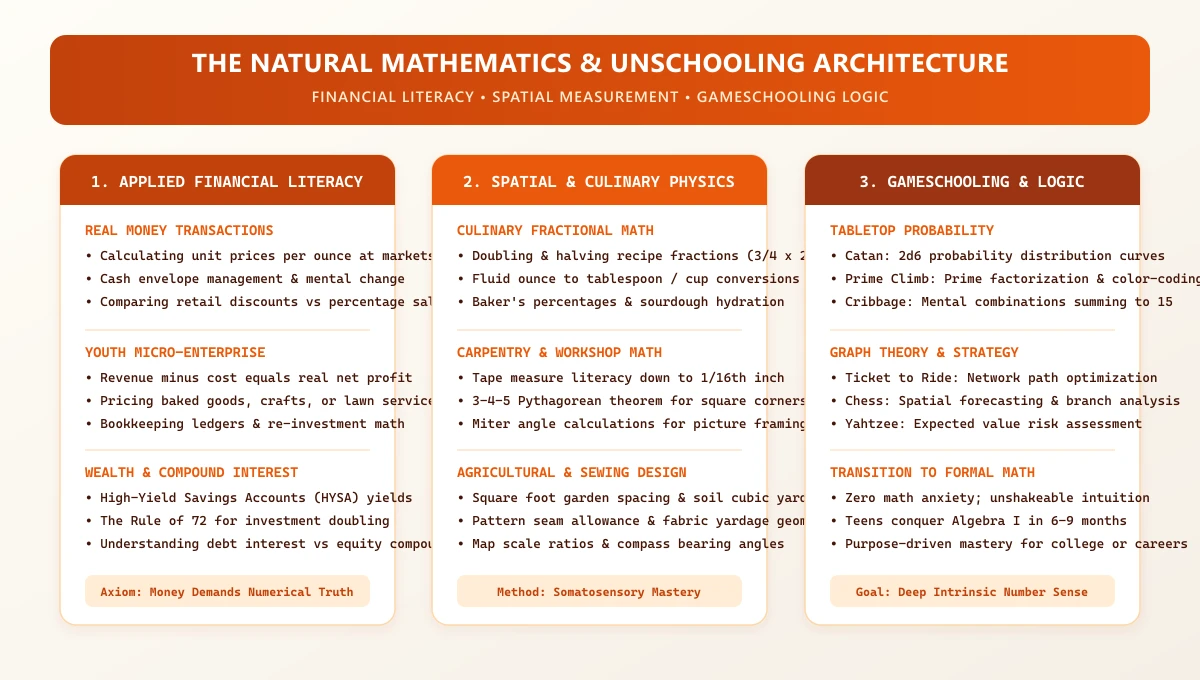
Pillar I: Real-World Financial Literacy as the Foundational Anchor
Money is the single most powerful, emotionally engaging vehicle for developing rigorous numerical fluency. Unlike textbook word problems involving hypothetical trains traveling from Chicago to Denver, personal finances have immediate, tangible consequences. A child who miscalculates their change at a farmers’ market or underestimates sales tax experiences an immediate, authentic lesson in arithmetic precision.
1. Market Mathematics & Unit Price Analysis
Transform everyday grocery shopping into a living mathematics laboratory:
- Unit Price Decoding: Teach children to ignore marketing claims and calculate the price per ounce, pound, or liter across competing brands. Is the 32-ounce family size genuinely cheaper per unit than the two 16-ounce packages on sale?
- Discounts and Sales Tax Calculations: Have your student calculate a 25% off markdown in their head before reaching the register, then add your state’s local sales tax.
- Cash Envelope Operations: Provide young children with a physical cash envelope for their personal discretionary spending. Handling paper currency and physical coins establishes concrete tactile connections to base-10 place value that digital credit cards obscure.
2. Youth Micro-Enterprise & Business Ledgers
Nothing accelerates mathematical mastery faster than running an authentic micro-business. Whether your teenager sells handmade pottery on Etsy, operates a summer lawn-aeration route, breeds heritage chickens for organic egg sales, or organizes a neighborhood bake sale, they immediately encounter advanced accounting concepts:
- The Fundamental Business Equation: ( ext{Revenue} - ext{Expenses} = ext{Net Profit}). Children quickly discover that making $100 in sales does not mean they have $100 to spend if ingredient costs were $65.
- Inventory & Margin Calculations: Determining cost of goods sold (COGS), profit margins, and volume pricing.
- Bookkeeping Spreadsheets: Learning basic spreadsheet formulas in Google Sheets or Excel (( ext{SUM}), ( ext{AVERAGE}), cell multiplication), creating automated financial dashboards that teach applied algebra organically.
3. High-Yield Savings, The Rule of 72 & Compound Interest
Introduce children to the mathematical wonder of compound interest before high school:
- The Rule of 72: A simple mental math shortcut to calculate how many years it will take an investment to double at a given interest rate: ( ext{Years to Double} = 72 div ext{Annual Interest Rate}). At a 6% annual return, their money doubles in 12 years; at 9%, it doubles in only 8 years.
- Compound Growth Curves: Graphing exponential growth curves versus linear arithmetic growth, helping teens visualize the long-term mathematical reality of investing early in index funds versus the catastrophic exponential drag of credit card debt.
Pillar II: Spatial Physics, Measurement & Culinary Geometry
Mathematics is the universal language of physical creation. When children engage with tangible materials—wood, cloth, clay, flour, and soil—they develop an intuitive mastery of geometry, fractions, ratios, and dimensional analysis that textbook worksheets can never replicate.
1. Culinary Mathematics & Baker’s Ratios
The kitchen is a rigorous chemistry and fraction laboratory where mathematical precision directly dictates culinary success:
- Fraction Manipulation: Doubling, tripling, or halving complex recipes. A student attempting to make 1.5 times a batch of cookies must solve: $$ rac{3}{4} imes 1.5 = rac{3}{4} imes rac{3}{2} = rac{9}{8} = 1 rac{1}{8} ext{ cups}$$ Because measuring spoons only come in standard increments, the child must figure out how to assemble (1 rac{1}{8}) cups using a 1-cup measure and two tablespoons.
- Baker’s Percentages: In professional bread baking, all ingredients are calculated as a percentage of the total flour weight (e.g., 72% hydration, 2% salt, 20% sourdough starter). Calculating hydration percentages using digital kitchen scales teaches proportional reasoning far more effectively than abstract ratios on a whiteboard.
2. Carpentry, Woodworking & The 3-4-5 Triangle
When building a birdhouse, bookshelves, or a backyard chicken coop, mistakes cannot be erased with a pencil; cutting a board an eighth of an inch too short ruins a workpiece:
- Fractional Tape Measure Fluency: Learning to read sixteenths and eighths of an inch on an imperial tape measure without pausing to count tick marks.
- The Pythagorean Theorem in the Workshop: Long before formal high school geometry, children building garden beds or framing walls learn the ancient builder’s 3-4-5 rule: measuring 3 feet along one side and 4 feet along the adjacent side ensures a perfectly square 90-degree corner if the diagonal measures exactly 5 feet ((3^2 + 4^2 = 9 + 16 = 25 = 5^2)).
- Angular Calculations: Calculating miter angles for hexagonal or octagonal picture frames ((360^circ div ext{sides} div 2)), putting applied geometry into immediate creative service.
3. Agricultural & Cartographic Mathematics
- Square Foot Gardening: Calculating soil volume in cubic yards for raised garden beds (( ext{Length} imes ext{Width} imes ext{Depth} div 27)) and determining plant spacing ratios using square grid layouts.
- Map Scales & Orienteering: Using compass bearings, magnetic declination angles, and topographic map scales (e.g., 1:24,000 where 1 inch equals 2,000 feet) during wilderness hiking expeditions.
Pillar III: Gameschooling as a Formal Mathematics Laboratory
One of the most potent, joyful secrets of unschooling families is Gameschooling: utilizing commercial tabletop board games, card games, and role-playing games to develop world-class mental arithmetic, probability theory, graph theory, and strategic resource management.
When playing a captivating board game, children willingly execute hundreds of rapid mathematical calculations without a shred of fatigue or resistance because the math serves an immediate, competitive, or cooperative objective:
| Tabletop Game | Target Age Range | Core Mathematical & Logical Concepts Mastered |
|---|---|---|
| Prime Climb | Ages 8+ | Prime factorization, multiplication, division, mental arithmetic, and visual color-coded number theory. |
| The Settlers of Catan | Ages 10+ | 2d6 probability distribution curves (why 6 and 8 roll more frequently than 2 and 12), resource ratios, and trade valuation. |
| Cribbage | Ages 8+ | Rapid mental addition, combinations summing to 15, card counting, and probability estimation. |
| Ticket to Ride | Ages 8+ | Graph theory, network optimization, spatial logistics, and route efficiency calculations. |
| Yahtzee & Farkle | Ages 6+ | Discrete probability, expected value risk assessment, rapid addition, and tactical forecasting. |
| Monopoly Deal | Ages 7+ | Asset liquidity, debt settlement, set collection geometry, and rapid mental financial balancing. |
| Dungeons & Dragons (D&D 5e) | Ages 11+ | Multi-die probability distribution (d20, d12, 2d6), modifier algebra (( ext{Roll} + ext{Proficiency} + ext{Stat Mod})), encumbrance ratios, and spatial grid movement. |
Bridging the Gap: How Unschoolers Transition to Formal High School Math
Perhaps the greatest anxiety harbored by parents considering unschooling is: “What happens when my child needs Algebra, Calculus, or the SAT? Can real life really prepare them for higher mathematics?”
The answer from decades of unschooling research is a resounding yes. When a teenager has spent their childhood building rock-solid number sense, spatial intuition, and zero math anxiety, their brain is primed for rapid formal acquisition. They do not view math as an instrument of torture; they view it as a useful tool or an intriguing intellectual puzzle.
The Self-Motivated Ramp: The 6-to-12 Month Mastery Pathway
When an unschooled teen reaches ages 14 to 17 and identifies a clear personal goal—such as entering an engineering program, pursuing aviation flight school, passing the SAT/ACT, or enrolling in community college dual-enrollment calculus—their trajectory follows a predictable, highly accelerated pattern:
- Self-Directed Curriculum Selection: Rather than having a textbook imposed upon them, the teen selects a self-paced, high-quality mastery program that fits their cognitive learning style:
- Mr. D Math: Highly engaging, interactive online instruction specializing in demystifying Pre-Algebra through Pre-Calculus with supportive live coaching.
- Khan Academy: Free, adaptive, mastery-based digital progression allowing students to test out of concepts they already intuitively understand and focus exclusively on specific gaps.
- Art of Problem Solving (AoPS) / Beast Academy: For mathematically gifted, puzzle-loving teens who crave deep conceptual proofs and competitive problem-solving.
- Life of Fred: A unique, story-driven curriculum by Dr. Stanley Schmidt that teaches high-level mathematics through the humorous, narrative life of a five-year-old math prodigy.
- Accelerated Velocity: Because the teen is emotionally mature, cognitively developed, and intrinsically motivated, they do not need 180 school days to complete Algebra I. They routinely conquer an entire year’s worth of textbook algebra in three to four months, working for one to two focused hours per day without burnout.
- Flawless Conceptual Retention: Because their formal math studies are anchored in years of hands-on physical experience with money, tools, cooking, and strategy games, abstract formulas immediately click. When an unschooled teen encounters linear slope ((y = mx + b)), they intuitively connect it to roof pitch or business profit margins.
Practical Action Plan: Designing a Math-Rich Home Environment
You do not need to discard all math books tomorrow to begin unschooling math; you simply need to shift the locus of authority from arbitrary external worksheets to organic, daily problem-solving:
| Step | Actionable Implementation Protocol | Desired Mindset Shift |
|---|---|---|
| 1. The Math De-Escalation Period | Declare a 30-day “math cease-fire.” Put away all worksheets, timed flashcards, and grading pens. Allow math anxiety and emotional resistance to dissipate completely. | From “I hate math” to emotional neutrality and safety. |
| 2. Stock the Physical Environment | Place measuring tapes, high-quality digital scales, dice, geometric origami paper, real currency, and calculating abacuses openly in shared living areas. | From math as a printed chore to math as an ambient, tactile tool. |
| 3. Implement Weekly Game Nights | Designate Friday evenings as Family Board Game Night, rotating through math-rich strategy games (Prime Climb, Catan, Yahtzee, Cribbage). | From tedious drill to competitive, joyful cognitive engagement. |
| 4. Involve Kids in Real Decisions | Hand your child the family vacation budget, restaurant tipping calculations, or garden planting blueprints, asking for their genuine advice and analysis. | From passive dependency to active, responsible partnership. |
| 5. Support the Formal Bridge | When your teen expresses a personal goal requiring formal credentials, provide high-quality, self-paced mastery resources without pressure or judgment. | From coerced compliance to empowered, self-directed scholarship. |
By stepping back from coercive textbook regimens and trusting your child’s innate capacity for mathematical reasoning, you transform numbers from a source of tears into an empowering, lifelong superpower. When math is lived rather than merely studied, children emerge with something infinitely more precious than high test scores: they emerge with unshakeable common sense, fearless problem-solving agility, and an abiding wonder at the numerical elegance of the universe.
Disclaimer: This post is for informational and educational purposes only, accurate to the best of our knowledge at publication. It does not constitute advice. We do not guarantee accuracy or completeness and accept no liability for any decisions or losses resulting from reliance on this content.