
In the popular imagination, “worldschooling” is often depicted through glossy, curated social media montages: sunlit children sketching Roman aqueducts in watercolor journals, teenagers learning marine biology while snorkeling vibrant coral reefs in Southeast Asia, and smiling families boarding high-speed trains without a care in the world.
Yet behind every successful, joyful worldschooling adventure lies an unglamorous, ironclad foundation of operational logistics. What happens when your family exceeds the Schengen Zone’s strict 90-day tourist limitation? How do you maintain legal homeschool compliance in your home state to avoid truancy investigations while crossing international borders? How do you manage reliable high-speed connectivity for a teen completing high school chemistry while anchored in a remote Greek harbor or traversing the Costa Rican cloud forest? And how do you design an academic routine that flexes around jet lag, bus delays, and spontaneous cultural festivals without collapsing into academic neglect?
As Worldschooling Specialist at Motherly Insights and an educational geographer who has navigated long-term travel with homeschooling families across five continents, I have designed this comprehensive 2026 operational blueprint. This guide addresses the unvarnished realities of modern global home education: visa regulations, legal domicile preservation, hardware redundancy, international healthcare, and asynchronous pedagogical architecture.
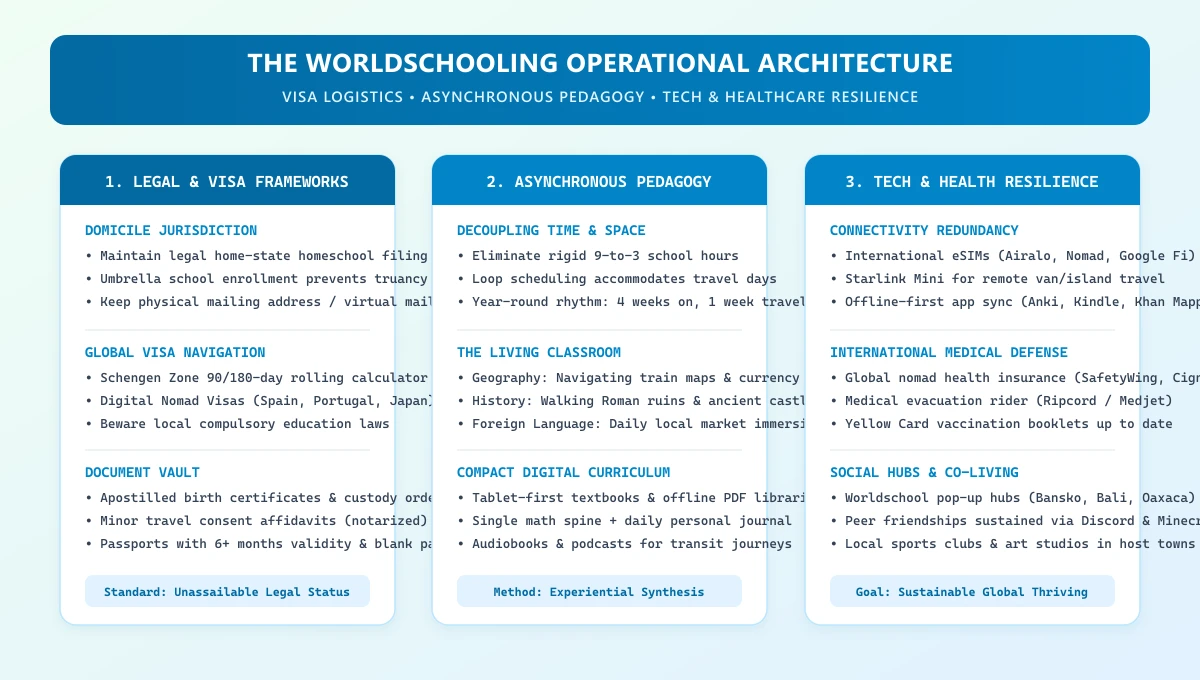
The Legal Triad: Domicile, Umbrella Schools & Truancy Immunity
The single most common legal mistake traveling families make is assuming that the moment their airplane clears international airspace, they are exempt from all homeschooling laws. In reality, education is governed by jurisdiction, and jurisdiction is anchored to your legal domicile.
If you are a citizen or permanent resident of the United States, your family remains subject to the compulsory education laws of your legal home state until you formally establish permanent legal residency in another country.
1. Preserving Your Home-State Legal Anchor
To protect your family from truancy inquiries or state-level record audits:
- Maintain Domicile in a Low-Regulation State: Families who sell their primary residence often re-establish legal domicile in states with zero notification requirements and no state income tax—most notably Texas, Florida, South Dakota, or Alaska. South Dakota and Florida, in particular, offer well-established statutory frameworks for full-time travelers to register vehicles, vote, and maintain legal residency via commercial mail-forwarding services (such as America’s Mailbox or St. Brendan’s Isle).
- Filing in Moderate-Regulation States: If maintaining domicile in your existing home state (e.g., Ohio, Virginia, or California), continue submitting your annual Notice of Intent (NOI) using your permanent physical address or legal mail-forwarding address. Never tell a local district superintendent that you are “traveling indefinitely”; maintain that your student is legally homeschooled under state statute, completing coursework asynchronously via distance learning.
2. The Umbrella School Defense Strategy
For traveling families who wish to bypass state-by-state portfolio reviews, standardized testing mandates, or superintendent approvals altogether, enrolling in an accredited private umbrella school (often based in Tennessee, Florida, or California) is the ultimate safeguard.
Under this model:
- Your student is legally categorized as a private school student enrolled in a registered institution, completely exempting you from local public school homeschool oversight.
- The umbrella school maintains official cumulative records, verifies attendance, issues apostilled transcripts, and provides official enrollment verification letters.
- If a border control official, immigration officer, or airline agent asks why your school-aged child is traveling in October, you can present a laminated private school enrollment card and an official letter from the school principal confirming that the student is engaged in an approved independent study program abroad.
Navigating Passports, Digital Nomad Visas & Border Crossings in 2026
Global immigration enforcement has transformed dramatically in 2026. Automated biometric entry systems, the European Union’s European Travel Information and Authorisation System (ETIAS), and digital entry registries mean that traveling families can no longer rely on casual “border runs” or vague tourist explanations.
1. The Schengen Zone 90/180-Day Rule
For families traveling through Europe, understanding the Schengen Agreement is essential. Non-EU citizens (including Americans, Canadians, and Australians) are permitted to stay within the 29 Schengen member states for a maximum of 90 days within any rolling 180-day window.
- The Rolling Window Mechanism: The 180-day window is dynamic, looking back exactly 180 days from each day of your stay. Exceeding 90 days—even by a single hour—triggers severe consequences: immediate deportation, biometric flags, and multi-year entry bans.
- The Non-Schengen Shuffle: To travel long-term in Europe without a residency visa, worldschoolers utilize the “Schengen Shuffle”: spending 90 days inside the Schengen Zone (e.g., France, Italy, Germany), followed immediately by 90 days in neighboring non-Schengen nations:
- The United Kingdom & Ireland: The UK permits US citizens to stay up to 6 months visa-free as tourists.
- The Balkans: Albania (permits US citizens to stay a full 365 days visa-free), Montenegro, Bosnia & Herzegovina, and North Macedonia.
- Cyprus & Turkey: Generous 90-day independent tourist stays outside the Schengen calculation.
2. Digital Nomad Visas for Families
In 2026, over 60 countries offer official Digital Nomad Visas (DNVs) or Temporary Residence Visas designed specifically for remote workers, freelancers, and their dependent families:
| Country & Visa Type | Monthly Income Requirement | Validity & Extensions | Homeschooling Legal Environment |
|---|---|---|---|
| Spain (Digital Nomad Visa) | ~€2,600/mo (primary) + €1,000/mo per dependent | 1 year (renewable up to 5 years) | Spanish law mandates local school attendance for residents; DNV holders must prove distance enrollment via accredited US online/umbrella school. |
| Portugal (D8 Digital Nomad Visa) | ~€3,280/mo (primary) + 50% spouse + 30% per child | 1 year (renewable for 2-year increments) | Homeschooling is legally recognized in Portugal but requires registration with a local patron school and annual Portuguese-language testing. |
| Costa Rica (Estancia Nomad) | $3,000/mo (family $4,000/mo) | 1 year (renewable for 1 additional year) | Total autonomy; no local educational registration required for foreign temporary residents. |
| Japan (Digital Nomad Visa) | ¥10,000,000/yr (~$68,000 USD) | 6 months (non-renewable; must exit 6 months before re-applying) | Zero local school requirements; exceptional safety, bullet-train connectivity, and historical immersion. |
| Croatia (Digital Nomad Permit) | ~€2,540/mo + 10% per dependent | 1 year (cannot be renewed immediately; requires 6-month exit) | English widely spoken; excellent coastal base for non-Schengen rotation periods. |
3. The Minor Border-Crossing Documentation Vault
Traveling internationally with minors requires meticulous legal preparation to prevent suspicion of parental child abduction. Always carry physical, laminated copies and encrypted digital cloud backups of:
- Valid Passports: Every family member’s passport must have at least 6 months of validity remaining beyond your planned return date and at least 4 completely blank visa pages.
- Certified Long-Form Birth Certificates: Showing both parents’ full legal names.
- Notarized Minor Travel Consent Letter: If one parent is traveling alone with the children (even for a brief side trip), carrying a notarized consent letter signed by the non-traveling spouse is mandatory in many jurisdictions (such as Mexico, Canada, and South Africa).
- Certified Custody / Death Certificates: If applicable, sole custody court decrees or death certificates must be apostilled.
Asynchronous Pedagogical Design: Decoupling Time from Learning
The most destructive mistake a newly traveling family can make is attempting to recreate a traditional school day in a hotel room: demanding that children sit at a dining table from 9:00 AM to 2:00 PM completing digital worksheets while the vibrant streets of Kyoto, Florence, or Oaxaca pass by outside the window.
True worldschooling requires asynchronous pedagogical design: decoupling education from fixed hours, five-day school weeks, and rigid nine-month school calendars.
The Three Operational Rhythms of Travel Learning
| Operational Travel Mode | Duration & Setting | Curricular Focus & Daily Learning Rhythm |
|---|---|---|
| Basecamp Mode | 4–6 Weeks in a single rental apartment or villa | • Intensive core academics: Math mastery, formal literature, grammar • Everyday life rhythm: Local market shopping, playground visits, daily writing • Deep community immersion: Joining neighborhood sports clubs, pottery studios, language exchanges |
| Transit Mode | 3–7 Days of active travel (trains, ferries, road trips) | • Zero formal digital schoolwork: Laptops packed away, zero worksheets • Experiential practical geography: Navigating train maps, timetables, currency conversion • Passive literacy: Listening to regional audiobooks, mythology podcasts, historical memoirs |
| Exploration Mode | 1–2 Weeks of intense regional excursions | • Field immersion: Ancient ruins, museums, national reserves, marine biology centers • Multidisciplinary journaling: Daily watercolor nature sketches, architectural drawings, ticket stubs • Evening oral narrations: Family synthesis discussions examining cultural and historical contrasts |
1. Loop Scheduling for Unpredictable Itineraries
Instead of assigning specific subjects to days of the week (“Mondays are for History, Tuesdays are for Science”), utilize Loop Scheduling.
A loop schedule is a sequential checklist of core subjects that you advance through only when instructional time is available. If a delayed ferry or a spontaneous village festival consumes an entire Wednesday, no curriculum “falls behind.” When you sit down on Thursday, you simply pick up the very next item on the loop.
2. The Ultra-Compact Curricular Spine
When luggage space is constrained to carry-on bags, physical curriculum must be ruthlessly curated. A world-class worldschooling curriculum requires only four core portable assets:
- One Rigorous Math Spine: An adaptive, offline-compatible digital curriculum (such as Beast Academy Online, CTCMath, or Singapore Math PDFs on an iPad) completed for 30 focused minutes, 4 mornings per week.
- A High-Capacity E-Reader (Kindle / Kobo): Preloaded with hundreds of unabridged living books, classic historical fiction, biographies, and regional folk tales connected to your itinerary.
- A Hardbound Multimedia Travel Journal: A heavyweight, mixed-media sketchbook for each child. Used for daily copywork, botanical pressings, watercolor sketches, train ticket collages, and handwritten personal narrations.
- Audio Storytelling: Unabridged audiobooks (Audible, LibriVox, Scribd) and educational history podcasts (such as Dan Carlin’s Hardcore History for teens or Greeking Out for elementary students) turning long bus journeys into profound historical lectures.
Hardware, Power & Connectivity Resilience in 2026
A single hardware failure or dead Wi-Fi router can paralyze a digital nomad family’s remote work and educational flow. In 2026, traveling families must engineer complete technological redundancy:
1. Mobile Internet & Dual-SIM Protocols
Never depend exclusively on Airbnb or hotel Wi-Fi, which is notoriously unreliable in historic European city centers and developing nations.
- Global Travel eSIMs: Utilize digital eSIM apps (such as Airalo, Nomad, or Holafly) to purchase local high-speed data packages the moment your plane touches down on the tarmac, eliminating the need to locate physical airport SIM card kiosks.
- Starlink Mini Satellite Terminals: In 2026, SpaceX’s backpack-sized Starlink Mini has become the ultimate game-changer for nomadic families. Operating on 12V–24V DC battery power (drawing only 25–40 watts), Starlink Mini provides 100+ Mbps broadband in the middle of the Sahara Desert, Patagonian fjords, or remote Scottish Highlands.
- Cellular Hotspot Backup: Keep an unlocked 5G mobile hotspot (such as a Netgear Nighthawk) equipped with a high-allowance local data SIM card, serving as an automatic failover for work Zoom calls and student submissions.
2. Offline-First Digital Architectures
Ensure that all student learning applications function 100% offline without active internet connections:
- Download offline Wikipedia dumps and offline Google Maps regions for every destination.
- Sync entire Google Drive and Notion curriculum databases locally to laptop solid-state drives.
- Cache Khan Academy, Duolingo, and Anki spaced-repetition flashcard decks for transit flights and remote camping stretches.
3. Power Architecture & Voltage Defense
- Universal GaN Fast Chargers: Carry 100W–140W Gallium Nitride (GaN) multi-port USB-C chargers with interchangeable international plug adapters (US, UK, EU, AU). GaN technology delivers immense charging power for multiple laptops and tablets simultaneously in a package the size of a deck of cards.
- Rugged Power Banks: Equip each student with an airline-compliant 20,000mAh to 27,650mAh (99.9Wh) USB-C power bank capable of recharging a laptop once or an iPad three times during overnight train journeys.
International Healthcare, Insurance & Emergency Protocols
A medical emergency abroad without adequate insurance can result in catastrophic financial ruin or compromised clinical care. Domestic health insurance policies (including US Medicare and commercial HMOs) rarely provide coverage outside domestic borders.
1. Dedicated International Nomad Insurance
Traveling families must secure comprehensive international major medical insurance:
- Travel Medical Insurance (e.g., SafetyWing Nomad Insurance, World Nomads): Inexpensive, subscription-based coverage designed for unexpected illnesses, accidents, emergency room visits, and urgent dental treatment abroad.
- Comprehensive Global Health Insurance (e.g., Cigna Global, GeoBlue, Allianz Worldwide): Premium, annually underwritten coverage that includes routine pediatric well-checks, childhood immunizations, specialist consultations, and pre-existing condition management worldwide.
- Emergency Medical Evacuation Riders (e.g., Ripcord Rescue, Medjet): Crucial for families traveling in rural, mountainous, or developing regions. If a child suffers a severe injury in a remote location where local hospitals lack pediatric surgical facilities, medical transport services coordinate private aeromedical jet evacuation to an internationally accredited hospital center of your choice.
2. The Traveling Medical Apothecary
Never travel internationally without a dedicated, sealed pediatric first-aid kit containing:
- Broad-spectrum prescription antibiotics (prescribed in advance by your family pediatrician for emergency travel use).
- Oral rehydration salts (ORS) for severe gastroenteritis.
- Pediatric liquid ibuprofen and acetaminophen (many European pharmacies restrict over-the-counter pain relievers or sell unfamiliar formulations).
- Epinephrine auto-injectors (EpiPens) with official physician travel travel letters in multiple languages.
- Comprehensive international yellow fever and immunization record booklets (WHO Yellow Card).
Socialization, Community & Sustaining Long-Term Well-Being
The most profound challenge of long-term worldschooling is not academic achievement or visa calculations; it is relational consistency and emotional stability. Constant relocation can leave children feeling untethered, longing for familiar friendships, shared inside jokes, and predictable routines.
1. The Worldschool Hub Phenomenon
To solve the isolation of nomadic life, the global community has established Worldschool Hubs and Co-Living Communities. Destinations like Bansko (Bulgaria), Bali (Indonesia), Lake Atitlán (Guatemala), Granada (Spain), and Chiang Mai (Thailand) host seasonal pop-up communities where dozens of traveling families co-locate for 4 to 12 weeks.
Children attend collaborative project-based learning workshops, play in local parks together, and participate in group excursions, while parents share co-working spaces, curriculum mentoring, and communal dinners.
2. Anchoring Digital Peer Groups
Protect your child’s friendships with intentional digital bridges:
- Schedule recurring weekly Minecraft or Roblox build sessions with their best friends back home.
- Establish private Discord or WhatsApp channels where teens can stream movies together or share creative writing projects across time zones.
- Maintain consistent pen-pal routines, encouraging your children to mail handwritten postcards and unique regional stamps to cousins and friends from every post office they visit.
3. The Power of “Anchoring Rituals”
When physical environments change every month, family rituals become the “home” your children carry with them:
- Friday evening family movie and homemade pizza nights, regardless of whether you are in an apartment in Tokyo or a cabin in Norway.
- A specific bedtime read-aloud book that travels across every hotel and rental bedroom.
- A shared travel mascot or small keepsake that marks your family’s presence in each new dwelling.
The Transformative Fruit of a Global Education
When you step into the world with your children, geography ceases to be colored shapes printed in a textbook; it becomes the scent of roasting spices in a Marrakech souk, the sound of church bells echoing across a Tuscan valley, and the exhilaration of navigating a high-speed train terminal in a language you only began studying six weeks ago.
Worldschooling dismantles ethnocentric parochialism, cultivates fearless adaptability, and instills a bone-deep reverence for the astonishing diversity of human civilization. With rigorous legal planning, resilient technology, and a flexible asynchronous mindset, the entire planet becomes your children’s living laboratory, nursery, and playground—an education without borders that will shape their minds, hearts, and character for the rest of their lives.
Disclaimer: This post is for informational and educational purposes only, accurate to the best of our knowledge at publication. It does not constitute advice. We do not guarantee accuracy or completeness and accept no liability for any decisions or losses resulting from reliance on this content.