If you hand an eight-year-old a worksheet with forty long-division problems, their brain perceives an exhausting, high-stakes threat[2]. Shoulders tense, breathing becomes shallow, and the working memory centers of the prefrontal cortex begin to throttle down under the physiological weight of math anxiety.
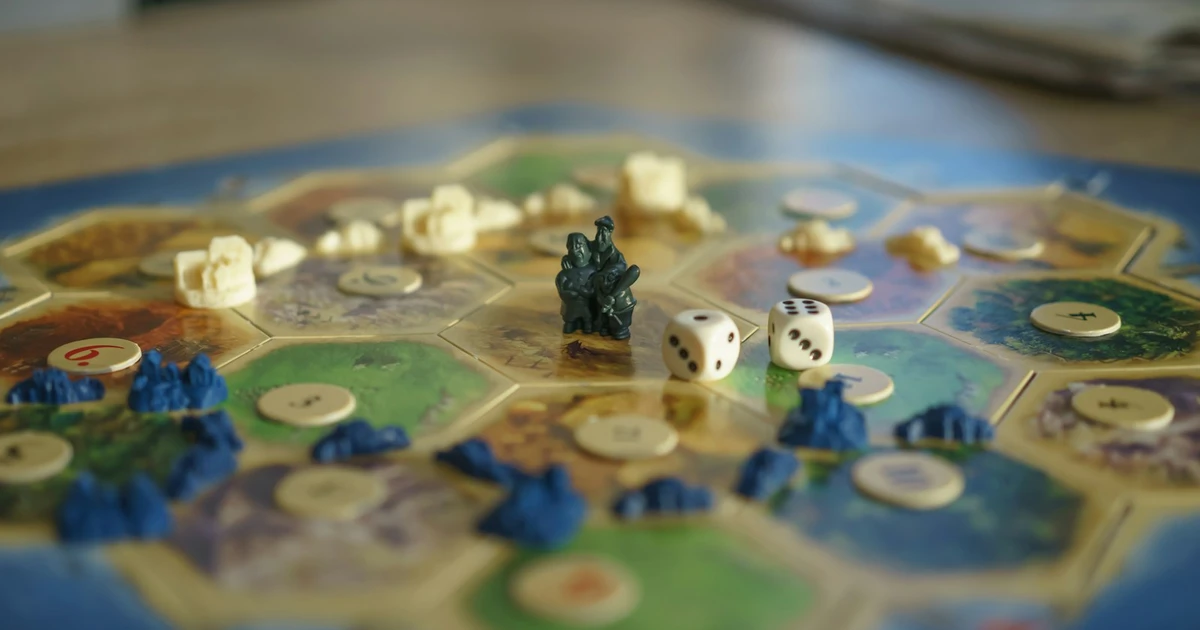
Now hand that exact same eight-year-old two ten-sided dice and the board game Prime Climb.
Suddenly, that same child spends the next forty-five minutes calculating prime factorizations, multiplying double digits, and finding common denominators with laser-sharp focus—giggling with delight as they bump their parent’s pawn back to start.
This is the transformative power of Gameschooling[1].
Gameschooling is not an educational bribe where children do “real school” first in exchange for ten minutes of play. It is an intentional, research-backed pedagogical approach that uses tabletop board games, card games, and cooperative strategy challenges as the primary instructional vehicles for mastering academic competencies[1].
The Cognitive Science of Play: Why Games Beat Worksheets
Dutch cultural historian Johan Huizinga noted that play is the primordial wellspring of human civilization, language, and law[3]. In contemporary cognitive psychology, researchers have proven why gameplay produces substantially higher retention rates than traditional rote drills:
- Lowering the Affective Filter: Coined by linguist Stephen Krashen, the “affective filter” is an emotional barrier that prevents information from reaching the brain’s language and reasoning acquisition centers. When a child fears making a mistake on a graded test, the filter shoots up. In a game, however, failure is merely a temporary game state. If you roll poorly in Yahtzee or lose a city in Ticket to Ride, you simply re-evaluate your strategy on the next turn.
- Immediate, Low-Stakes Feedback Loops: Dr. James Paul Gee demonstrated that well-designed games operate as sophisticated learning engines because they offer constant, instant feedback without shame[1]. The rules of the board enforce natural consequences; the parent does not have to act as the disciplinarian or grader.
- Multisensory Neural Encoding: Moving physical wooden meeples across a geographic map, feeling the tactile weight of dice, and verbally negotiating trades with siblings activates visual, auditory, and kinesthetic neural pathways simultaneously[4].
The Academic Tabletop Taxonomy: Mapping Games to Disciplines
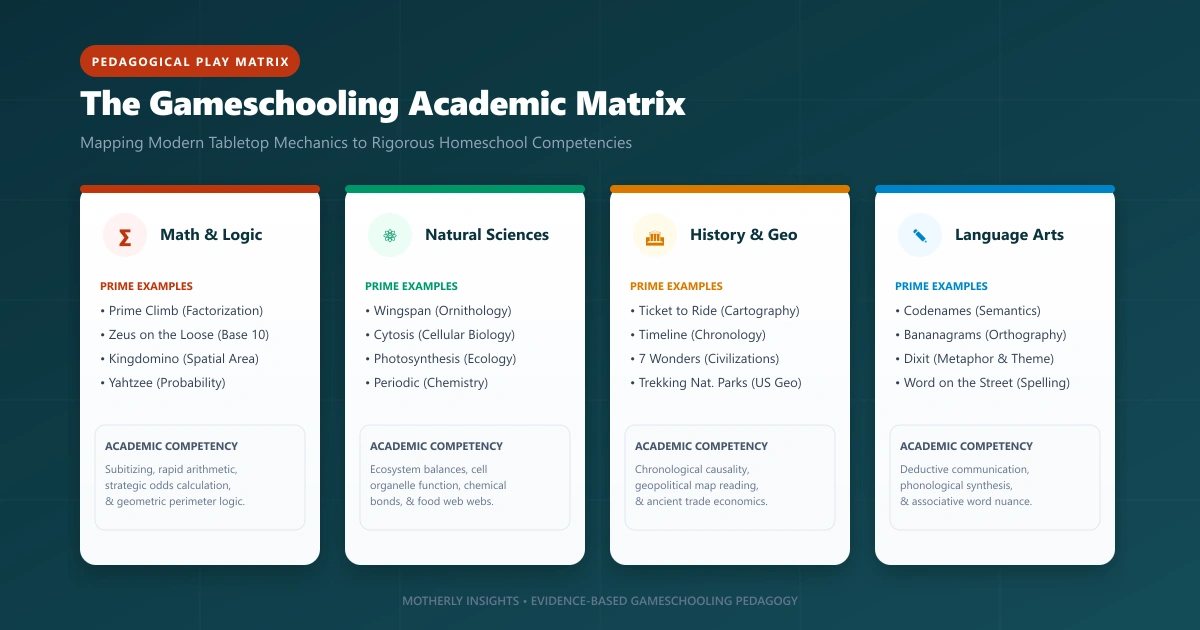
To practice gameschooling with legitimate academic rigor, parents must understand which tabletop mechanics correlate to specific subject proficiencies.
Here is an authentic breakdown of clinical recommendations across core disciplines:
1. Mathematics, Arithmetic & Probability
Traditional math curricula isolate operations into abstract symbolic formulas. Tabletop games reconnect math to its real-world origins: resource counting, spatial geometry, and probabilistic risk calculation.
- Prime Climb (Factorization & Mental Math): Designed by mathematicians Dan Finkel and Katherine Cook, this game uses a color-coded circular board where prime numbers are assigned unique colors. Multiplying numbers corresponds visually to combining color wedges on the ring, transforming prime factorization into an intuitive visual art.
- Zeus on the Loose (Base-10 Arithmetic): Players discard cards to race Mount Olympus to a value of 100, executing rapid mental addition while practicing multiples of 10 and strategic reverse numbers.
- Kingdomino (Spatial Geometry & Multiplication): Winner of the prestigious Spiel des Jahres, players draft 2x1 domino-style land tiles to build a 5x5 grid kingdom. Scoring requires calculating the area of contiguous biomes multiplied by the number of crowns, cementing the geometric formula (Area × Multiplier).
- Yahtzee & Can’t Stop (Probability & Statistics): Players analyze bell-curve probability distributions of two six-sided dice, learning when to press their luck and when to bank resources.
2. Natural Sciences, Biology & Ecology
Gone are the days when science games were glorified trivia decks. Modern designer tabletop games simulate authentic ecological balances, chemical reactions, and cellular structures.
- Wingspan (Ornithology & Ecosystem Modeling): Elizabeth Hargrave’s masterpiece features 170 distinct bird species, each with scientifically accurate wingspans, nesting types, habitat requirements, and geographic ranges. Players learn biological niche dynamics, food webs, and avian migration.
- Cytosis: A Cell Biology Game: A worker-placement game that takes place inside a human cell. Players utilize cell organelles (the nucleus, ribosomes, endoplasmic reticulum, and Golgi apparatus) to synthesize proteins, lipids, and carbohydrates while managing ATP energy.
- Photosynthesis (Botanical Light Competition): Players guide trees through their life-cycle from seed to full bloom, calculating the angle of the revolving sun and managing canopy shade casts to absorb light energy.
- Periodic: A Game of The Periodic Table: Players navigate across the actual Periodic Table of Elements, utilizing periodic trends (atomic radius, ionization energy, and atomic mass) to discover elemental groups.
3. History, Geography & Geopolitics
Reading historical dates in chronological order is notoriously dry. Experiencing historical causality through tabletop strategy brings civilizations to life.
- Ticket to Ride (Cartography & Industrial Infrastructure): Players claim railway routes connecting major cities across North America or Europe, developing spatial geographical literacy, distance estimation, and network topology.
- Timeline Series (Historical Chronology & Causality): Players place historical inventions, events, and discoveries into a collective chronological timeline. Was the can opener invented before or after the lightbulb? Did the steam engine precede the telegraph? Children develop an intuitive sense of historical progression.
- 7 Wonders & Civilization (Civic Economics & Trade): Players draft cards to build ancient wonders, develop commercial trade routes, research technological trees, and balance military defenses against cultural achievements.
- Trekking the National Parks (U.S. Physical Geography): Families travel across iconic American national parks, learning physical terrain landmarks, native wildlife conservation, and regional climate variations.
4. Language Arts, Vocabulary & Logic
- Codenames (Semantics & Deductive Associations): Spymasters provide one-word clues linked to multiple words on a grid. Players analyze semantic nuances, homonyms, connotations, and linguistic categorization.
- Bananagrams (Orthography & Spatial Anagrams): Fast-paced tile arrangement that rewards rapid phonetic decoding, spelling precision, and vocabulary expansion without the pressure of turn-order wait times.
- Dixit (Metaphor, Poetry & Inferential Reasoning): Players select dreamlike illustrated cards that match a subtle phrase or poetic quote, cultivating abstract metaphorical interpretation and theory of mind.
Designing a Weekly Gameschooling Rhythm
You do not need to replace your entire homeschool curriculum overnight. Most veteran homeschoolers integrate gameschooling through a structured, predictable rhythm:
The "Game-Day Friday" Weekly Operating Template
- Monday through Thursday (Core Conceptual Foundations): Deliver systematic, linear lessons in phonics, handwriting, and formal math curriculum.
- Friday Morning (Subject Review Games): Swap textbooks for targeted review games. Use Prime Climb instead of a math quiz; play Timeline instead of a history test.
- Friday Afternoon (Family Strategy Immersion): Unpack an expansive multi-player strategy game (e.g., Wingspan or Ticket to Ride) where older and younger siblings collaborate, practice sportsmanship, and solve complex problems together.
Scaffolding Multi-Age Tabletop Play
When playing with children across wide age spans (e.g., a 6-year-old and a 12-year-old), implement asymmetrical handicapping:
- In Codenames, allow the younger child to partner with a parent as a “Co-Spymaster.”
- In Ticket to Ride, give the younger child an open hand of train cards, allowing them to solicit strategic advice without feeling excluded.
- Rotate into pure cooperative games (such as Outfoxed!, Forbidden Island, or Pandemic), where all players win or lose together against the board, eliminating sibling friction while teaching team communication.
How to Award High School Transcript Credit for Gameschooling
As children reach high school, parents often mistakenly abandon gameschooling in favor of dry test-prep textbooks. Yet modern tabletop games embody the exact higher-order analytical reasoning that university admissions officers crave.
In most states, homeschool parents possess statutory legal authority to define graduation requirements and evaluate course completion through Carnegie credit hours (120–150 hours per 1.0 credit)[1].
Valid High School Course Electives Built on Tabletop Play:
- Applied Game Theory & Strategic Economics (0.5 to 1.0 Credit):
- Core Study: Analyzing mathematical equilibrium, minimax algorithms, opportunity costs, and resource scarcity in complex Euro-style games (Terraforming Mars, Power Grid, Brass: Birmingham).
- Paired Literature: Readings in behavioral economics (e.g., Thomas Schelling’s The Strategy of Conflict).
- Probability & Applied Statistics (0.5 Credit):
- Core Study: Calculating dice probability matrices, variance, card distribution curves, and expected values in tabletop war games and drafting games.
- World History & Geopolitical Conflict (1.0 Credit):
- Core Study: Simulating diplomatic alliances, trade embargoes, and military campaigns in simulation board games (Memoir ’44, Twilight Struggle, History of the World), paired with historical research essays analyzing historical accuracy versus game mechanics.
Maintain a dedicated Tabletop Activity Log recording date, game title, players, duration, and the specific mathematical, historical, or economic concepts demonstrated during the session.
💡 Related Educational Pathways: To compare related legal frameworks and recommended study programs, explore our detailed reviews on California homeschool legal guidelines, Ohio homeschool notification regulations, Pennsylvania Act 169 requirements.
Frequently Asked Questions About Gameschooling
How do I deal with sore losers and emotional meltdowns during games? ↓
Is board gaming expensive to sustain for a homeschool budget? ↓
Can gameschooling replace formal curriculum entirely? ↓
What if my children refuse to play educational-marketed games? ↓
Disclaimer: This post is for informational and educational purposes only, accurate to the best of our knowledge at publication. It does not constitute advice. We do not guarantee accuracy or completeness and accept no liability for any decisions or losses resulting from reliance on this content.