Step into a conventional kindergarten or elementary classroom, and you will find an environment meticulously sanitized of danger. Plastic safety scissors that struggle to cut construction paper, synthetic rubber-mulch play surfaces engineered to absorb three-foot tumbles, and rigid behavioral reprimands for running, balancing on rocks, or picking up sticks longer than an arm.
Now step into a true Forest School (Skogsmulle in Sweden, Udeskole in Denmark)[1]. A seven-year-old child sits on a mossy log holding a razor-sharp Scandinavian carbon-steel whittling knife, carefully shaving dry pine kindling into delicate feather sticks. Fifty feet away, a ten-year-old balances across an icy fallen hemlock trunk suspended six feet above a woodland creek, calculating the friction of wet bark with every deliberate step. There are no sirens, no panic, and no adult screaming “Be careful!” What exists instead is profound, rapturous, hyper-focused attention.
This is Wildschooling: the deliberate fusion of home education with the rigorous principles of the global Forest School movement. It is not an abandonment of scholarship; it is the ultimate laboratory for biological observation, mathematical physics, autonomic nervous system regulation, and moral courage.
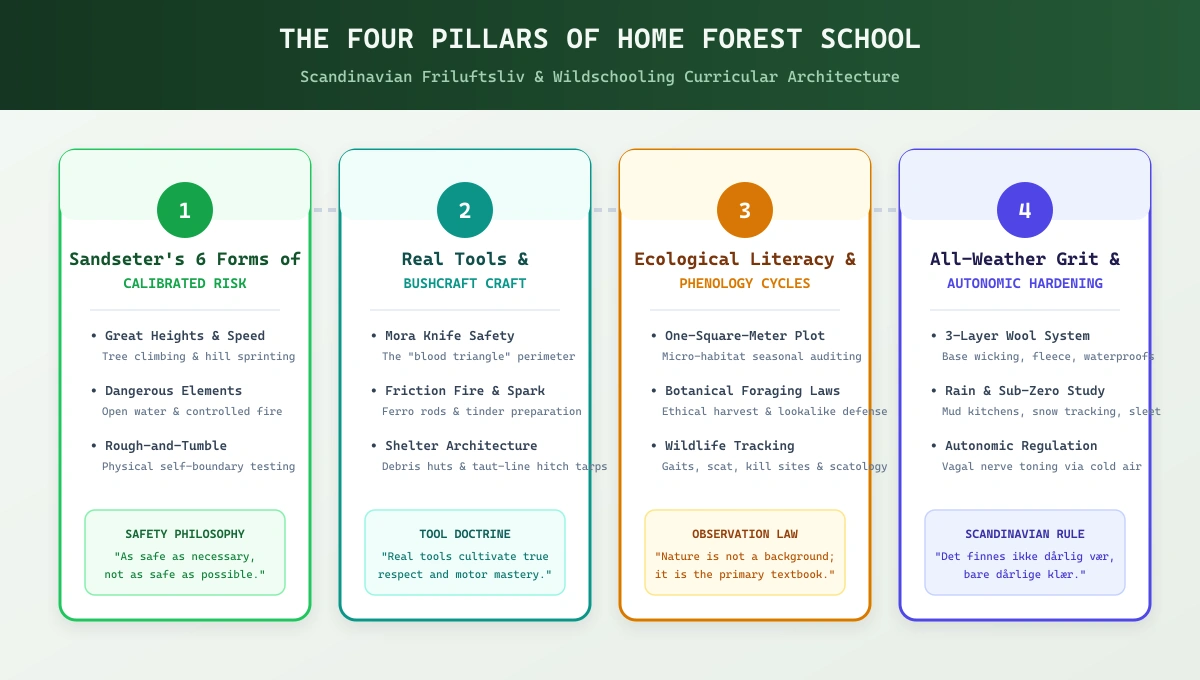
1. Ellen Sandseter’s 6 Categories of Risky Play: The Anti-Phobic Shield
In 2011, Norwegian developmental psychologist Dr. Ellen Beate Hansen Sandseter published groundbreaking research demonstrating that risky play is an evolutionary necessity for human childhood[1]. When children engage in thrilling, physically demanding play where they experience uncertainty and fear, they are actively inoculating their nervous systems against chronic anxiety disorders.
By feeling the visceral surge of adrenaline while climbing a high birch branch and successfully navigating back down, the developing brain registers that intense physical sensation does not equal catastrophic danger. Children denied these experiences frequently develop generalized phobias, executive fragility, and poor sensory-motor calibration[2].
| Risky Play Category | Authentic Forest School Activity | Neurological & Physical Benefit | Parent Scaffolding & Boundary |
|---|---|---|---|
| 1. Great Heights | Climbing mature oak trees, scrambling up granite boulder fields. | Vestibular integration, spatial depth perception, grip strength. | Rule: “You may only climb as high as you can independently reach without adult lifting.” |
| 2. High Speed | Sledding steep powder hills, sprinting down uneven leaf-covered slopes. | Dynamic vestibular reflex, rapid visual tracking, reflexive falling mechanics. | Clear run-out zones free of barbed wire, roadways, or jagged root snags. |
| 3. Dangerous Tools | Carving with Mora fixed-blade knives, using bow saws and hand augers. | Fine motor finger-thumb opposition, deep focus, personal accountability. | Enforce the 2-meter “Blood Triangle” perimeter and mandatory seated posture. |
| 4. Dangerous Elements | Fire-building, cooking over coals, traversing wading streams and tidal pools. | Thermal perception, combustion physics, respect for elemental forces. | Fire circle boundaries; mandatory cold-water bucket placed beside the pit. |
| 5. Rough-and-Tumble | Wrestling on deep leaf mulch, stick dueling, team tug-of-war. | Proprioceptive feedback, social boundary negotiation, impulse inhibition. | Rule: “Both parties must be laughing; stop instantly upon the word ‘Yield’.” |
| 6. Disappear / Get Lost | Exploring dense brush out of adult sight, solo woodland sit spots. | Autonomy, orientation mapping, overcoming existential solitude anxiety. | Boundary whistle protocols: 3 sharp blasts signals immediate regrouping. |
2. Dynamic Risk-Benefit Assessment (RBA) vs. Risk Elimination
Modern institutional schooling relies on Hazard Elimination: if a tree branch poses a potential fall risk, the school cuts down the tree. Forest School philosophy relies on Dynamic Risk-Benefit Assessment (RBA)[3].
Before forbidding an outdoor activity, wildschooling parents ask two questions:
- What is the genuine developmental benefit of this experience?
- What is the difference between a hazard and a risk?
A hazard is an invisible or uncontrollable source of harm that a child cannot reasonably see or manage (such as a rotten, dead tree branch overhead ready to snap in the wind, a concealed hornet nest, or broken glass buried under river silt). Parents must ruthlessly inspect and eliminate hazards.
A risk, in contrast, is an observable challenge that the child can see, evaluate, and choose whether to confront (such as a steep, slippery muddy embankment or a heavy log). When parents intervene and remove all risks, they rob the child of the opportunity to develop internal risk assessment.
Transforming Your Language: Ditching “Be Careful!”
The phrase “Be careful!” is completely useless to a child. It transmits adult panic without providing actionable spatial information. Replace vague warnings with empowering cognitive prompts:
- Instead of “Be careful!” $ ightarrow$ “Notice how slippery that wet moss is under your right boot.”
- Instead of “Don’t climb so high!” $ ightarrow$ “Do you have a secure three-point contact on that branch?”
- Instead of “Put that stick down right now!” $ ightarrow$ “Look around you. Do you have two stick-lengths of clear space before you swing?”
- Instead of “You’re going to fall!” $ ightarrow$ “What is your plan for getting your footing down from there?”
3. Bushcraft Mastery: Real Knives, Friction Fire & Tool Pedagogy
Nothing transforms a child’s relationship with responsibility faster than handing them a real, razor-sharp tool. When children are given fake plastic tools, they treat them like toys—waving them recklessly and ignoring consequences. When given an authentic Mora 511 carbon-steel knife or an Opinel No. 7 with a wooden handle, the child immediately registers the gravity of the object[4].
The Blood Triangle Safety Protocol
Before any blade unsheathes, the child must establish the Blood Triangle:
- Sit securely on a sturdy stump or bench with both feet flat on the ground and elbows resting on knees. Never carve while standing, walking, or lying down.
- Extend the arm holding the sheathed knife full-length and rotate 360 degrees in a complete circle. No other human or animal may enter this perimeter.
- Every knife stroke must travel outward away from the body, fingers, and legs. If the blade slips, it must cut only empty air.
Progressive Tool Scaffolding Roadmap
| Developmental Stage | Recommended Tools | Core Skill Milestones | Practical Bushcraft Projects |
|---|---|---|---|
| Early Years (Ages 4–6) | Heavy vegetable peelers, wooden mallets, blunt garden trowels. | Peeling green branches, hammering wooden stakes, excavating clay soils. | Willow wands, mud brick construction, cordage twisting. |
| Primary (Ages 7–9) | Fixed-blade carving knife (Mora Safe/511), small hand drill, bow saw. | Whittling points, cutting straight poles, 2-person sawing teamwork. | Feather sticks, roasting skewers, mallet heads, tripod wash-stands. |
| Middle Years (Ages 10–13) | Ferrocerium fire steel, pocket bellows, folding camp saw, draw knife. | Spark ignition of natural char cloth, tinder processing, notch carving. | A-frame debris shelters, wooden spoons, boiling tea over fire. |
| Teenage (Ages 14–18) | Splitting hatchet, two-man crosscut saw, carving gouges, augers. | Safe bucking and limbing, quadrant shelter framing, fire maintenance. | Permanent bushcraft camp benches, timber-framed earth ovens. |
4. The Scandinavian All-Weather Doctrine: Friluftsliv
In Norway, Sweden, and Denmark, families live by the timeless adage: “Det finnes ikke dårlig vær, bare dårlige klær” (“There is no bad weather, only bad clothing”).
If your forest school ceases operations when the thermometer drops below freezing or when rain begins to fall, you miss 70% of nature’s most vivid instructional moments. Sleet teaches the thermodynamics of phase changes; pouring rain transforms tiny dry gullies into raging miniature hydrological rivers; winter reveals the secret tracks of coyotes, foxes, and mice in crisp snow.
The Three-Layer Technical Clothing System:
- Base Layer (Wicking): Strictly 100% merino wool or high-grade synthetic polypropylene. Cotton is strictly forbidden in wet or cold weather. Cotton absorbs moisture and holds it directly against the skin, causing rapid hypothermia (“Cotton Kills”).
- Mid Layer (Thermal Insulation): Heavyweight boiled wool, shearling, or high-loft polar fleece to trap pockets of warm, body-heated air.
- Outer Shell (Weatherproof Barrier): Unlined, rugged, polyurethane-coated rain overalls (bibs) and a hooded storm jacket with welded seams, paired with neoprene-lined rubber bogs or insulated winter boots.
5. Phenology, Taxonomy & Living Nature Notebooks
Forest school is not merely recreation; it is the living heart of biological and earth sciences. Root your academic tracking in Phenology—the study of cyclic and seasonal natural phenomena in relation to climate and plant/animal life.
The “One-Square-Meter” Year-Long Study
Designate a single square meter of wild ground in your local woods or backyard. Hammer four wooden corner pegs and stretch twine around the perimeter. Throughout the academic year, your children visit this exact plot weekly to observe, sketch, and document:
- Soil temperature and moisture levels at 2-inch and 6-inch depths.
- Seed germination dates and insect larvae emergence cycles.
- Fungal fruiting bodies that flourish for only 48 hours following autumn rains.
- Deciduous leaf decay and earthworm decomposition rates.
Children translate these observations into a Charlotte Mason-style Nature Journal utilizing watercolor washes, graphite sketches, taxonomic species labeling (binomial nomenclature), and precise weather logs.
Practical Implementation: Building Your Forest School Day
| Time | Block | Pedagogical Objective |
|---|---|---|
| 9:00 AM – 9:30 AM | The Base Camp Hike | Kinetic warm-up, gross motor lung-expansion, sensory transition into wild woodland space. |
| 9:30 AM – 10:30 AM | Deep Nature Observation & Journaling | Silent sit spot (10 minutes), watercolor sketches, botanical taxonomy, microscope loupe inspection. |
| 10:30 AM – 12:00 PM | Bushcraft & Risky Play Lab | Tool work (whittling, saw work), shelter building, tree scrambling, physical problem-solving. |
| 12:00 PM – 1:00 PM | Campfire Cooking & Storytelling | Lighting fire via ferro rod, boiling pine needle tea or roasting bannock bread, folklore read-alouds. |
| 1:00 PM – 2:00 PM | Free Wild Exploration & Stream Play | Unstructured child-led play, mud dam engineering, cooperative pretend play, loose parts building. |
When you open the backdoor and invite your children to measure their strength against living trees, rough stone, and changing weather, you liberate them from the claustrophobia of digital screens and static desks. You grant them childhood as nature designed it: muddy, brave, resilient, and utterly unforgettable.
Disclaimer: This post is for informational and educational purposes only, accurate to the best of our knowledge at publication. It does not constitute advice. We do not guarantee accuracy or completeness and accept no liability for any decisions or losses resulting from reliance on this content.