
The transition from middle school to high school is often accompanied by parental anxiety regarding college admissions, state graduation mandates, and official documentation. However, home-educated students have attained record admissions rates at Ivy League universities, top-tier research institutions, and service academies across the United States[1].
The single most critical credential in this admissions journey is the official homeschool high school transcript.
Contrary to widespread misconceptions, parents do not need state department accreditation, umbrella school certification, or bureaucratic permission to author a fully accredited, legal transcript recognized by the Common Application, the NCAA Eligibility Center, and collegiate financial aid offices.
This comprehensive guide details the mathematical formulation of Carnegie units, unweighted versus weighted GPA methodologies, course description portfolios, standardized test reporting, and graduation validation protocols.
High School Credit & Grading Architecture: Core Standards
Before drafting your student’s transcript document, review standard academic accounting benchmarks.
1. Credit Calculations: The Carnegie Unit Formula
In American secondary education, high school academic rigor is measured using the Carnegie Unit. Home educators calculate credits through one of three standardized methodologies:
Method 1: The Hourly Logging Model (Instructional Hours)
The most common metric for non-traditional or self-designed coursework:
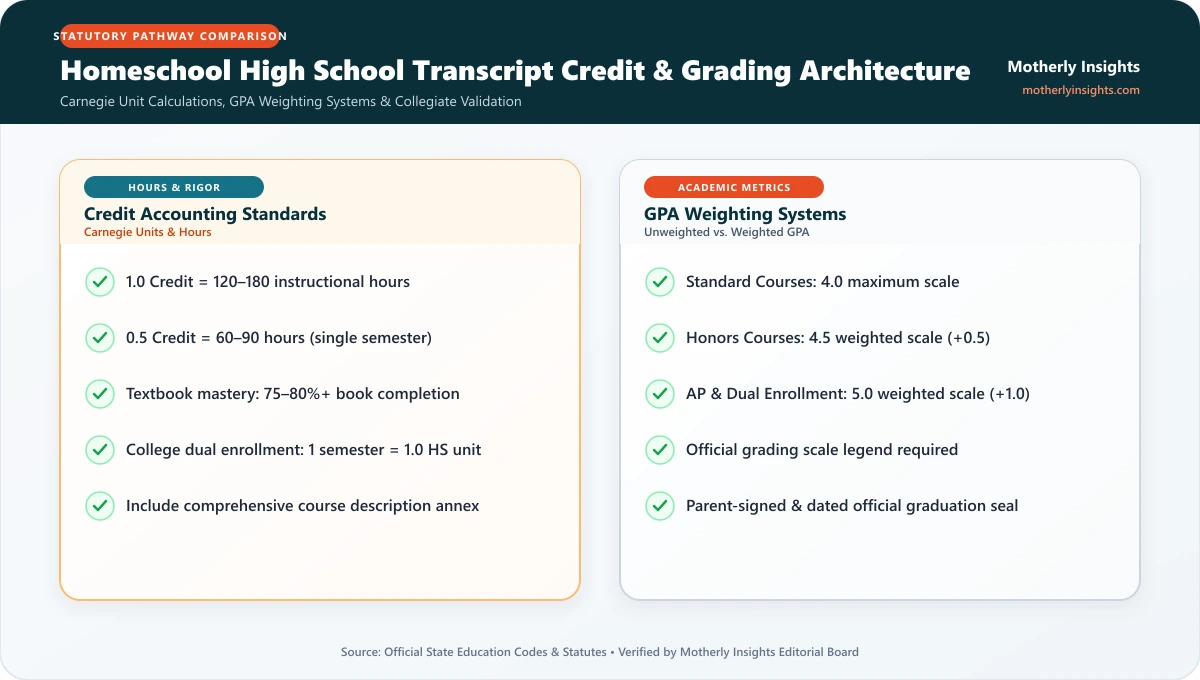
- 1.0 Full Credit: Requires 120 to 180 hours of focused study, lab work, research, and assessment. A standard academic course averaging 150 hours (roughly 50 minutes per day, 5 days per week, over 36 weeks) represents 1 full Carnegie unit.
- 0.5 Half Credit: Requires 60 to 90 hours of instruction (equivalent to a single-semester course such as Economics, American Government, or Health).
Method 2: Textbook & Curricular Completion
For structured, publisher-designed high school curricula (e.g., Saxon Advanced Mathematics, Apologia Chemistry, BJU Press History):
- Completing 75% to 80% or more of a comprehensive college-preparatory textbook represents 1.0 full high school credit, regardless of whether the student completed it in 100 hours or 200 hours.
Method 3: College Dual Enrollment (Concurrent Enrollment)
Courses completed at accredited community colleges or universities translate directly onto the high school transcript[2]:
- 1 Semester College Course (3 to 4 credit hours) = 1.0 Full High School Credit (and earns weighted GPA honors status).
2. GPA Calculation: Unweighted 4.0 vs. Weighted 5.0 Scales
Colleges evaluate applicant rigor by examining both unweighted and weighted grade point averages. Transparent reporting prevents admissions confusion.
The Standard Unweighted 4.0 Scale:
In an unweighted system, every course carries equal weight regardless of difficulty:
- A (93–100%): 4.0 grade points
- A- (90–92%): 3.7 grade points
- B+ (87–89%): 3.3 grade points
- B (83–86%): 3.0 grade points
- B- (80–82%): 2.7 grade points
- C+ (77–79%): 2.3 grade points
- C (73–76%): 2.0 grade points
The Weighted 5.0 Academic Rigor Scale:
To reflect the substantial difficulty of advanced coursework, weighted scales allocate extra quality points:
- Honors Courses: Add +0.5 quality points (an “A” equals 4.5).
- Advanced Placement (AP) & Dual Enrollment: Add +1.0 quality point (an “A” equals 5.0).
$$\text{Cumulative GPA} = \frac{\sum (\text{Course Grade Points} \times \text{Credit Hours})}{\text{Total Credits Earned}}$$
Admissions Best Practice: Report both unweighted and weighted GPAs side-by-side on your transcript, accompanied by an explicit grading scale legend.
3. Anatomy of a Legally Valid Homeschool Transcript
To be accepted seamlessly by university registrars and scholarship boards, your transcript should fit on a single clean page and contain the following essential elements:
- Header & Institutional Identity:
- Formal school name (e.g., “Oakridge Academy” or “Smith Family Home School”).
- School address, administrative phone number, and primary counselor email.
- Student Demographics:
- Full legal student name, date of birth, gender, and social security number (or Common App ID).
- Projected or actual graduation date.
- Academic Course History (Organized by Academic Year or Subject):
- Columns: Course Title, Grade Earned, Credits Earned, Course Level (Standard, Honors, AP, Dual Enrollment).
- Summary Statistics:
- Total credits earned per academic year and cumulative total (typically 22 to 28 credits for graduation).
- Cumulative Unweighted GPA and Cumulative Weighted GPA.
- Grading Scale Legend:
- Clear percentage ranges mapped to letter grades and GPA point values.
- Standardized Test Scores (Optional but Recommended):
- Composite and sub-scores for SAT, ACT, Classic Learning Test (CLT), and AP exams.
- Official Authentication:
- Signature of Primary Administrator / Home Educator with date.
- Formal declaration: “I hereby certify that this transcript represents the official academic record of [Student Name].”
- Notarization or embossed homeschool seal (recommended for out-of-state colleges or military enlistment).
4. The Course Description Annex: Your Secret Admissions Weapon
While public school transcripts offer only cryptic course titles, home educators can submit an official Course Description Portfolio (typically 3 to 6 pages attached to the transcript). Admissions committees at selective universities frequently cite these descriptions as the decisive factor in admitting homeschoolers[3].
Format for Each Course Entry:
- Course Title & Credit: e.g., Honors American Literature (1.0 Credit)
- Course Overview: A concise 3-to-4 sentence summary of core themes, literary analysis techniques, and writing projects.
- Primary Textbooks & Literature Read: Complete bibliography including title, author, and publisher.
- Evaluation Metrics: Percentages allocated to analytical essays, lab reports, oral presentations, and final exams.
- Provider / Instructor: Self-directed home study, online provider (e.g., Memoria Press Online, Well-Trained Mind Academy), or college professor.
5. Navigating the Common App & NCAA Eligibility
The Common Application Homeschool Protocol:
When applying through Common App, the parent creates a Common App Counselor Account. In this role, the parent:
- Uploads the official PDF transcript.
- Submits the School Report explaining your homeschool philosophy, grading criteria, and whether class ranking is utilized (always mark “Class Rank: None”).
- Uploads the Counselor Recommendation Letter, providing nuanced insight into the student’s intellectual curiosity, work ethic, and character.
NCAA Division I & II Athlete Requirements:
Homeschooled student-athletes seeking NCAA eligibility must register with the NCAA Eligibility Center and satisfy the 16 core-course rule:
- 4 years of English, 3 years of mathematics (Algebra I or higher), 2 years of natural/physical science, 1 extra year of English/math/science, 2 years of social science, and 4 years of additional core courses (foreign language, philosophy, comparative religion).
- Maintain detailed syllabus documentation and textbook publisher receipts for all core courses.
Summary High School Graduation Checklist
- Complete at least 22 to 26 core high school credits (4 English, 4 Math, 3–4 Science with labs, 3–4 Social Studies, 2 Foreign Language, 2 Fine Arts/PE, and electives).
- Maintain an updated single-page transcript tracking grades and Carnegie unit hours at the end of every semester.
- Compile comprehensive course descriptions and book reading lists in a master portfolio binder.
- Document standardized test score reports (PSAT, SAT, ACT, CLT, AP).
- Prepare an official high school diploma signed and dated by the primary educators upon graduation completion.
Frequently Asked Questions About Homeschool Transcripts
Does a homeschool transcript need to be accredited by an outside agency? ↓
Can high school courses taken in 8th grade count on the high school transcript? ↓
How should parents handle GPA if they do not give letter grades? ↓
Disclaimer: This post is for informational and educational purposes only, accurate to the best of our knowledge at publication. It does not constitute legal or financial advice. We do not guarantee accuracy or completeness and accept no liability for any decisions or losses resulting from reliance on this content.