
In Kansas, there is no separate legal definition for "homeschooling." Instead, home education operates entirely under the statutory framework of a Non-Accredited Private School (NAPS) pursuant to Kansas Statutes Annotated (K.S.A.) § 72-3120[1]. Once a family completes a simple, one-time school registration with the Kansas State Department of Education (KSDE), they enjoy remarkable educational freedom with zero recurring filings, testing mandates, or state curriculum interference[2].
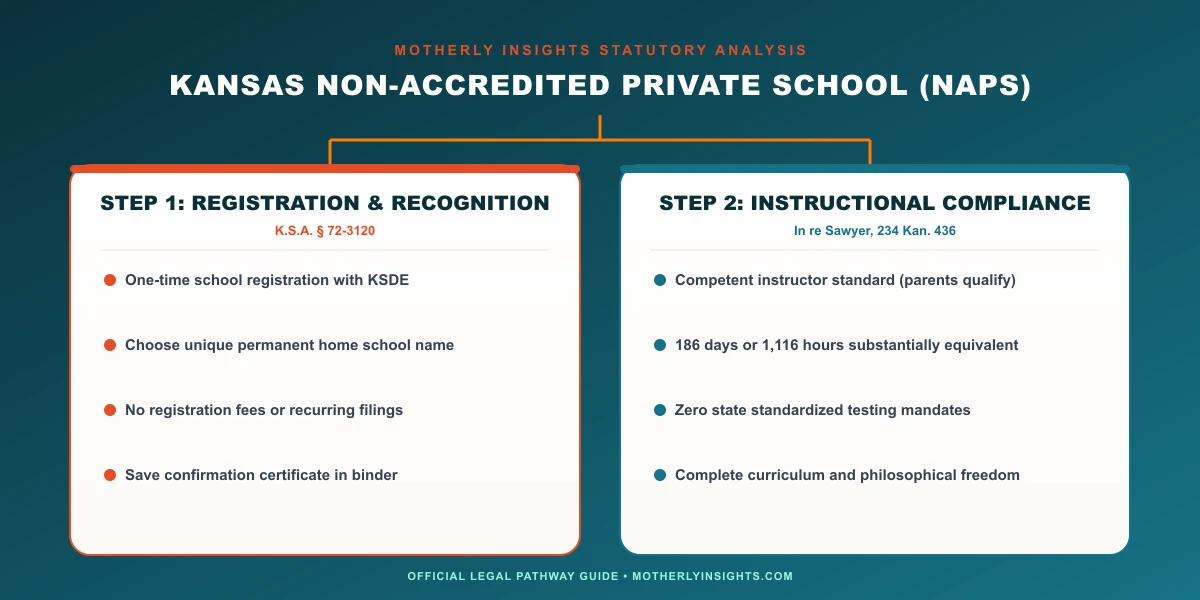
Figure 1: Statutory steps for operating a Non-Accredited Private School in Kansas.
Statutory Authority: K.S.A. § 72-3120 & In re Sawyer (1983)
Under Kansas compulsory school attendance law (K.S.A. § 72-3120), every child who has reached the age of seven and is under the age of eighteen must attend a public, private, denominational, or parochial school taught by a competent instructor for a period substantially equivalent to public schools.
The legal recognition of home-based private schools was cemented by the Supreme Court of Kansas in the historic landmark case In re Sawyer (234 Kan. 436, 1983)[3]. The high court confirmed that a home school qualifies as a valid private school under Kansas law provided that instruction is continuous, planned, and delivered by a competent instructor. The court explicitly affirmed that parents are presumed competent without needing state teacher certifications, collegiate education degrees, or state licenses.
How to Register Your Non-Accredited Private School (NAPS)
Under K.S.A. § 72-53,101, all non-accredited private schools in Kansas must register their official school name and custodian address with the State Board of Education. Follow these steps:
- Choose an Official School Name: Select a permanent, dignified name for your home school (e.g., "Prairie Meadow Academy" or "Sunflower Christian School"). This name will appear on your KSDE registration confirmation and high school transcripts.
- Submit the Online KSDE Registration: Navigate to the official Kansas State Department of Education Non-Accredited Private School registry portal. Complete the one-time electronic form listing your school name, residential physical address, contact telephone, and primary custodian name.
- Zero Filing Fees & One-Time Rule: Registration is 100% free of charge. You do not re-register each school year. Re-registration is required only if your family moves to a different residential address.
- Archive the Official Confirmation: Print the KSDE electronic registration confirmation receipt. File this certificate in your permanent homeschool binder as legal verification of private school operation.
Instructional Time & Subject Requirements
Kansas statute requires that non-accredited private school terms be "substantially equivalent" to public school terms:
- Instructional Days and Hours: Public schools operate for 186 days per academic year, equating to 1,116 hours for grades 1 through 11 (and 1,080 hours for grade 12). While home educators are not required to punch a mechanical timeclock, maintaining a log demonstrating approximately 186 instructional days provides complete statutory compliance.
- Core Academic Subjects: Comparable instruction covers core academic disciplines: language arts (reading, spelling, grammar, writing), mathematics, science, social studies (Kansas history, U.S. history, civics), health, and physical education.
The KSDE and municipal school districts have zero statutory authority to review, approve, or prescribe textbooks. Parents have total freedom to select classical literature, faith-based curricula, or modern online coursework.
High School Graduation, Diplomas, and Kansas Board of Regents Admissions
As an administrator of a Kansas Non-Accredited Private School, parents hold the full legal right to establish graduation course requirements, assign final grades, and award high school diplomas:
- Kansas Board of Regents University Admissions: The University of Kansas (KU), Kansas State University (K-State), Wichita State University, Emporia State, Pittsburg State, and Fort Hays State University routinely admit homeschooled graduates based on high school transcripts and ACT/SAT scores.
- Kansas Qualified Admissions: Homeschooled applicants qualify for guaranteed admission to Kansas Regents universities by earning an ACT composite score of 21 or higher (or SAT of 1060+).
- State & Federal Financial Aid: Homeschooled graduates are 100% eligible for federal Pell Grants, student loans, and competitive collegiate merit scholarships without requiring a GED.
Extracurriculars and KSHSAA Sports Eligibility
Under guidelines established by the Kansas State High School Activities Association (KSHSAA) and state dual-enrollment provisions:
- Public School Sports Access: In 2023, the Kansas Legislature enacted legislation expanding extracurricular access. Non-accredited private school students can participate in KSHSAA-sponsored sports (football, basketball, volleyball, track, wrestling, soccer) and activities at their local public school, provided they enroll in at least one course at the school.
- Inquiring with Your District: Parents should contact the local public high school athletic director prior to the sport's season to verify eligibility documentation and transfer rules.
- Independent Youth Leagues: Kansas features active independent homeschool athletic associations, youth club soccer leagues, and private fine arts academies.
Recommended Homeschool Record-Keeping Standards
To maintain an airtight legal defense and streamline future college transcript creation, maintain a "Master Homeschool Binder" containing:
- KSDE Registration Certificate: A printed copy of your official Non-Accredited Private School registration confirmation.
- 186-Day Attendance Calendar: A calendar documenting instructional days, field trips, and academic hours.
- Curriculum Syllabi & Booklists: A record of textbooks, literature titles, online learning platforms, and instructional software utilized.
- Representative Student Work Samples: Dated writing assignments, math exams, and lab reports collected across the school term.
- Cumulative High School Transcript: For grades 9 through 12, an ongoing transcript detailing course credits, letter grades, and GPA calculations.
Frequently Asked Questions About Kansas Homeschool Laws
Are Kansas homeschoolers required to take standardized tests?
Does the local public school district inspect Kansas homeschools?
Do parents need a teaching license or college degree to homeschool in Kansas?
Can Kansas homeschooled students play sports at their local public high school?
What is the compulsory school age in Kansas?
Are parent-issued diplomas legally valid in Kansas?
💡 Related Educational Pathways: To compare legal requirements in neighboring Midwestern states, explore our detailed guides on Missouri homeschool laws, Oklahoma constitutional homeschool freedom, and Colorado homeschool regulations.
💡 Related Educational Pathways: To compare related legal frameworks and recommended study programs, explore our detailed reviews on California homeschool legal guidelines, Ohio homeschool notification regulations, Pennsylvania Act 169 requirements.
💡 Related Educational Pathways: To compare related legal frameworks and recommended study programs, explore our detailed reviews on Georgia homeschool compliance framework, Michigan homeschool statutory rules, Indiana homeschool attendance laws.