
Mississippi maintains one of the most deregulated, parent-friendly homeschool legal structures in the United States. Under the Mississippi Compulsory School Attendance Law (Mississippi Code Annotated § 37-13-91), parents possess clear statutory rights to educate their children at home with minimal bureaucratic intrusion[1].
Compulsory school attendance in Mississippi applies to children between the ages of six (6) and seventeen (17). Fulfilling the legal requirements involves filing a single, straightforward certificate of enrollment each academic year.
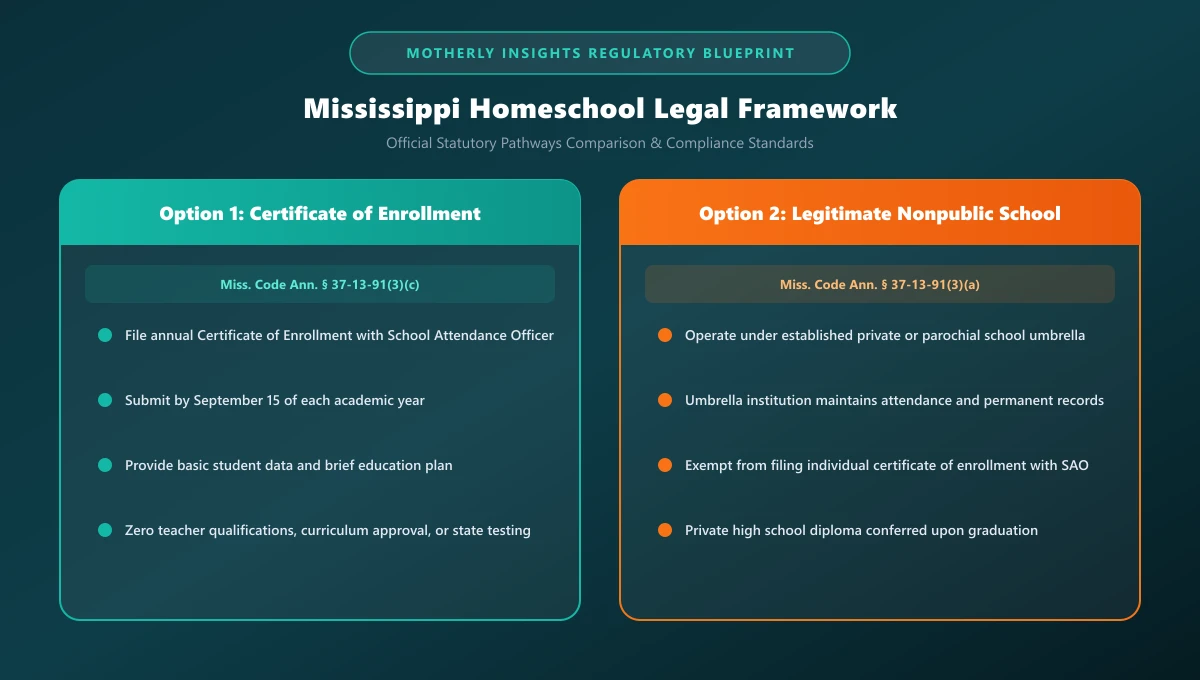
Mississippi Homeschool Legal Pathways: Statutory Overview
1. Filing the Mississippi Certificate of Enrollment
Under Miss. Code Ann. § 37-13-91(3)(c), a parent or guardian who educates their child at home must complete a Certificate of Enrollment[2]:
Filing Details and Deadlines:
- Submission Deadline: The certificate must be completed and submitted by September 15 of each school year.
- Recipient: The certificate is filed with the School Attendance Officer (SAO) assigned to your local youth court or school attendance district (not with the local public school principal or superintendent).
- Required Information: Mississippi statute strictly limits the information required on the certificate. You must provide:
- The name, address, and telephone number of the parent and child.
- The date of birth of the child.
- A simple “brief description of the course of study designed to provide a well-rounded education” (e.g., standard educational subjects: English, math, science, social studies, and reading).
- Statutory Limits on District Demands: School attendance officers cannot demand curriculum inspection, book purchases receipts, standardized test scores, or home visits.
2. Parent Qualifications and Curriculum Autonomy
Mississippi imposes zero educational requirements on teaching parents:
- No Degrees or Certifications: Parents are not required to hold a high school diploma, college degree, or teaching license.
- Complete Curriculum Freedom: The state does not prescribe textbooks, grading scales, or academic schedules. Parents select all living books, classical literature, or online programs that align with their educational philosophy.
- No Mandatory Testing: Mississippi does not require homeschooled students to take state tests or national standardized assessments[3].
3. High School Transcripts, Graduation, and State Scholarships
Mississippi parents hold exclusive legal authority to certify high school completion and confer valid high school diplomas:
- Parent-Issued Diplomas: A diploma issued by a Mississippi homeschool parent is a legally recognized credential for college admissions, military enlistment, and employment.
- State Financial Aid (MTAG, MESG, HELP): Mississippi homeschool graduates can qualify for state-funded financial assistance programs, including the Mississippi Tuition Assistance Grant (MTAG) and the Mississippi Eminent Scholars Grant (MESG), by meeting the standard ACT score benchmarks (composite 15 for MTAG, composite 29 for MESG).
4. Homeschool Recordkeeping and Portfolio Blueprint
Veteran Mississippi home educators recommend organizing a centralized recordkeeping binder:
- Copy of Filed Certificate of Enrollment: Keep a date-stamped copy or postal receipt of your annual Certificate of Enrollment.
- Attendance Record: Maintain a record showing a typical 180-day educational calendar.
- Course Syllabi and Booklists: Record textbooks, literature titles, and educational resources utilized.
- Representative Work Samples: Archive quarterly writing assignments, mathematics quizzes, and science investigations.
- High School Transcript: Maintain a four-year credit ledger tracking courses, credits earned, and GPA.
5. Extracurricular Activities and Sports Access
While Mississippi public schools are not statutorily mandated to open interscholastic sports to non-enrolled students, many school districts exercise local discretion. Additionally, Mississippi homeschoolers participate in thriving independent leagues, including the Mississippi Coast Christian Athletic Association and regional homeschool athletic teams.
6. Dual Enrollment at Mississippi Community Colleges
Mississippi homeschoolers in grades 10 through 12 have broad access to dual enrollment at local community colleges (including Hinds, Pearl River, Northwest, and Jones College). Under Mississippi dual enrollment articulation agreements:
- Eligible Courses: Students may complete general education core courses (English Composition, College Algebra, Biology, General Psychology).
- Dual Credit: Credits earned satisfy both high school graduation requirements and transfer directly into Mississippi public universities (Ole Miss, Mississippi State, Southern Miss).
- Admissions Benchmarks: Community colleges typically require an ACT composite score of 17 to 19 or placement testing.
7. Special Education “Child Find” and Therapy Services
Under federal IDEA law, Mississippi school districts must conduct Child Find evaluations for homeschooled students suspected of having learning disabilities. Parents can request comprehensive diagnostic psychoeducational assessments, speech-language evaluations, and audiological screenings through their resident public school district at zero parental expense.
8. Military Enlistment and Post-Secondary Validation
Under federal Tier 1 enlistment guidelines, homeschooled graduates who present a parent-certified diploma and four-year transcript are recognized as Tier 1 recruits alongside public school graduates across the U.S. Army, Navy, Air Force, Marine Corps, and Coast Guard without requiring a separate GED.
9. Homeschool Co-ops, Tutorial Services, and Local Networks
Mississippi families enjoy access to an extensive statewide network of parent-led homeschool cooperatives, university-model hybrid programs, and enrichment tutorials:
- Academic Co-operatives: Groups operating across Jackson, Gulfport, Southaven, and Hattiesburg offer collaborative laboratory sciences, foreign language immersion, and speech debate.
- Athletic Leagues: Competitive Christian homeschool athletics programs offer basketball, soccer, volleyball, cross-country, and baseball leagues for middle and high school students.
- Arts and Music Collaboratives: Choral groups, band ensembles, and drama productions provide stage performance opportunities.
10. Step-by-Step Procedure for Withdrawing from Mississippi Public Schools
If your child is currently enrolled in a Mississippi public school, follow these formal withdrawal protocols to prevent truancy confusion:
- Submit Formal Written Withdrawal: Provide written notification to the principal of your child’s zoned school stating your intention to withdraw under Mississippi Code Annotated § 37-13-91.
- File the Certificate of Enrollment: Complete and submit your Certificate of Enrollment to your local School Attendance Officer.
- Request Cumulative Academic Records: Request copies of previous report cards, standardized test records, and health documents for your home school file.
11. Frequently Addressed Mississippi Homeschool Legal Inquiries
Do Mississippi school attendance officers visit homeschool residences?
No. Mississippi statutes do not authorize attendance officers or district representatives to conduct unannounced home inspections or home visits. Submission of a timely, compliant Certificate of Enrollment satisfies all compulsory attendance requirements.
Can Mississippi homeschoolers take individual classes at public high schools?
Mississippi law grants local school districts full discretion to permit part-time enrollment. Many districts allow homeschooled students to enroll in advanced laboratory science classes, foreign language sequences, or career technical education (CTE) courses upon written application.
💡 Related Educational Pathways: To compare related legal frameworks and recommended study programs, explore our detailed reviews on California homeschool legal guidelines, Ohio homeschool notification regulations, Pennsylvania Act 169 requirements.
💡 Related Educational Pathways: To compare related legal frameworks and recommended study programs, explore our detailed reviews on Georgia homeschool compliance framework, Michigan homeschool statutory rules, Indiana homeschool attendance laws.