

Educating children at home in the Land of Enchantment is governed by clear, sensible statutory provisions. Under the New Mexico Public School Code (NMSA 1978 § 22-1-2.1), home schools are officially recognized as non-public educational programs operated by a parent or legal guardian[1].
Compulsory school attendance in New Mexico applies to children from age five (5) until the child reaches age eighteen (18) or graduates from high school under NMSA § 22-12-2.
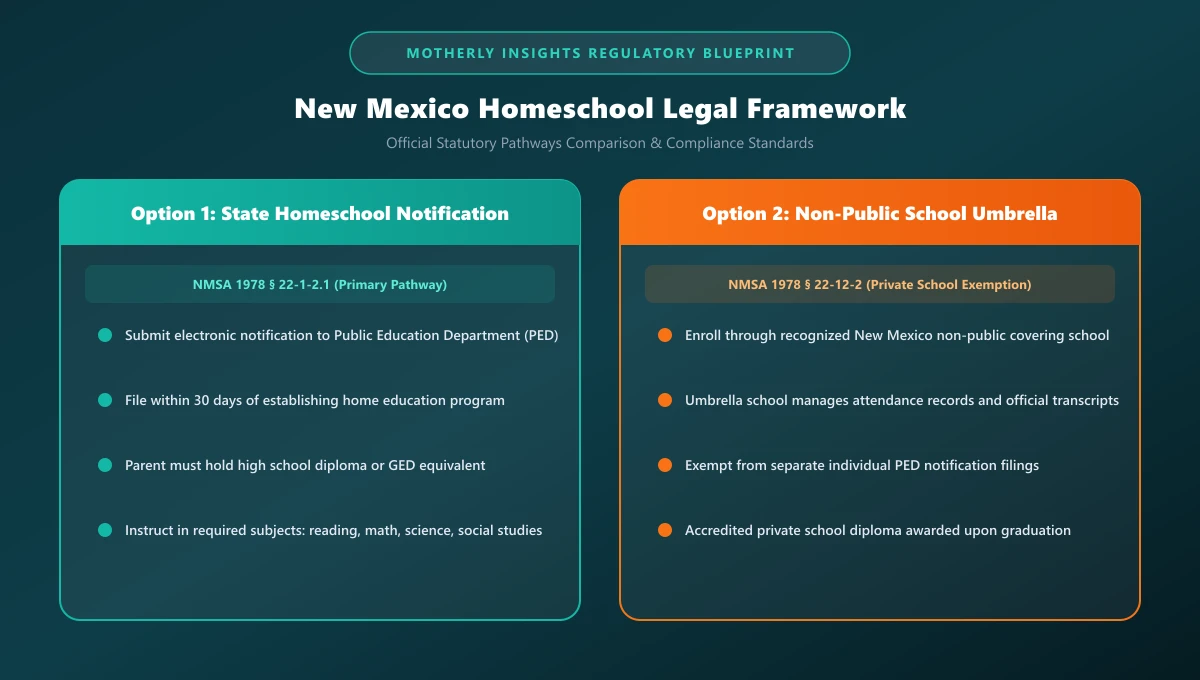
New Mexico Homeschool Legal Pathways: Regulatory Blueprint
1. Filing the Annual NMPED Notification
Under NMSA § 22-1-2.1(B), parents must submit an electronic notification to the New Mexico Public Education Department (NMPED)[2]:
Filing Schedule and Protocols:
- Initial Notification: Must be submitted within thirty (30) days of establishing your home school.
- Annual Confirmation: Re-submitted by August 1 of each subsequent academic school year.
- Electronic Portal: Notifications are submitted online via the official NMPED Home School Registration Portal. Upon submission, the portal generates an official confirmation certificate.
- Parent Qualification: New Mexico statute requires the teaching parent to possess at least a high school diploma or GED equivalent.
2. Mandatory Core Subjects and Instructional Freedom
New Mexico law requires that home instruction include basic academic content in five fundamental disciplines:
- Reading and Language Arts: Phonics, composition, literature, and grammar.
- Mathematics: Arithmetic, algebraic thinking, and quantitative reasoning.
- Social Studies: World history, U.S. history, geography, and civics.
- Science: General, biological, and physical sciences.
While these core areas are mandated, parents maintain total pedagogical autonomy over curriculum selection, instructional pacing, and teaching methodologies.
3. Standardized Testing and Assessment Exemption
New Mexico law does not require home-educated students to take state standardized tests, nor does it mandate portfolio evaluations or district meetings[3]. Parents evaluate student academic progress internally according to their chosen educational philosophy.
4. Interscholastic Sports and Public School Activities Access
Under NMSA 1978 § 22-8-23.8, New Mexico provides equal access protections allowing homeschooled students to participate in interscholastic athletics and extracurricular activities sanctioned by the New Mexico Activities Association (NMAA)[4]:
- Students may try out for athletic teams at the public high school within their attendance attendance zone.
- Parents must submit proof of compliant NMPED notification and verification of academic progress.
5. High School Graduation and New Mexico Opportunity Scholarship
New Mexico home educators hold the legal authority to issue high school diplomas and certified transcripts:
- Parental Diploma Validity: Homeschool diplomas are recognized for admissions at institutions like the University of New Mexico (UNM) and New Mexico State University (NMSU).
- New Mexico Legislative Lottery & Opportunity Scholarships: Homeschool graduates can qualify for tuition-free college education under New Mexico’s generous scholarship programs by meeting high school equivalency or first-semester college GPA benchmarks.
6. Dual Credit at New Mexico Universities and Colleges
New Mexico offers an extraordinary dual credit program under NMSA 1978 § 21-1-1.2. Homeschooled high school juniors and seniors can take tuition-free college coursework at institutions like Central New Mexico Community College (CNM), Santa Fe Community College (SFCC), and the University of New Mexico (UNM):
- Tuition Waiver: Tuition is waived for eligible dual credit courses.
- Credit Mobility: Credits transfer seamlessly to undergraduate degree programs statewide.
- High School Alignment: One 3-credit college course fulfills a full 1.0 high school Carnegie unit.
7. New Mexico Homeschool Recordkeeping and Compliance Binder
While New Mexico does not conduct routine portfolio inspections, maintaining a professional binder ensures compliance and simplifies college admissions:
- Official PED Confirmation: Keep a printed copy of your annual electronic NMPED confirmation certificate.
- Attendance Log: Document approximately 180 days of active instruction.
- Immunization Records: Maintain current immunization records or a notarized Certificate of Exemption from Immunization on file.
- Curriculum Syllabi: Retain lists of textbooks, literature, and online resources used for core subjects.
- Work Samples & High School Transcript: Maintain graded assignments, lab notes, and a running four-year transcript.
8. Driver Education and MVD Licensing Protocols
When a homeschooled student applies for an instructional permit or provisional driver’s license through the New Mexico Motor Vehicle Division (MVD), parents present:
- Proof of lawful enrollment (the official NMPED Home School Confirmation Certificate).
- Certificate of completion from a state-approved driver education program.
- Standard identity and residency documentation.
9. Homeschooling Neurodivergent and Twice-Exceptional Learners in New Mexico
New Mexico’s flexible homeschool legal framework provides ideal conditions for children with unique neurodevelopmental profiles, including ADHD, autism spectrum conditions, dyslexia, and sensory processing differences:
- Pacing Freedom: Parents can customize daily lesson lengths, implement frequent movement breaks, and adjust academic pacing according to cognitive capacity rather than arbitrary age-grade lockstep.
- Multisensory Curricula: Families can integrate Orton-Gillingham structured literacy, multisensory mathematics (such as Math-U-See or RightStart), and hands-on unit studies.
- Low-Stress Learning Environments: Removing high-stakes testing pressures enables students to build academic resilience and authentic intellectual curiosity.
10. Legal Precedents and Constitutional Protections: State v. Edgington
The foundation of New Mexico homeschool freedom is reinforced by significant state judicial precedent, notably State v. Edgington (1983). The New Mexico Court of Appeals recognized the right of parents to direct the education of their children so long as basic educational competencies are addressed. Combined with NMSA § 22-1-2.1, parents enjoy substantial statutory protection against unauthorized local district encroachment.
11. Frequently Addressed New Mexico Homeschool Legal Inquiries
Does New Mexico require attendance hour tracking?
While New Mexico statute mandates that instruction must equal at least the length of the school term established by the public school district (typically 180 days), parents are not required to submit daily hourly timesheets or attendance logs to the state.
Are New Mexico homeschooled students eligible for public school IEP accommodations?
Homeschooled students may access diagnostic testing and equitable services under federal IDEA Child Find mandates, but public school districts are not legally required to implement a formal IEP within the home education setting.
💡 Related Educational Pathways: To compare related legal frameworks and recommended study programs, explore our detailed reviews on California homeschool legal guidelines, Ohio homeschool notification regulations, Pennsylvania Act 169 requirements.