
Homeschooling in New Jersey is governed by a single statutory provision: New Jersey Statutes Annotated (N.J.S.A.) § 18A:38-25, which mandates that every parent or guardian of a child between ages six and sixteen ensure that the child attends public school or receives "equivalent instruction elsewhere than at school"[1]. Due to the landmark judicial ruling in State v. Massa (1967), New Jersey has established one of the nation's most autonomous and protective legal frameworks for home educators[2].
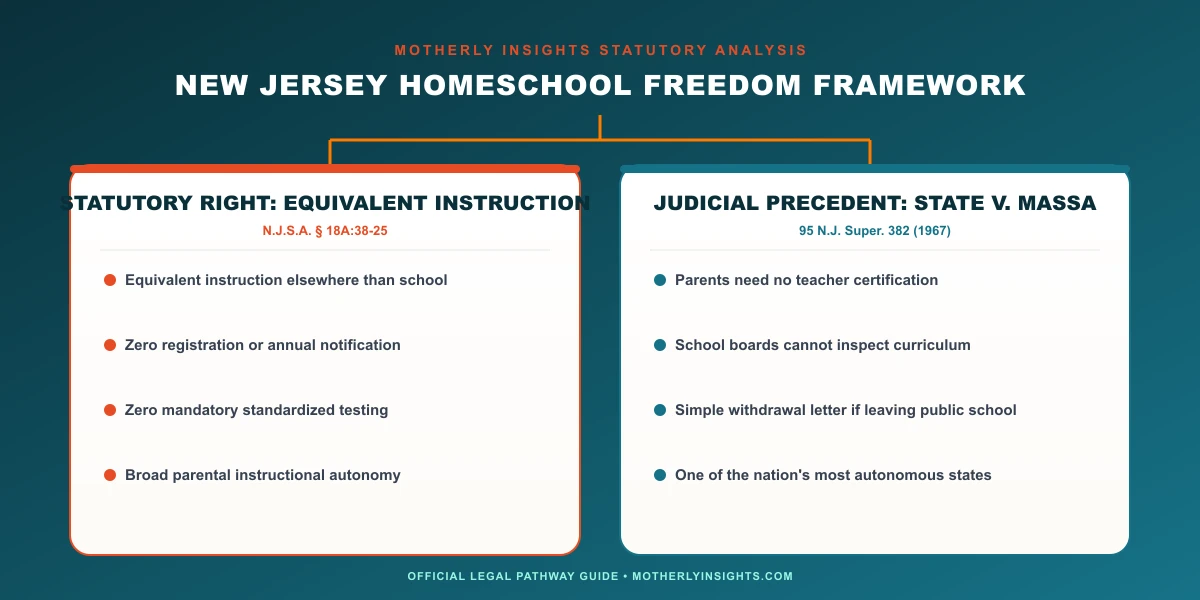
Figure 1: Visual breakdown of New Jersey's autonomous homeschool legal rights.
Statutory Authority: N.J.S.A. § 18A:38-25 & State v. Massa
Under New Jersey's compulsory education law, children between the ages of six and sixteen must receive regular education. Unlike neighboring states such as New York or Pennsylvania that impose extensive regulatory paperwork, quarterly reporting, and standardized testing, New Jersey law requires zero state registration.
The foundation of New Jersey homeschool freedom rests upon the historic 1967 Superior Court decision in State v. Massa (95 N.J. Super. 382)[3]. In this landmark case, the municipal school board attempted to prosecute homeschooling parents for truancy because their home curriculum and social environment did not replicate the public school system. The Superior Court ruled decisively in favor of the parents, establishing three fundamental legal precedents:
- Substantive Rather Than Identical Instruction: "Equivalent instruction" means academic instruction comparable in educational substance to public schools; it does not require replicating the public school calendar, hourly schedule, or classroom environment.
- No Teacher Certification Requirement: The court explicitly confirmed that parents do not need state teaching licenses, college degrees, or formal educator credentials to teach their children at home.
- Burden of Proof Rests on the State: In any legal proceeding alleging truancy, the burden of proof rests entirely on the local school board to demonstrate beyond a reasonable doubt that a child is receiving zero instruction.
Communicating with District Superintendents & Withdrawal Rules
Because New Jersey statutes mandate no registration, your administrative obligations depend entirely on whether your child is currently enrolled in a public school:
Case A: If Your Child Has Never Attended Public School
If your child has reached compulsory school age (six years old) but has never been enrolled in a New Jersey public or charter school, you have zero legal obligation to notify anyone. You do not contact the local school district, register with the municipal board, or file paperwork with the New Jersey Department of Education (NJDOE). You simply commence your chosen home curriculum.
Case B: Withdrawing a Student from an Active Public School
If your student currently attends a public school, submitting a formal written letter of withdrawal is legally vital to close their enrollment file and prevent unexcused absence flags:
- Draft a Formal Withdrawal Letter: Address the letter to the local school principal and district superintendent. State clearly that your child is being withdrawn from public school to receive equivalent instruction elsewhere pursuant to N.J.S.A. § 18A:38-25.
- Request Official Cumulative Records: In your letter, formally request full copies of your student's cumulative file, standardized test scores, and medical/immunization records for your home archive.
- Maintain Delivery Proof: Send the withdrawal notice via Certified Mail with Return Receipt Requested, or hand-deliver it to the school office and request a date-stamped copy for your records.
- Politely Decline Extra-Statutory Requests: School districts occasionally request parents to complete proprietary "homeschool approval applications," submit booklists, or meet with curriculum directors. The NJDOE Nonpublic Office has repeatedly clarified in official policy memorandums that school boards have no statutory authority to review, approve, or monitor home education programs.
Core Academic Subjects & Pedagogical Freedom
Under the "equivalent instruction" standard, home educators provide instruction across subjects traditionally taught in New Jersey elementary and secondary schools:
- Language Arts & Literacy: Phonics, vocabulary development, spelling, formal grammar, literature study, and expository composition.
- Mathematics: Foundations of arithmetic, pre-algebra, algebra I, geometry, and advanced high school calculus or statistics.
- Science: Earth science, life science, physical science, biology, chemistry, and laboratory experimentation.
- Social Studies & Civics: New Jersey state history and geography, United States history, world civilizations, and constitutional civics.
- Health & Physical Education: Age-appropriate physical fitness, nutrition, personal hygiene, and safety education.
Parents have complete latitude to select secular, faith-based, classical, or interest-led curricula. You are not required to follow the New Jersey Student Learning Standards (NJSLS) or utilize district-adopted textbooks.
Standardized Testing & Academic Assessment
Standardized testing is 100% voluntary in New Jersey. Home-educated students are not required to participate in the New Jersey Student Learning Assessments (NJSLA) or any national testing batteries. The state does not require parents to submit portfolios, hire certified teacher evaluators, or provide test scores to local school boards.
Many New Jersey homeschooling families choose to administer independent annual achievement tests (such as the California Achievement Test [CAT], Iowa Assessments, or Stanford 10) in their home for personal diagnostic insight. These scores remain completely private within your family archive.
High School Graduation, Diplomas, and College Admissions
In New Jersey, parents hold the exclusive authority to set graduation requirements, assign course credits, and award high school diplomas for their home-educated students. Under state law, parent-issued diplomas and transcripts are fully recognized legal credentials:
- New Jersey College Admissions: Rutgers University (New Brunswick, Newark, Camden), The College of New Jersey (TCNJ), Montclair State University, Rowan University, Princeton University, and county community colleges routinely admit homeschooled graduates based on high school transcripts and SAT/ACT scores.
- New Jersey State Financial Aid: Homeschooled graduates qualify for New Jersey Tuition Aid Grants (TAG), Educational Opportunity Fund (EOF) grants, and federal financial aid without requiring a GED or state-issued equivalency diploma.
- Military Enlistment: The U.S. Armed Forces enlist New Jersey homeschool graduates under Tier 1 enlistment status with equal standing to traditional high school graduates.
Extracurriculars and NJSIAA High School Sports
Participation in public school interscholastic athletics and extracurricular clubs is regulated by the New Jersey State Interscholastic Athletic Association (NJSIAA) and local board of education policy:
- Local School Board Discretion: Under NJSIAA guidelines, individual local school boards hold the authority to determine whether non-enrolled homeschooled students may try out for public high school athletic teams (football, soccer, basketball, track, baseball).
- Inquiring with Your District: Parents interested in public school sports should consult their local district board of education policy manual. Many suburban districts welcome homeschooled athletes, while others restrict participation to enrolled students.
- Homeschool Leagues & Club Sports: New Jersey features an extensive ecosystem of competitive independent club sports leagues, youth travel teams, and homeschool athletic co-ops across every county.
Recommended Homeschool Record-Keeping Standards
To maintain a proactive legal shield against truancy inquiries and streamline future college transcript creation, every New Jersey family should maintain a "Master Homeschool Binder" containing:
- Withdrawal Documentation: A copy of your initial withdrawal letter and certified mail return receipt (if your child previously attended public school).
- Annual Attendance Record: A calendar logging approximately 180 days of active instruction.
- Curriculum Syllabi & Booklists: A record of textbooks, literature titles, online learning platforms, and instructional software utilized.
- Student Work Samples: Periodic dated samples of writing, math assessments, and science reports collected at the beginning, middle, and end of the academic year.
- High School Transcript: A cumulative multi-year transcript documenting completed Carnegie course units, letter grades, and GPA calculations.
Frequently Asked Questions About New Jersey Homeschool Laws
Do I need to register or seek approval to homeschool in New Jersey?
Does the local school board have the right to inspect my homeschool curriculum?
Are New Jersey homeschoolers required to take standardized tests?
Can New Jersey homeschoolers play sports at their local public high school?
What is the compulsory school age in New Jersey?
Are parent-issued diplomas legally valid in New Jersey?
💡 Related Educational Pathways: To compare legal requirements in neighboring states, explore our detailed guides on New York IHIP regulations, Pennsylvania Act 169 portfolio evaluations, and Maryland portfolio review rules.
💡 Related Educational Pathways: To compare related legal frameworks and recommended study programs, explore our detailed reviews on California homeschool legal guidelines, Ohio homeschool notification regulations, Georgia homeschool compliance framework.