

Disclaimer: This post is for informational and educational purposes only, accurate to the best of our knowledge at publication. It does not constitute advice. We do not guarantee accuracy or completeness and accept no liability for any decisions or losses resulting from reliance on this content.
In May 2023, South Carolina Governor Henry McMaster signed into law Act 8 (Senate Bill 39), establishing the Education Scholarship Trust Fund (ESTF) program codified under S.C. Code § 59-8-110 through § 59-8-160. Following extensive judicial scrutiny in 2024, the program’s framework for independent and nonpublic educational choice represents a milestone in Palmetto State school choice policy.
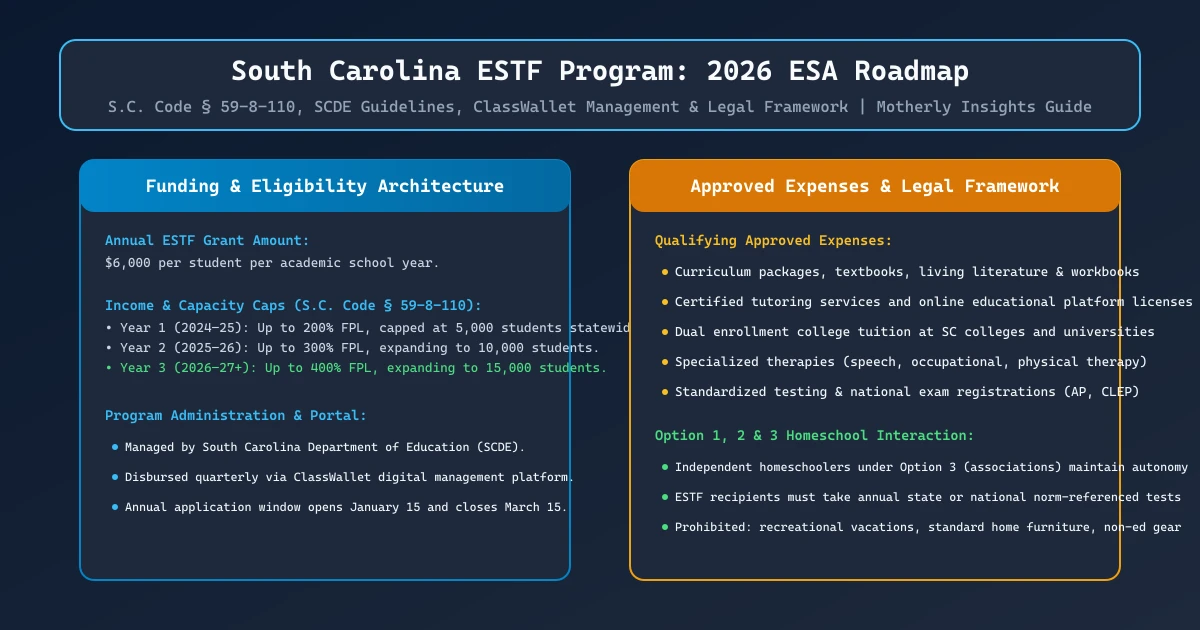
Under the ESTF program, eligible South Carolina students receive $6,000 per academic year deposited into dedicated digital Education Savings Accounts (ESAs). Administered by the South Carolina Department of Education (SCDE) and managed through the ClassWallet portal, these funds allow parents to customize learning via private tutoring, curriculum purchases, accredited online academies, and clinical therapies.
For South Carolina home educators—who traditionally operate under Option 1 (local school board), Option 2 (SCAIHS), or Option 3 (independent accountability associations) pursuant to S.C. Code § 59-65-40, 45, and 47—navigating the ESTF requires evaluating the benefits of state funding against statutory annual standardized testing requirements and vendor oversight.
This comprehensive guide—authored by homeschool educational compliance specialists—examines the ESTF funding mechanics, income eligibility caps, approved qualifying expenses, ClassWallet management, and legal considerations for home educators.
1. How Much Funding Does the South Carolina ESTF Provide?
Under S.C. Code § 59-8-110, the annual scholarship allocation is set at $6,000 per student per school year. The state releases these funds in quarterly installments of $1,500 into the student’s digital ClassWallet account:
| Academic Year | Annual Award Per Student | Statewide Student Cap | Household Income Limit |
|---|---|---|---|
| 2024–2025 (Year 1) | $6,000 | 5,000 students | ≤ 200% Federal Poverty Level (FPL) |
| 2025–2026 (Year 2) | $6,000 | 10,000 students | ≤ 300% Federal Poverty Level (FPL) |
| 2026–2027 (Year 3+) | $6,000 | 15,000 students | ≤ 400% Federal Poverty Level (FPL) |
Unspent funds remain in the student’s account throughout the academic school year and roll over across semesters. However, unspent funds forfeit upon high school completion, departure from South Carolina residency, or withdrawal from the program.
2. Eligibility Phasing & Student Qualifications
The ESTF Act established a phased multi-year expansion designed to expand capacity while prioritizing low-to-moderate-income families:
1. Household Income Limits
- Phase 1 (2024–2025): Family income at or below 200% of the federal poverty guidelines (e.g., ~$60,000 for a family of four).
- Phase 2 (2025–2026): Family income at or below 300% FPL (~$93,600 for a family of four).
- Phase 3 (2026–2027+): Family income at or below 400% FPL (~$124,800 for a family of four).
2. Prior Public School Enrollment Requirement
To qualify, a student must be a South Carolina resident who was enrolled in a South Carolina public school during the previous school year, OR who is entering kindergarten for the first time.
Students already enrolled in nonpublic or home education are eligible to apply as the program expands, provided they meet income criteria and state statutory benchmarks.
3. Approved vs. Prohibited Educational Expenses
Under S.C. Code § 59-8-110(4), the SCDE enforces strict expenditure guidelines to ensure funds directly serve academic purposes:
Approved Qualifying Expenses (Green Light)
- Comprehensive Boxed Curricula: Core subject curricula and instructional packages (e.g., Singapore Math, Math-U-See, Timberdoodle, BookShark, All About Reading, Saxon Math, Memoria Press).
- Textbooks and Literary Reference Materials: History anthologies, classic literature, science reference guides, and workbooks.
- Accredited Tutoring Services: Individualized instruction provided by a South Carolina certified teacher or approved educational tutoring provider.
- Dual Enrollment College Coursework: Tuition, fees, and books for college courses taken through South Carolina community colleges or state universities.
- Standardized Testing Fees: Registration costs for national standardized achievement tests (Iowa Assessments, Stanford 10), Advanced Placement (AP) exams, and College Board CLEP tests.
- Clinical Therapies: Contracted occupational, physical, or speech-language therapy provided by licensed healthcare specialists.
- STEM Science Equipment: Dissection kits, microscopes, and physical science lab packages tied directly to a course of study.
- Educational Software: Approved software platform subscriptions (e.g., MiaPrep, Beast Academy, CTCMath).
Prohibited Expenses (Red Light)
- General adult domestic electronics, television monitors, standard smartphones, or video game systems.
- Recreational family travel, lodging, airfare, meals, and automotive transportation.
- General domestic home furniture, lighting, or residential renovations.
- Extracurricular community youth sports leagues (e.g., youth soccer, Little League) that are not part of an accredited physical education curriculum.
- Materials or services provided by a parent, guardian, or immediate family member.
4. Legal Architecture: ESTF vs. South Carolina Homeschool Options (1, 2, and 3)
South Carolina home educators operate under one of three established statutory frameworks:
| Feature | Option 1 (S.C. Code § 59-65-40) | Option 2 (SCAIHS § 59-65-45) | Option 3 (Associations § 59-65-47) | ESTF Program (§ 59-8-110) |
|---|---|---|---|---|
| Oversight Entity | Local public school district board of trustees. | South Carolina Association of Independent Home Schools. | Independent accountability association (e.g., Palmetto, PACE). | South Carolina Department of Education (SCDE). |
| State Funding | $0.00 (Self-funded). | $0.00 (Self-funded). | $0.00 (Self-funded). | $6,000 annually via ClassWallet. |
| Mandatory Testing | Required state testing (SC READY). | Annual testing required. | None required by statute (association policies govern). | Mandatory annual assessment (state test or national norm test). |
| Financial Oversight | Zero financial audit. | Zero financial audit. | Zero financial audit. | ClassWallet invoice audits and receipt verification. |
| Parent Autonomy | District review of educational plan. | High academic standards; association support. | Maximum parental autonomy; preferred by 90%+ of SC homeschoolers. | Autonomy over approved purchases; subject to testing reporting. |
For families committed to the absolute privacy and flexibility of Option 3, self-funding preserves total regulatory independence. However, for families requiring substantial financial aid for specialized therapies, advanced curricula, or accredited tutoring, the ESTF provides unprecedented resources.
5. Annual Assessment and Accountability Mandates
Under S.C. Code § 59-8-150, academic accountability is a cornerstone of the ESTF program:
- Required Annual Assessment: Participating students in grades 3 through 8 must take the state summative assessment (SC READY) in English language arts and mathematics OR a nationally norm-referenced test approved by the SCDE. High school students take the ACT, SAT, or state-approved end-of-course exams.
- Score Submissions: Assessment results must be submitted annually to the SCDE to verify academic progress and renew scholarship eligibility.
- Academic Progress Standard: If a student fails to demonstrate satisfactory academic progress across consecutive assessment cycles, the SCDE may require individualized remediation plans.
6. How to Apply: The Step-by-Step ESTF Timeline
The application process is conducted entirely online through the South Carolina Department of Education portal at ed.sc.gov:
The Annual Application Roadmap:
- January 15: Online application window opens for the upcoming school year.
- March 15: Firm application deadline. Late applications are placed on a waitlist pending funding availability.
- Documentation Required:
- Proof of South Carolina residency (driver’s license, utility bill, or mortgage statement).
- Verification of prior school enrollment (public school withdrawal documentation or kindergarten eligibility).
- Household income verification (federal tax return Form 1040, W-2s, or Medicaid/SNAP documentation).
- April – May: The SCDE evaluates applications against statutory priority tiers and issues award letters.
- July 1: Approved parents set up their ClassWallet digital accounts and begin purchasing approved curricula and tutoring services.
7. Strategic Recommendations for Palmetto State Families
The South Carolina Education Scholarship Trust Fund represents a transformative opportunity for families seeking customized learning solutions.
To maximize your grant and maintain total compliance:
- Apply Early in the Window: With statutory capacity caps (5,000 to 15,000 students), submit your application as close to January 15 as possible.
- Maintain Clear Expense Records: Store digital copies of all educational receipts and order confirmations for three years as audit protection.
- Order Curricula Well Ahead of Fall: Place orders through the ClassWallet marketplace in July to avoid shipping delays before the school year starts.
Sources & Statutory Citations
- South Carolina General Assembly: Act 8 of 2023 (Senate Bill 39 - The Education Scholarship Trust Fund Act).
- South Carolina Code of Laws: Title 59, Chapter 8 (Education Scholarship Trust Fund Program).
- South Carolina Code of Laws: Title 59, Chapter 65, Sections 40, 45, and 47 (Compulsory Attendance & Home Schooling).
- South Carolina Department of Education (SCDE): ESTF Parent Handbook and Approved Education Service Provider Guidelines.