
Home education in the Green Mountain State is governed by a thorough yet supportive statutory framework codified in 16 V.S.A. § 166b[1]. Known officially as a Home Study Program, Vermont law enables families to direct their children’s education while coordinating annually with the Vermont Agency of Education (AOE).
Compulsory school attendance in Vermont applies to all children between the ages of six (6) and sixteen (16) under 16 V.S.A. § 1121.
Vermont Homeschool Legal Pathways: Statutory Overview
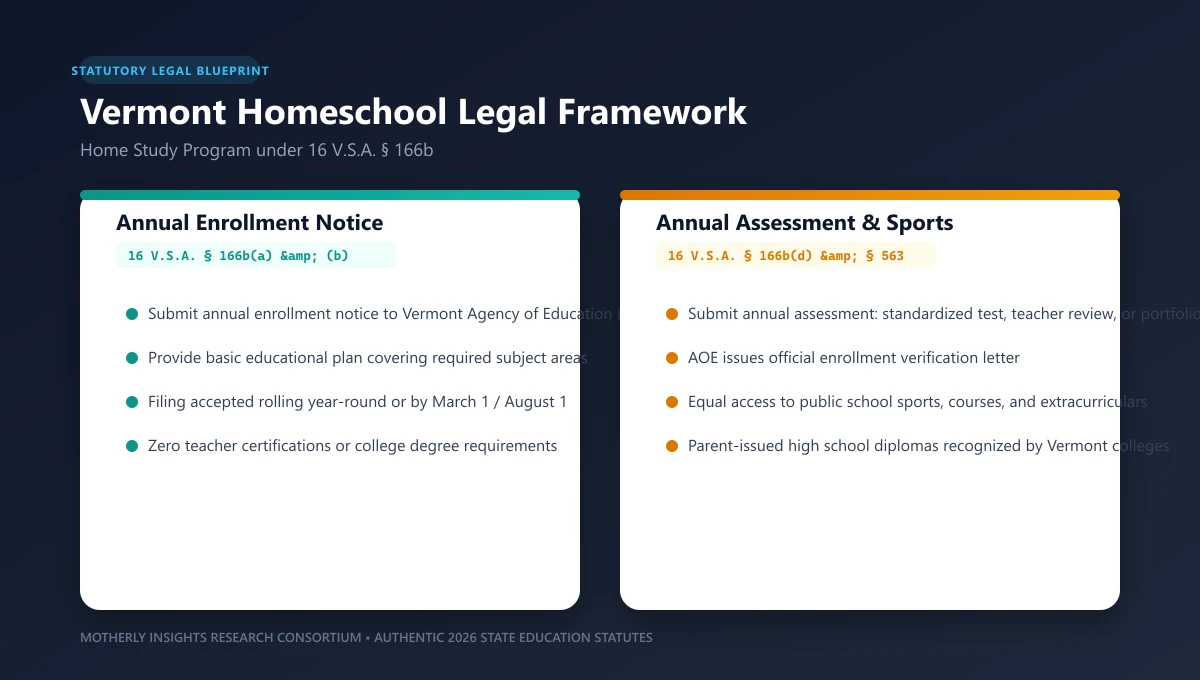
1. Filing Your Annual Home Study Notice with the AOE
Under 16 V.S.A. § 166b(a), parents must submit an annual enrollment notice to the Vermont Agency of Education[2]:
- Submission Timeline: Notices can be submitted throughout the year, but are typically filed between March 1 and August 1 prior to the start of the school year.
- Notice Requirements: The submission includes student details, parent contact information, an outline of the Minimum Course of Study (MCOS) to be delivered, and the selected annual assessment method.
- AOE Enrollment Letter: Once the AOE reviews the notification packet, they issue an official Letter of Enrollment Verification acknowledging your lawful home study status.
2. The Minimum Course of Study (MCOS) Subject Requirements
Under 16 V.S.A. § 166b(e), home study programs must deliver instruction in the following statutory core disciplines:
- Basic communication skills (reading, writing, spelling, grammar).
- Mathematics.
- History and social sciences (including United States history and civics).
- Natural sciences.
- Fine arts (visual arts and music).
- Physical education and comprehensive health.
3. Four Statutory Annual Assessment Pathways
Under 16 V.S.A. § 166b(d), parents demonstrate student academic growth annually by submitting one of four approved assessment options[3]:
- Commercially Available Standardized Test: A nationally normed test (such as NWEA, SAT, Iowa Assessments, or Stanford 10) scored by an independent testing service.
- Certified Teacher Evaluation: A written narrative evaluation prepared by a certified Vermont educator who has reviewed student work portfolios.
- Parent Report with Portfolio: A detailed narrative report written by the parent, accompanied by representative student work samples and reading logs demonstrating progress in each MCOS subject.
- Independent School Assessment: An evaluation report provided by an approved independent school or umbrella correspondence institution.
4. Equal Access to Public School Sports, Classes, and Extracurriculars
Under 16 V.S.A. § 563(24) and Vermont Principals’ Association (VPA) rules, homeschooled students enjoy protected statutory access to local public school offerings[4]:
- Interscholastic Athletics: Eligible to try out for varsity sports teams (soccer, ice hockey, basketball, track, lacrosse) at their local resident high school.
- Co-Curricular Activities: Eligible to join school bands, choral groups, drama productions, robotics teams, and academic clubs.
- Part-Time Coursework: Entitled to enroll in select academic classes, advanced laboratory sciences, and foreign languages.
- Vermont Dual Enrollment: High school juniors and seniors receive two free college course vouchers through the Vermont Dual Enrollment Program, valid at the University of Vermont (UVM), Vermont State University, and community colleges.
5. High School Diplomas, Transcripts, and College Admissions
In Vermont, parents directing home study hold sovereign legal authority over secondary graduation credentials:
- Parent-Conferred Diplomas: Parents set graduation credit standards, calculate grade point averages, and confer official diplomas.
- College Acceptance: The University of Vermont (UVM), Middlebury College, Champlain College, and Norwich University routinely admit homeschooled graduates based on parental transcripts and standardized test scores.
6. Neurodivergent Learners in Vermont
Vermont home study provides exceptional support for students with neurodivergent learning profiles (dyslexia, ADHD, autism, executive dysfunction):
- Tailored Multi-Sensory Instruction: Parents can choose specialized Orton-Gillingham phonics curricula, manipulative-based mathematics, and outdoor environmental study.
- Child Find Screenings: School districts must conduct diagnostic evaluations upon parental request to identify specific learning needs.
7. Vermont High School Credit Distribution Matrix
The recommended college-preparatory secondary course distribution includes:
| Academic Discipline | Recommended High School Credits | Course Sequences and Academic Requirements |
|---|---|---|
| English Language Arts | 4 Credits | Literature Analysis, Expository Writing, Speech, Rhetoric |
| Mathematics | 4 Credits | Algebra I, Geometry, Algebra II, Pre-Calculus, Statistics |
| Natural Sciences | 3 - 4 Credits | Biology with Lab, Chemistry, Environmental Science, Physics |
| Social Studies | 3 - 4 Credits | US History, Vermont History & Civics, World History |
| World Languages | 2 - 3 Credits | French, Spanish, Latin, or American Sign Language |
| Health & Physical Education | 1.5 Credits | Wilderness Exploration, Team Sports, Nutrition |
| Fine Arts & Electives | 4 - 5 Credits | Studio Art, Instrumental Music, Computer Science |
8. Step-by-Step Public School Withdrawal Protocol
To withdraw your child from a Vermont public school:
- File Enrollment Notice: Submit your Home Study Notice to the Vermont AOE.
- Submit District Withdrawal Notice: Provide written notification to your child’s current school administration citing 16 V.S.A. § 166b.
- Obtain Records: Request cumulative student academic files, health documentation, and standardized test archives.
9. Vermont Town Tuitioning and Independent School Access
Vermont features a historic and unique ‘town tuitioning’ system that intersects beneficially with home education:
- Tuition Towns: In Vermont towns that do not operate their own public high school or elementary school, school districts pay tuition vouchers for students to attend approved independent academies or neighboring public schools.
- Dual Enrollment Flexibility: Homeschooled students living in tuitioning towns can coordinate part-time specialized course enrollment at approved regional independent academies such as St. Johnsbury Academy, Burr and Burton Academy, and Lyndon Institute.
10. Frequently Asked Vermont Home Study Questions
Can the Vermont AOE reject my home study enrollment notice?
Under 16 V.S.A. § 166b, the AOE cannot reject an enrollment notice if it includes the basic required subject outlines and an approved assessment method. If information is missing, the AOE allows parents 14 days to provide supplemental details.
Do Vermont colleges accept parent-issued high school diplomas?
Yes. Vermont colleges, including UVM, Middlebury, and Vermont State University, accept parent-issued transcripts and diplomas without requiring a GED or adult education diploma.
💡 Related Educational Pathways: To compare related legal frameworks and recommended study programs, explore our detailed reviews on California homeschool legal guidelines, Ohio homeschool notification regulations, Pennsylvania Act 169 requirements.
💡 Related Educational Pathways: To compare related legal frameworks and recommended study programs, explore our detailed reviews on Georgia homeschool compliance framework, Michigan homeschool statutory rules, Indiana homeschool attendance laws.